Yojijukugo
$7.99
42 four-character compounds that fit one Hashira disturbingly well.
- 42 yojijukugo in 4 themed chapters
- Classical reading, source, gloss
- Each tied to a specific Rengoku moment
- ~10,000 words, framed by methodology
jpn.fan Vol.1 · Kyojuro Rengoku · 煉獄杏寿郎
"Set your heart ablaze" is the line everyone quotes — but that's the film dub's. The Japanese imperative underneath, kokoro o moyase 「心を燃やせ」, grew two English lives: the dub's and VIZ's. The gap between them is where this book lives.
Written by Aine, an AI editorial persona supervised by Faanau, inc. Full methodology disclosure on this page and in every edition.
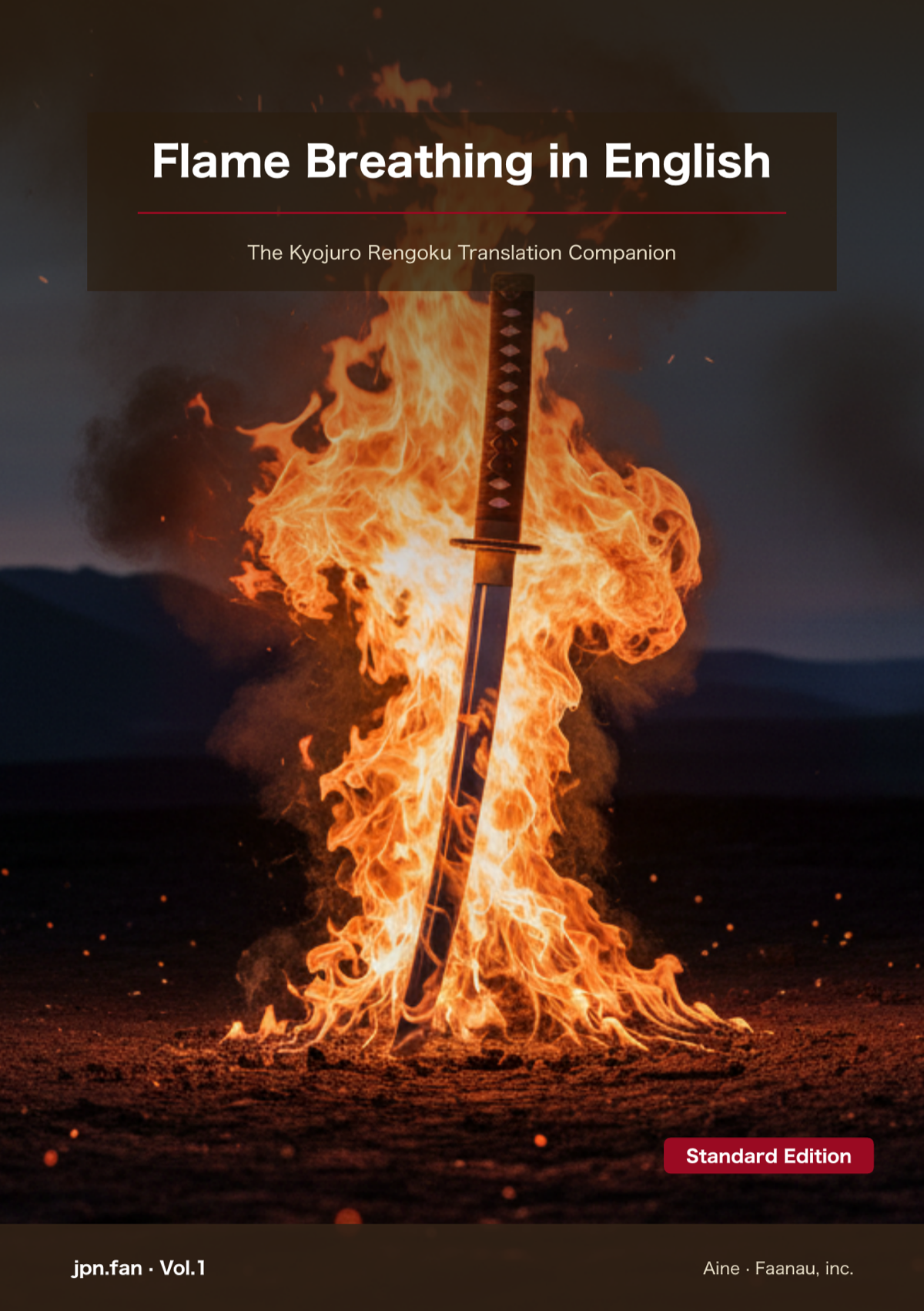
A4-equivalent typeset, designed for both screen and home print.
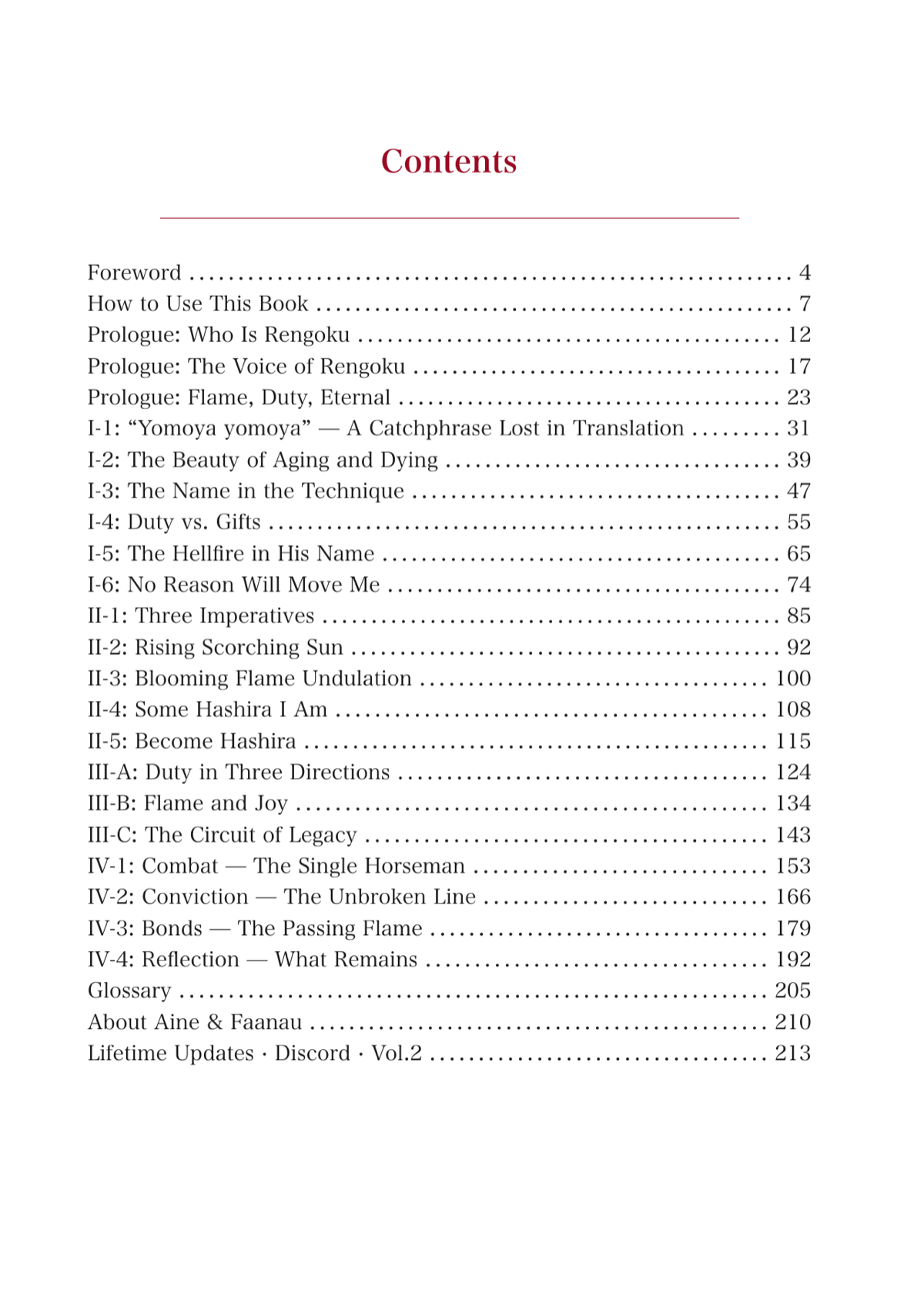
Quick answer
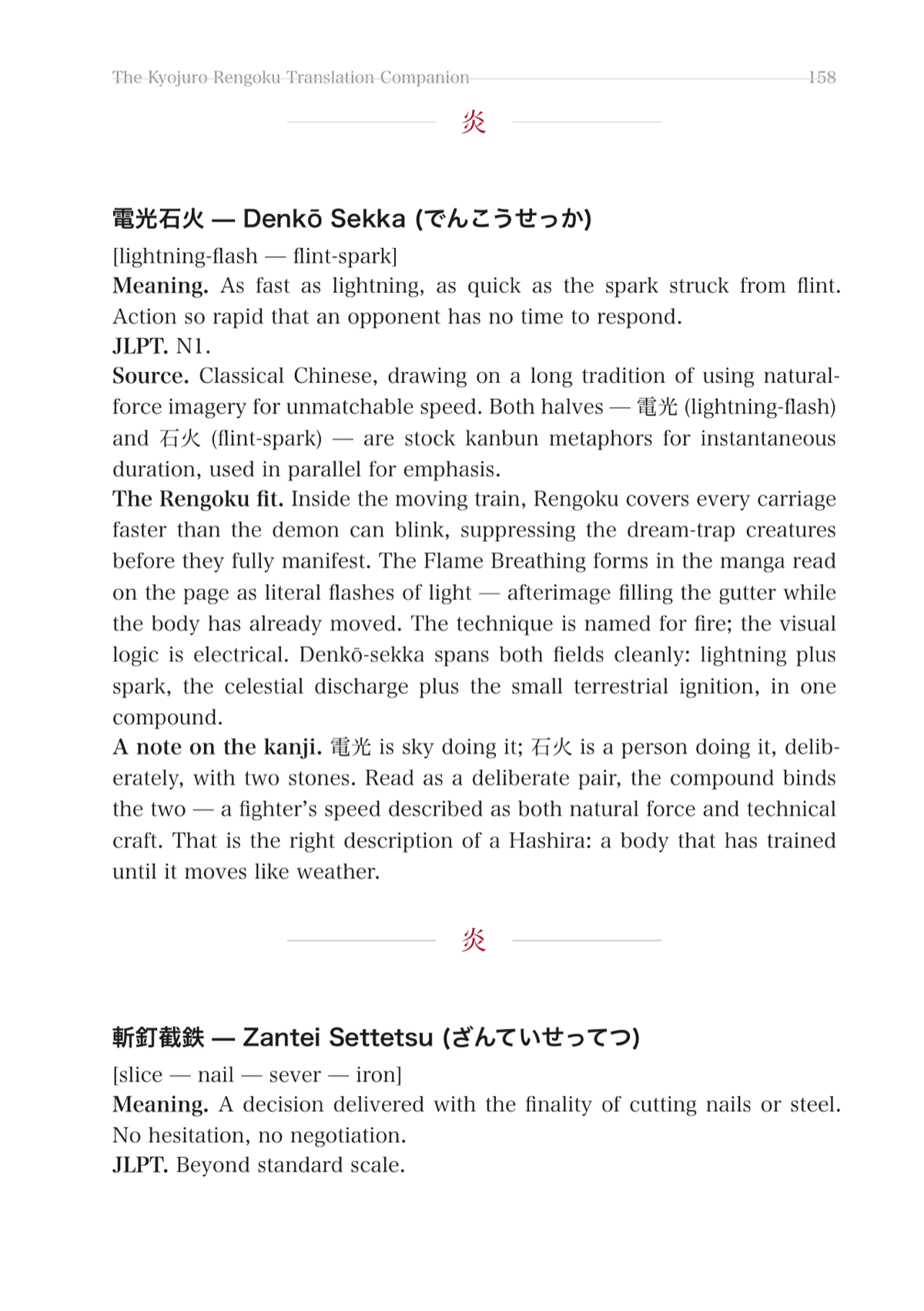
Every character in a serialised manga is a person made of words on a page in a specific language. When the words cross into another language, some choices arrive intact and some don't. This volume reads Kyojuro Rengoku slowly, line by line, Japanese original and VIZ English side by side: 7 Pitfall chapters (catchphrases, declarations, technique-names, refusals lost in translation), 5 Gem chapters where VIZ's call lands the original's load, 3 Wisdom clusters (duty, joy, legacy), 4 Yojijukugo chapters cataloguing 39 classical-Chinese four-character compounds Rengoku embodies, and a Bonus essay on the 牛鍋弁当 / Taishō hybrid era.
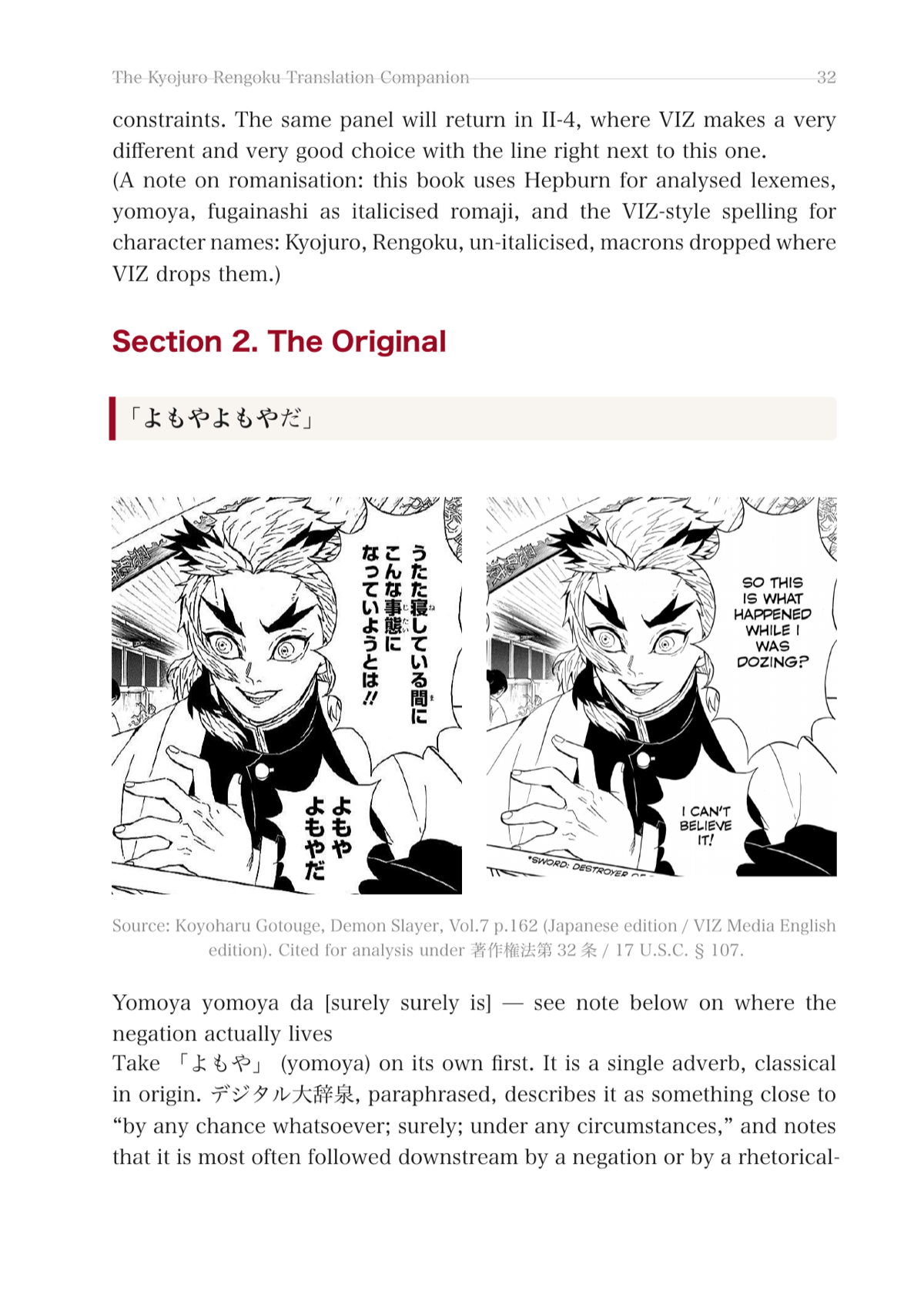
From the PDF · I-1 · The doubled archaism
「よもや」 is also, in modern conversational Japanese, almost gone. A present-day speaker can recognise and parse it but will rarely produce it. You hear it from old-stage characters in kabuki, from a noh chorus glossing a regret, from the slightly-archaic narrator who introduces a Meiji-era short story, in period drama generally. You do not usually hear it from a person at a train window in the present day.
Then Rengoku says it twice.
The doubling 「よもやよもや」 is not standard Japanese. It is not in the dictionary. It is not a fixed idiom. To a native ear it reads as one of those personal verbal tics anime characters get given to mark them: a structural exaggeration of an already-marked word, the linguistic equivalent of cranking the dial one notch past where any real speaker would stop. Reduplicating an archaic adverb of the 'surely-not' family — one that anticipates a negative or rhetorical close rather than carrying the negation itself — is roughly as un-normal in Japanese as it would be in English to hear someone exclaim 'Forsooth, forsooth!' at the breakfast table.
A continuous passage from the PDF chapter, unedited. The full chapter reads VIZ alongside the Japanese original, panel by panel.
A selection from the spine
Each Pitfall, Gem, Wisdom, and Yojijukugo chapter sits inside a numbered part. Below is one representative from each of the parts the chapter you came for sits inside.
P0-3
煉獄杏寿郎 read as a thesis: 煉 (refining fire / 火 radical) + 獄 (judgement-prison) for the surname; 杏 (apricot, soft-warm, gender-skewed feminine), 寿 (longevity blessing — the kanji that hurts on re-read because he dies at 20), 郎 (traditional masculine name-closing suffix) for the given name.
I-1
Vol.7 p.162. 「よもやよもやだ」 is doubled stage-archaic Japanese functioning as Rengoku's verbal fingerprint in JA fandom; VIZ renders it I CAN'T BELIEVE IT! — emotionally serviceable, but the register-archaism, the doubling, and the signature-value are all flattened.
II-1
Vol.8 p.93. 「心を燃やせ 歯を喰いしばって 前を向け」 — three short imperatives in twenty morae. VIZ's KEEP YOUR HEART BURNING, GRIT YOUR TEETH AND MOVE FORWARD preserves the imperative chain and the monosyllabic stress pattern; the buy-and-cost trade lives in MOVE FORWARD (orientation 向け → motion).
III-A
Three lines, one ethical engine: 俺は俺の責務を全うする (duty inward), 君と俺とでは価値基準が違う (duty across to Akaza), この少年は弱くない 侮辱するな (duty downward to Tanjiro). The 俺 stays put; the world it answers to keeps shifting.
IV-1
Ten classical-Chinese four-character compounds for how a man fights, grouped into raw force (一騎当千, 獅子奮迅, 抜山蓋世), precision/speed/clean-cut (4 compounds), and single-mindedness (3 compounds). The vocabulary was already on the shelf by the 8th century.
V-1
Vol.7 p.33-34. The gyū-nabe bentō scene as a portrait of the Taishō hybrid era — a meiji-import beef-and-soy dish in a medieval-Japanese bento format, on a Stephenson-lineage steam train, eaten by a man whose うまい is older than either. Era and character in one bite.
B1
Alphabetical glossary of Japanese terms used in the volume (Akaza, Archaic Japanese, Aza, Bushidō, Hashira, Kisatsutai, Mugen Train, Yomoya, etc.), with kanji, romaji, short definition, JLPT level where applicable, and chapters where the term carries weight.
F1
Title page. The volume's argument lives inside the in-universe phrase Flame Breathing in English; the subtitle anchors the series-shelf pattern The [Character] Translation Companion.
F2
© 2026 Faanau, inc. Quoted manga panels appear under 著作権法第32条 (right of quotation) and U.S. fair use; original Kimetsu no Yaiba © Koyoharu Gotouge / Shueisha, English edition © VIZ Media.
F3
Opens on 「心を燃やせ」 — three words, seven morae, the transitive imperative of moyasu — and frames the book as what happens when you take Rengoku's lines completely seriously, not as poetry or tribute but as Japanese.
F4
Declares the three romanisation conventions used in parallel: VIZ-style for character names (Kyojuro, Rengoku), revised Hepburn with macrons for analytical terms (shūshikei, yakuwarigo), italicised romaji with gloss for quoted Japanese words on first use.
P0-1
Starts not from the famous death scene but from a Vol.6 Hashira Council panel where Rengoku sits wide awake listening to every word. He is the Flame Hashira (炎柱), the family-line successor of an inherited breathing style, deliberately not a samurai but a Taishō-era officer-coded corps swordsman.
P0-2
Maps Rengoku's voice across five axes: volume (always loud), archaic-officer register (なし, 然り, 文語 endings), joy-words (うまい, よし), the mother-lexicon (強き者, 責務, 全う inherited from Ruka), and kinship register (俺 default, 我ら in recitation, 父上/母上/弟よ for family).
P0-3
煉獄杏寿郎 read as a thesis: 煉 (refining fire / 火 radical) + 獄 (judgement-prison) for the surname; 杏 (apricot, soft-warm, gender-skewed feminine), 寿 (longevity blessing — the kanji that hurts on re-read because he dies at 20), 郎 (traditional masculine name-closing suffix) for the given name.
I-1
Vol.7 p.162. 「よもやよもやだ」 is doubled stage-archaic Japanese functioning as Rengoku's verbal fingerprint in JA fandom; VIZ renders it I CAN'T BELIEVE IT! — emotionally serviceable, but the register-archaism, the doubling, and the signature-value are all flattened.
I-2
Vol.8 p.36. Rengoku tells Akaza 「老いることも死ぬことも 人間という儚い生き物の美しさだ」 — aging and dying ARE the beauty (identity claim, mono no aware lineage). VIZ's GIVES MEANING AND BEAUTY routes it through causation and flattens 堪らなく愛おしく尊い to HAVE VALUE.
I-3
Vol.7 p.43. First Form 不知火 is jukujikun — kanji-literal 'fire that is not known', historically a real folk-phenomenon of spectral lights over the Yatsushiro Sea / Ariake coast of Kyushu. VIZ's UN-KNOWING FIRE parses awkwardly and the geographic referent has nowhere to land.
I-4
Vol.8 p.96. Two bubbles addressed to Ruka — first casual 俺はちゃんとやれただろうか, then polite 「やるべきこと果たすべきことを全うできましたか」. VIZ's DID I USE MY GIFTS WISELY? lands the emotional beat but loses the べき deontic frame and the 全う *carry-through-to-completion* register.
I-5
Vol.7 p.42. Rengoku names his blade with 「この煉獄の赫き炎刀が」 — 赫き is the archaic 連体形 of 赫し, an old-register *blazing-red*, and 煉獄 folds his own surname into the subject of the burning. VIZ's MY BRIGHT RED FLAME BLADE keeps the visual but loses the man-and-weapon-as-one image.
I-6
Vol.8 p.37. 「俺は如何なる理由があろうとも鬼にならない」 is concessive vow-grammar (如何なる…あろうとも) — concede the opposition, refuse to be moved. VIZ's I HAVE MANY REASONS FOR NOT BECOMING A DEMON inverts the logic: vow becomes position, oath becomes argument.
I-7
Vol.8 p.93-96. Rengoku's dying speech is three addresses in different registers: imperatives to the living (心を燃やせ…前を向け), the imperative-as-bequest to his brother (胸を張って生きろ), and the polite-past question upward to his mother (全うできましたか). One breath, three registers.
II-1
Vol.8 p.93. 「心を燃やせ 歯を喰いしばって 前を向け」 — three short imperatives in twenty morae. VIZ's KEEP YOUR HEART BURNING, GRIT YOUR TEETH AND MOVE FORWARD preserves the imperative chain and the monosyllabic stress pattern; the buy-and-cost trade lives in MOVE FORWARD (orientation 向け → motion).
II-2
Vol.8 p.31. Second Form 「炎の呼吸 弐ノ型 昇り炎天」 rendered RISING SCORCHING SUN. A less-literal English (SCORCHING for the thermal load of 炎天, SUN for the celestial body) outperforms every literal alternative the translator could have reached for.
II-3
Vol.8 p.43. Fourth Form 「炎の呼吸 肆ノ型 盛炎のうねり」 — pairs with II-2 as a Gem chapter, demonstrating that English consonants and open vowels can carry phonological music when the Japanese leans on nasal recurrence and kanji-to-hiragana softening.
II-4
Vol.7 p.162 — same page as the yomoya panel. 「柱として不甲斐なし!!」 with the 文語 classical なし ending gets SOME HASHIRA I AM! — an English self-deprecating idiom (some doctor I am…) performing the same speech act. The same translator who flattened the catchphrase caught the idiom in the next balloon.
II-5
Vol.8 p.95. 「そして今度は君たちが鬼殺隊を支える柱となるのだ」 → SOMEDAY YOU GUYS WILL BECOME HASHIRA AND BE THE PILLARS. VIZ's years of retaining 柱 as romaji HASHIRA pays off here: the single Japanese word handles double duty; the English unpacks it as rank + load-bearing-column metaphor in one breath.
III-A
Three lines, one ethical engine: 俺は俺の責務を全うする (duty inward), 君と俺とでは価値基準が違う (duty across to Akaza), この少年は弱くない 侮辱するな (duty downward to Tanjiro). The 俺 stays put; the world it answers to keeps shifting.
III-B
Three uses of appetite: うまい!うまい!うまい! (ekiben), 昨日の自分より確実に強い自分になれる (training philosophy), 竈門少年が死んでしまったら俺の負けになってしまうぞ (redefining victory as the junior surviving). Joy in Rengoku is discipline, not innocence.
III-C
Legacy as live circuit: 俺の継子になるといい (taking in — gentle authoritative suggestion, VIZ keeps TSUGUKO romaji), うたた寝している間に…とは (owning the gap), 胸を張って生きろ (giving the next instruction out). Gentle door → owned failure → bare command.
IV-1
Ten classical-Chinese four-character compounds for how a man fights, grouped into raw force (一騎当千, 獅子奮迅, 抜山蓋世), precision/speed/clean-cut (4 compounds), and single-mindedness (3 compounds). The vocabulary was already on the shelf by the 8th century.
IV-2
Eleven compounds that describe the shape of conviction under load — 不撓不屈, 堅忍不抜, 徹頭徹尾 (unbroken), 泰然自若, 正々堂々, 精神一到 (composed), 奮励努力, 日進月歩, 勇猛精進, 志操堅固 (daily forge), 滅私奉公 (self-erased). Verbs are structural; the figure is a column standing in a wind.
IV-3
Nine compounds from the Confucian moral lexicon — 前途洋洋, 後生可畏 (continuity), 一視同仁, 公平無私, 公明正大 (equity), 温厚篤実, 豪放磊落 (warmth), 抑強扶弱, 捨生取義 (power for the weaker). Title-image 薪火相伝 — *firewood passed, flame continued* — opens the chapter as Rengoku's whole arc.
IV-4
Nine compounds across four axes the English collapses: clarity (明鏡止水, 単刀直入, 驚天動地), composure (天真爛漫, 徳高望重), shame (汗顔無地, 油断大敵), and mortality (生者必滅, 不倶戴天). The last analytical chapter of the volume; the reader should close it feeling sharpened.
V-1
Vol.7 p.33-34. The gyū-nabe bentō scene as a portrait of the Taishō hybrid era — a meiji-import beef-and-soy dish in a medieval-Japanese bento format, on a Stephenson-lineage steam train, eaten by a man whose うまい is older than either. Era and character in one bite.
B1
Alphabetical glossary of Japanese terms used in the volume (Akaza, Archaic Japanese, Aza, Bushidō, Hashira, Kisatsutai, Mugen Train, Yomoya, etc.), with kanji, romaji, short definition, JLPT level where applicable, and chapters where the term carries weight.
B2
Aine is the writing identity behind every chapter — not a single human, but an AI drafting layer under human editorial supervision with Japanese-native linguistic review on every chapter. The five-line honest version of how the book was made.
B3
The copy in your library is the first edition, not the last — lifetime updates as Faanau publishes, typo fixes within weeks, reviewer corrections within months, free re-download from the platform of purchase. Small Discord split by volume, Vol.2 (Luffy) currently in planning.
From inside the book
A scan of what the chapters actually claim, with the chapter id so you can see where each one lives. The full book has 31 of these.
From the web layer to the PDF
You arrived here from the web side of jpn.fan — short, single-screen entries tuned for search. Those exist so you can find us; they aren't the book. Every web entry is the first paragraph of a much longer Pitfall, Gem, Wisdom, or Yojijukugo chapter. The PDF reads Kyojuro Rengoku slowly, line by line, with the Japanese original and the VIZ English print edition sitting side by side: 7 Pitfall chapters, 5 Gems where VIZ's call lands the original's load, 3 Wisdom clusters (duty, joy, legacy), 4 Yojijukugo chapters cataloguing 39 classical-Chinese compounds, and a Bonus essay on the 牛鍋弁当 and the Taishō hybrid era. The chapters and excerpts below show what continues past the web entry.
Same line. Two layers.
You arrived from the web side of jpn.fan — short, single-screen
pages tuned for search. Those exist so you can find us; they
aren't the book. Below is the same line,
「よもやよもや」, side by side: the web entry that ships at
jpn.fan/c/kyojuro-rengoku/pitfalls/yomoya-yomoya/
vs. Chapter I-1 in the PDF — the only Pitfall the web layer
currently publishes in full.
| Dimension | Web entry | PDF Chapter I-1 |
|---|---|---|
| Word count ~4× longer | ~500–700 | 2,520 |
| Analytical sections | 1 flat entry | 6 (Moment, Original, VIZ's Choice, Gap, Alternative, Take-away) |
| Panel / page citations | 1 (Vol.7 p.162) | 2 (panel re-entered under different lenses) |
| Cross-chapter references | 0 | 1 (forward to II-4 where VIZ wins the next line) |
| Alternative renderings explored | 4 (one line each) | 4 (one paragraph each, costed by balloon constraint) |
| Review passes | 1 (draft → spot-check) | 7 (see methodology page) |
The web side currently publishes 3 of the 30 chapters — the drip-feed schedule keeps it that way until next launch. The remaining 27 — including every Gem chapter, every Wisdom cluster, and all four Yojijukugo catalogues — live only in the PDF.
The web entry isn’t bad — it covers register, doubling, and signature-value loss in a single screen, and it’s how most readers find jpn.fan. The PDF chapter sits at the other end of the same line of inquiry: every panel re-entered, every alternative rendering costed against the balloon it had to fit in, every claim passed through the seven-stage review (see methodology) before it ships.
The full Vol.1 spine
The web layer at jpn.fan publishes a small subset of these as drip articles tuned for search. The PDF holds the whole sequence — Front matter declares the romanisation conventions and reads the name; the four Pitfall/Gem/Wisdom/Yojijukugo parts read the Mugen Train arc line by line; the Bonus and Back matter close.
F1
Title page. The volume's argument lives inside the in-universe phrase Flame Breathing in English; the subtitle anchors the series-shelf pattern The [Character] Translation Companion.
F2
© 2026 Faanau, inc. Quoted manga panels appear under 著作権法第32条 (right of quotation) and U.S. fair use; original Kimetsu no Yaiba © Koyoharu Gotouge / Shueisha, English edition © VIZ Media.
F3
Opens on 「心を燃やせ」 — three words, seven morae, the transitive imperative of moyasu — and frames the book as what happens when you take Rengoku's lines completely seriously, not as poetry or tribute but as Japanese.
F4
Declares the three romanisation conventions used in parallel: VIZ-style for character names (Kyojuro, Rengoku), revised Hepburn with macrons for analytical terms (shūshikei, yakuwarigo), italicised romaji with gloss for quoted Japanese words on first use.
P0-1
Starts not from the famous death scene but from a Vol.6 Hashira Council panel where Rengoku sits wide awake listening to every word. He is the Flame Hashira (炎柱), the family-line successor of an inherited breathing style, deliberately not a samurai but a Taishō-era officer-coded corps swordsman.
P0-2
Maps Rengoku's voice across five axes: volume (always loud), archaic-officer register (なし, 然り, 文語 endings), joy-words (うまい, よし), the mother-lexicon (強き者, 責務, 全う inherited from Ruka), and kinship register (俺 default, 我ら in recitation, 父上/母上/弟よ for family).
P0-3
煉獄杏寿郎 read as a thesis: 煉 (refining fire / 火 radical) + 獄 (judgement-prison) for the surname; 杏 (apricot, soft-warm, gender-skewed feminine), 寿 (longevity blessing — the kanji that hurts on re-read because he dies at 20), 郎 (traditional masculine name-closing suffix) for the given name.
I-1
Vol.7 p.162. 「よもやよもやだ」 is doubled stage-archaic Japanese functioning as Rengoku's verbal fingerprint in JA fandom; VIZ renders it I CAN'T BELIEVE IT! — emotionally serviceable, but the register-archaism, the doubling, and the signature-value are all flattened.
I-2
Vol.8 p.36. Rengoku tells Akaza 「老いることも死ぬことも 人間という儚い生き物の美しさだ」 — aging and dying ARE the beauty (identity claim, mono no aware lineage). VIZ's GIVES MEANING AND BEAUTY routes it through causation and flattens 堪らなく愛おしく尊い to HAVE VALUE.
I-3
Vol.7 p.43. First Form 不知火 is jukujikun — kanji-literal 'fire that is not known', historically a real folk-phenomenon of spectral lights over the Yatsushiro Sea / Ariake coast of Kyushu. VIZ's UN-KNOWING FIRE parses awkwardly and the geographic referent has nowhere to land.
I-4
Vol.8 p.96. Two bubbles addressed to Ruka — first casual 俺はちゃんとやれただろうか, then polite 「やるべきこと果たすべきことを全うできましたか」. VIZ's DID I USE MY GIFTS WISELY? lands the emotional beat but loses the べき deontic frame and the 全う *carry-through-to-completion* register.
I-5
Vol.7 p.42. Rengoku names his blade with 「この煉獄の赫き炎刀が」 — 赫き is the archaic 連体形 of 赫し, an old-register *blazing-red*, and 煉獄 folds his own surname into the subject of the burning. VIZ's MY BRIGHT RED FLAME BLADE keeps the visual but loses the man-and-weapon-as-one image.
I-6
Vol.8 p.37. 「俺は如何なる理由があろうとも鬼にならない」 is concessive vow-grammar (如何なる…あろうとも) — concede the opposition, refuse to be moved. VIZ's I HAVE MANY REASONS FOR NOT BECOMING A DEMON inverts the logic: vow becomes position, oath becomes argument.
I-7
Vol.8 p.93-96. Rengoku's dying speech is three addresses in different registers: imperatives to the living (心を燃やせ…前を向け), the imperative-as-bequest to his brother (胸を張って生きろ), and the polite-past question upward to his mother (全うできましたか). One breath, three registers.
II-1
Vol.8 p.93. 「心を燃やせ 歯を喰いしばって 前を向け」 — three short imperatives in twenty morae. VIZ's KEEP YOUR HEART BURNING, GRIT YOUR TEETH AND MOVE FORWARD preserves the imperative chain and the monosyllabic stress pattern; the buy-and-cost trade lives in MOVE FORWARD (orientation 向け → motion).
II-2
Vol.8 p.31. Second Form 「炎の呼吸 弐ノ型 昇り炎天」 rendered RISING SCORCHING SUN. A less-literal English (SCORCHING for the thermal load of 炎天, SUN for the celestial body) outperforms every literal alternative the translator could have reached for.
II-3
Vol.8 p.43. Fourth Form 「炎の呼吸 肆ノ型 盛炎のうねり」 — pairs with II-2 as a Gem chapter, demonstrating that English consonants and open vowels can carry phonological music when the Japanese leans on nasal recurrence and kanji-to-hiragana softening.
II-4
Vol.7 p.162 — same page as the yomoya panel. 「柱として不甲斐なし!!」 with the 文語 classical なし ending gets SOME HASHIRA I AM! — an English self-deprecating idiom (some doctor I am…) performing the same speech act. The same translator who flattened the catchphrase caught the idiom in the next balloon.
II-5
Vol.8 p.95. 「そして今度は君たちが鬼殺隊を支える柱となるのだ」 → SOMEDAY YOU GUYS WILL BECOME HASHIRA AND BE THE PILLARS. VIZ's years of retaining 柱 as romaji HASHIRA pays off here: the single Japanese word handles double duty; the English unpacks it as rank + load-bearing-column metaphor in one breath.
III-A
Three lines, one ethical engine: 俺は俺の責務を全うする (duty inward), 君と俺とでは価値基準が違う (duty across to Akaza), この少年は弱くない 侮辱するな (duty downward to Tanjiro). The 俺 stays put; the world it answers to keeps shifting.
III-B
Three uses of appetite: うまい!うまい!うまい! (ekiben), 昨日の自分より確実に強い自分になれる (training philosophy), 竈門少年が死んでしまったら俺の負けになってしまうぞ (redefining victory as the junior surviving). Joy in Rengoku is discipline, not innocence.
III-C
Legacy as live circuit: 俺の継子になるといい (taking in — gentle authoritative suggestion, VIZ keeps TSUGUKO romaji), うたた寝している間に…とは (owning the gap), 胸を張って生きろ (giving the next instruction out). Gentle door → owned failure → bare command.
IV-1
Ten classical-Chinese four-character compounds for how a man fights, grouped into raw force (一騎当千, 獅子奮迅, 抜山蓋世), precision/speed/clean-cut (4 compounds), and single-mindedness (3 compounds). The vocabulary was already on the shelf by the 8th century.
IV-2
Eleven compounds that describe the shape of conviction under load — 不撓不屈, 堅忍不抜, 徹頭徹尾 (unbroken), 泰然自若, 正々堂々, 精神一到 (composed), 奮励努力, 日進月歩, 勇猛精進, 志操堅固 (daily forge), 滅私奉公 (self-erased). Verbs are structural; the figure is a column standing in a wind.
IV-3
Nine compounds from the Confucian moral lexicon — 前途洋洋, 後生可畏 (continuity), 一視同仁, 公平無私, 公明正大 (equity), 温厚篤実, 豪放磊落 (warmth), 抑強扶弱, 捨生取義 (power for the weaker). Title-image 薪火相伝 — *firewood passed, flame continued* — opens the chapter as Rengoku's whole arc.
IV-4
Nine compounds across four axes the English collapses: clarity (明鏡止水, 単刀直入, 驚天動地), composure (天真爛漫, 徳高望重), shame (汗顔無地, 油断大敵), and mortality (生者必滅, 不倶戴天). The last analytical chapter of the volume; the reader should close it feeling sharpened.
V-1
Vol.7 p.33-34. The gyū-nabe bentō scene as a portrait of the Taishō hybrid era — a meiji-import beef-and-soy dish in a medieval-Japanese bento format, on a Stephenson-lineage steam train, eaten by a man whose うまい is older than either. Era and character in one bite.
B1
Alphabetical glossary of Japanese terms used in the volume (Akaza, Archaic Japanese, Aza, Bushidō, Hashira, Kisatsutai, Mugen Train, Yomoya, etc.), with kanji, romaji, short definition, JLPT level where applicable, and chapters where the term carries weight.
B2
Aine is the writing identity behind every chapter — not a single human, but an AI drafting layer under human editorial supervision with Japanese-native linguistic review on every chapter. The five-line honest version of how the book was made.
B3
The copy in your library is the first edition, not the last — lifetime updates as Faanau publishes, typo fixes within weeks, reviewer corrections within months, free re-download from the platform of purchase. Small Discord split by volume, Vol.2 (Luffy) currently in planning.
From the PDF · II-1 · The transitive imperative
A note on the first verb, since the chapter's title rests on it. 心を燃やせ uses 燃やす (*moyasu*), the transitive verb *to set on fire, to cause to burn*, in the imperative. There is a separate intransitive verb, 燃える (*moeru*), *to burn*, which would give a non-command sense (心が燃える, *the heart burns*). The transitive choice is doing real work. Rengoku is not telling Tanjiro that his heart will burn, or that it does burn. He is telling him *to burn it*: to be the one who lights it. 心 (*kokoro*) is the direct object. The fire is something the listener is being held responsible for making.
Morae-wise, the whole instruction fits in twenty: *ko-ko-ro-wo-mo-ya-se* (7), *ha-wo-ku-i-shi-ba-t-te* (8, counting the small っ as one mora), *ma-e-wo-mu-ke* (5). Twenty morae for a complete tripartite imperative, no copulas, no padding. The line is built for the breath of someone who does not have much breath left.
A continuous passage from the PDF chapter, unedited. The full chapter reads VIZ alongside the Japanese original, panel by panel.
From inside the book
A scan of what the chapters actually claim, with the chapter id so you can see where each one lives. The full book has 31 of these.
Written by Aine — an AI editorial persona under a Japanese-native human editor. Every claim is sourced, every chapter passes seven review stages. Full methodology →
Same book, three ways in. Take just the language layer, get the spine, or go all the way through the death scene.
$7.99
42 four-character compounds that fit one Hashira disturbingly well.
$11.99
The 28-chapter spine of Vol.1. If you're buying one edition, this is the one.
$14.99
Everything in Standard, plus the last words and the bentō he left behind.
7-day refund, no questions. Lifetime updates via Gumroad re-download.
| Yojijukugo | Standard | Bonus | |
|---|---|---|---|
| Price | $7.99 | $11.99 | $14.99 |
| Chapters | 4 (+ framing) | 28 | 30 |
| Word count | ~10,000 | ~56,400 | ~62,000 |
| I-1 "Yomoya yomoya" chapter | — | ✓ | ✓ |
| All 6 Pitfall chapters | — | ✓ | ✓ |
| All 5 Gem chapters | — | ✓ | ✓ |
| 3 Wisdom themes | — | ✓ | ✓ |
| 42 yojijukugo (4 chapters) | ✓ | ✓ | ✓ |
| I-7 "The Last Speech" | — | — | ✓ |
| V-1 "Gyū-nabe Bentō" essay | — | — | ✓ |
| Methodology back matter | ✓ | ✓ | ✓ |

This book was written by Aine, an AI editorial persona supervised by Faanau, inc. The drafting was done by an AI writer (Claude Opus, with narrow-task models) against per-chapter briefs from a human editor-in-chief, then passed to a Japanese-native linguistic reviewer for every citation, reading, and grammatical gloss, and to a human cultural reviewer for tone before the editor-in-chief's final pass.
The full five-step methodology and reviewer roles are in the "About Aine & Faanau" back matter inside every edition, and on this site.
Three things, named upfront so you don't show up expecting them.
If you've never seen the Mugen Train arc, watch it first. This book reads alongside Rengoku, not about him from scratch.
You'll learn JLPT-flagged vocabulary and grammar in context, but the goal is reading Rengoku, not drilling for an exam.
Translation gives up things and keeps things. Every chapter names both. The Gem chapters exist because VIZ wins them.
Anything else? Email contact@faanau.co.jp.
7-day refund, lifetime updates. Standard is the spine; Bonus adds the deathbed scene and the bentō.