The Moment
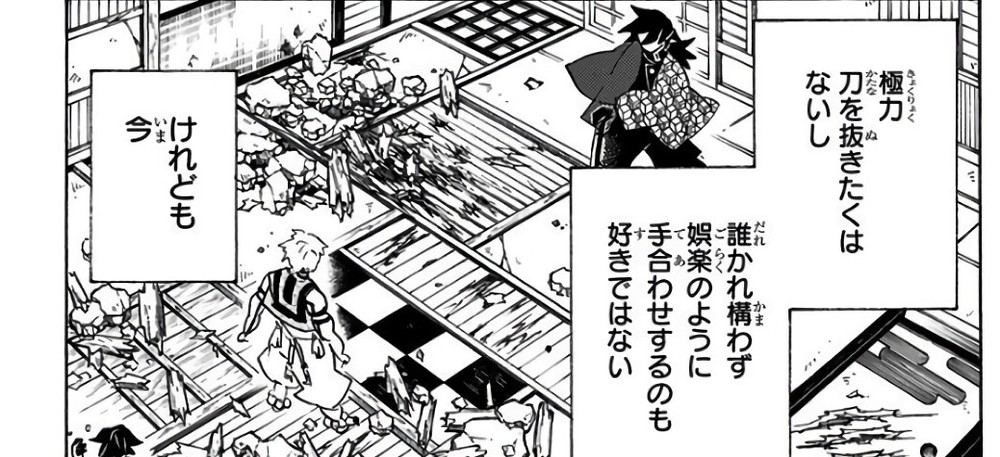
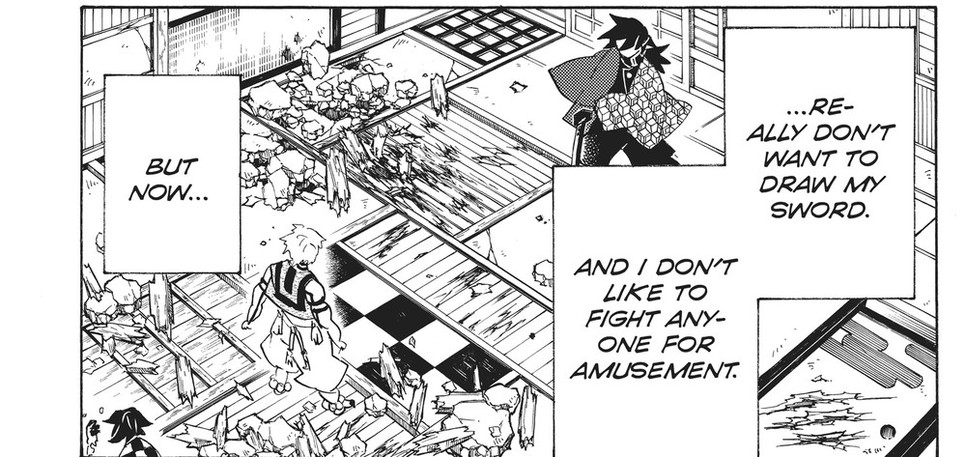
Vol.17, page 150 in the Japanese edition; VIZ Vol.17 at the corresponding panel. Mid-battle against Akaza, in a rare pause, Giyu walks the wrecked engawa of a burning building and narrates, in internal monologue, something close to a personal code:
「俺は極力刀を抜きたくはないし」 "...REALLY DON'T WANT TO DRAW MY SWORD."
「誰かれ構わず娯楽のように手合わせするのも好きではない」 "AND I DON'T LIKE TO FIGHT ANYONE FOR AMUSEMENT."
The scene is quiet — a bird's-eye panel of Giyu walking alone across broken wood and stone — set against a sentence about restraint, delivered in the middle of an all-out fight for the future of the Corps.
The Original
誰彼 (だれかれ) is a fused pair: 誰 (who) and 彼 (that person, a slightly literary/old-fashioned third-person pronoun) stacked together. Individually, both are already stand-ins for an unspecified person; doubled, they generalize into "this person or that person" — i.e., anyone at all. 構わず, from 構う (to mind, to care about, to be bothered by) plus the negative continuative ず, means "without minding" or "without discriminating." The whole compound, 誰彼構わず, is a fixed idiom meaning "indiscriminately, regardless of who" — one of a family of Japanese universal-quantifier idioms built the same way (何でも かんでも, "whatever and whatever," for things instead of people). Paired with it: 娯楽 (ごらく), the ordinary word for entertainment — the same word on a theater marquee or a hobby magazine — applied here to 手合わせ (crossing swords, sparring), and 極力 (きょくりょく, "to the utmost of one's power/ability"), an adverb usually reserved for effortful positive actions, here modifying a negative desire (not wanting to draw his sword) — an unusual, slightly ironic pairing: maximal effort spent on restraint.
VIZ's Choice
...REALLY DON'T WANT TO DRAW MY SWORD. AND I DON'T LIKE TO FIGHT ANYONE FOR AMUSEMENT.
Clear, accurate, and true to the sentiment. "Anyone" correctly captures the meaning of 誰彼構わず — the sentence's logical content survives the crossing intact.
Why It Works (and What's Lost)
The pleasure of 誰彼構わず is in its construction, not just its meaning: it builds the largest possible category (everyone, without exception) out of the smallest possible materials — two ordinary pronouns and a verb of "not minding." It's the linguistic equivalent of "any Tom, Dick, or Harry" — generality achieved by naming specifics and then waving the distinction away — except accomplished with grammar alone, no names required. "Anyone" is correct but featureless; it states the conclusion without performing the small act of doubling that gets you there.
The sentence's other pleasure is thematic: 娯楽 (entertainment) is a deliberately provocative word to attach to swordsmanship. It's the same register as a hobby or a stage show — and by naming it explicitly, Giyu draws a line between combat that matters (duty, survival, protecting people) and combat that's merely sport (the kind Akaza, notably, seems to relish). "For amusement" in English carries this fine, but loses the slight jolt of 娯楽's ordinary domestic connotation — the word doesn't usually sit next to swords at all, which is part of its point.
Finally, the two Japanese clauses are grammatically twinned: both end in hedged negatives (〜たくはない, "don't really want to"; 〜好きではない, "it's not that I like it") — litotes repeated, a rhythm of understatement performed twice in a row. English's two sentences — "I don't want to draw my sword" and "I don't like to fight anyone for amusement" — are both accurate but read as sequential facts rather than one repeated rhetorical gesture, because English doesn't have to reach for the same hedge-construction twice to sound natural.
What If
- "I don't want to fight just any old person, the way you would for sport." — restores something of 誰彼構わず's colloquial doubling ("any old person") and 娯楽's connotation of casual leisure.
- "Whoever they are, I don't care to cross swords with them for fun." — keeps the "doesn't matter who" logic explicit and separates it from the sport-framing clause.
- "It's not in me to spar with all comers, like it's a game." — "all comers" is a nice English idiom for indiscriminate opponents, with its own compact flavor, though it's more archaic/formal than 誰彼構わず's plain register.
- "...don't like to fight anyone for amusement" (VIZ's choice) — accurate, unadorned, and quietly strips out both the pronoun-doubling construction and the hedge-rhythm that ties the two clauses together in Japanese.
Take-away
Japanese has a small toolkit of idioms that build universal quantifiers ("everyone," "everything," "no matter what") out of doubled, specific-sounding words rather than abstract ones — 誰彼構わず (anyone), 何でもかんでも (anything and everything), どこもかしこも (everywhere) — and the doubling is not decorative; it's the mechanism, generality achieved by naming two instances and refusing to discriminate between them. Watch, too, for matched hedge-constructions repeated across a sentence: when a character says "I don't really want to X" and "it's not that I like Y" back to back, the repetition of the hedge is itself doing rhetorical work — performing modesty or restraint as a rhythm, not just stating it once. Giyu's quiet code, mid-battle, is built out of exactly this kind of doubled understatement: a man who will not claim a virtue outright, twice in one breath.
Every Japanese and English line quoted above is a byte-exact capture from the cited edition — 鬼滅の刃 Vol.17 (Japanese) and Demon Slayer: Kimetsu no Yaiba (VIZ Media) at the corresponding panel — via our bilingual page database; see Sources below. Speaker attributions follow scene context; the bilingual data itself does not tag speakers.