The Moment
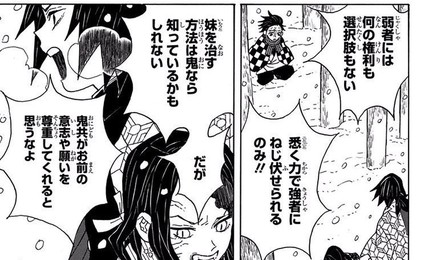
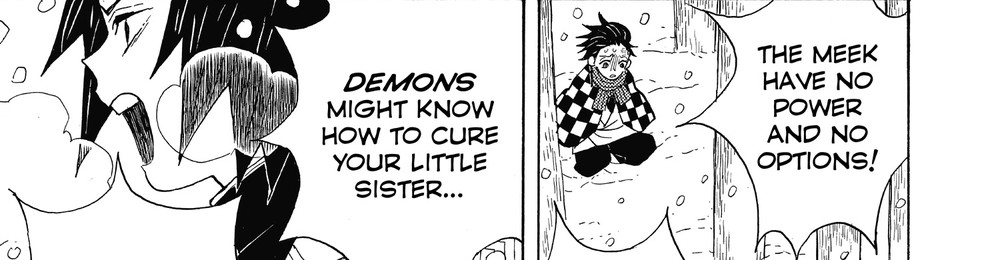
Vol.1, page 39 in the Japanese edition; VIZ Vol.1 at the corresponding panel. Still mid-rebuke — the same outburst that opens with 生殺与奪 and うずくまる — Giyu delivers the philosophical core of his speech to a broken Tanjiro, curled in the snow over his sister's unconscious body:
「弱者には何の権利も選択肢もない」 "THE MEEK HAVE NO POWER AND NO OPTIONS!"
「悉く力で強者にねじ伏せられるのみ!!」 "THE STRONG WILL CRUSH THEM IN EVERY WAY!"
Two clinical sentences, a binary opposition — 弱者 against 強者, the weak against the strong — stated as a law of nature, not an opinion.
The Original
弱者 (じゃくしゃ) is built from 弱 (weak) and 者 (person, "the one who —"), a compound as plain and functional as English "the weak" or "a weak person." It shows up in contexts with zero emotional or religious coloring: 弱者保護 (protection of vulnerable persons, standard social-policy vocabulary), nature documentaries describing the losing side of a hunt, sports commentary on an underdog. Its exact mirror, 強者 (きょうしゃ, "the strong"), appears in the very next line of Giyu's own speech — 弱者/強者 is a clean, symmetrical, taxonomic binary, weak-category against strong-category, with no more moral or spiritual charge built into either word than "predator" and "prey."
VIZ's Choice
THE MEEK HAVE NO POWER AND NO OPTIONS!
"Meek" is a real, defensible dictionary synonym for weak/submissive — nothing about the choice is a mistranslation in the narrow sense. But "meek" is not a neutral word in English the way 弱者 is neutral in Japanese. For the overwhelming majority of English readers, "the meek" summons one specific pre-existing sentence: Blessed are the meek, for they shall inherit the earth. It is difficult, arguably impossible, for an English reader raised in any culture touched by the King James Bible to hear "the meek" in a dramatic, capitalized declaration and not feel the shadow of Matthew 5:5 behind it.
The Accidental Beatitude
Read the two sentences side by side:
Matthew 5:5 — "Blessed are the meek, for they shall inherit the earth." Giyu, Vol.1 p.39 (VIZ) — "THE MEEK HAVE NO POWER AND NO OPTIONS!"
The second is, structurally, a direct negation of the first's promise. Where the Beatitude blesses gentleness with eventual inheritance, Giyu's line — via VIZ's word choice alone — denies the meek anything at all, here and now, no eventual reward implied. Nothing in the Japanese text is in dialogue with the Bible; 弱者 has no connection whatsoever to Christian scripture or its vocabulary of blessedness. The resonance is manufactured entirely by the English translator's word choice, and it is either a remarkably sharp piece of implicit commentary — dropping a bleak, anti-Christian echo into the mouth of a stoic swordsman a few pages into a manga about killing demons — or a coincidence of English near-synonyms that happens to land on the one word in the thesaurus entry that carries centuries of specific scriptural weight. Either way, an English-only reader receives an argument (gentleness is not rewarded; only strength survives) that a Japanese-only reader, working from 弱者's flat taxonomy, does not.
The 弱者/強者 symmetry survives asymmetrically. VIZ keeps "the strong" plain and unadorned for 強者 one line later ("THE STRONG WILL CRUSH THEM IN EVERY WAY") — no comparably loaded synonym is reached for on that side. The result is a binary that was perfectly symmetrical in Japanese (two equally clinical labels) and comes out lopsided in English: one side plain ("the strong"), one side unexpectedly loaded ("the meek").
What If
- "The weak have no rights, no options." — the flattest, most literal match; keeps the 弱者/強者 symmetry with "the strong," loses any of VIZ's accidental resonance (for better or worse).
- "The powerless have no rights or choices." — accurate and neutral, avoids importing any outside text, slightly less punchy as a shouted line.
- "The meek" (VIZ's choice) — dramatically effective, memorably quotable, and carries a whole uninvited argument from an entirely different book into Giyu's mouth.
Take-away
Even a plain, low-connotation word in the source language can pick up enormous unintended freight the moment a translator reaches for its "nearest" English synonym — because English words are never actually neutral synonyms of each other; each one drags its own history, and "meek" happens to drag the King James Bible behind it. This is worth watching for anywhere a translated line suddenly sounds unusually quotable or resonant in English: sometimes that resonance is a skillful choice, and sometimes it's a side effect the source text never intended, an argument the original character never actually made, added by the gravitational pull of the target language's own literary canon.
Every Japanese and English line quoted above is a byte-exact capture from the cited edition — 鬼滅の刃 Vol.1 (Japanese) and Demon Slayer: Kimetsu no Yaiba (VIZ Media) at the corresponding panel — via our bilingual page database; see Sources below. Speaker attributions follow scene context; the bilingual data itself does not tag speakers.