The Moment
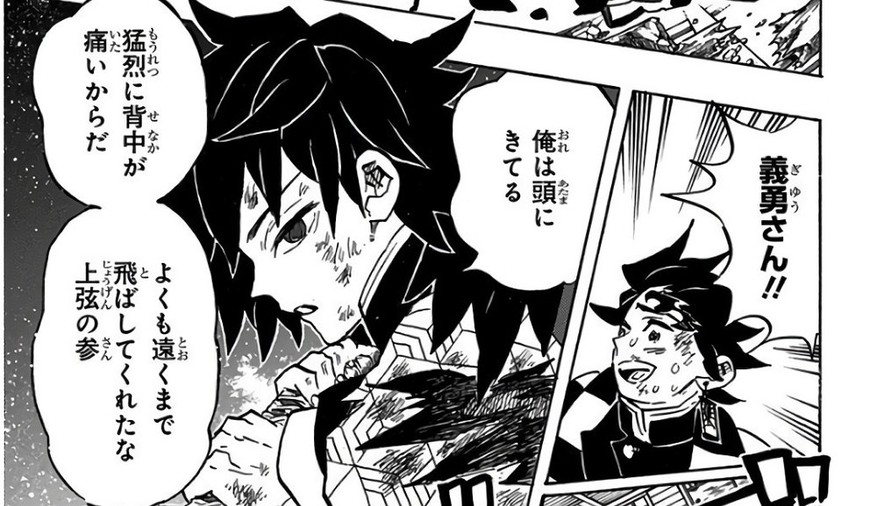
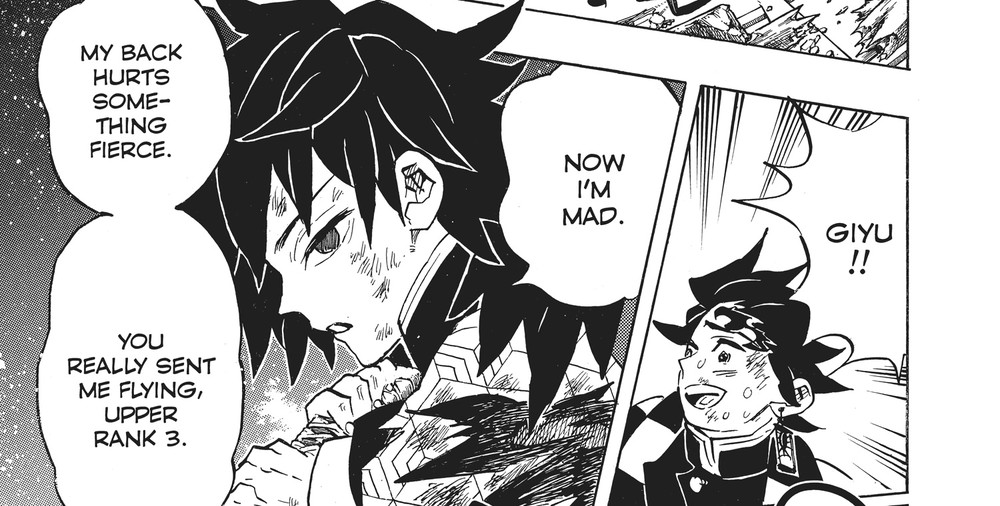
Vol.17, page 147 in the Japanese edition; VIZ Vol.17 at the corresponding panel. Giyu, just launched across a battlefield into rubble by Akaza, picks himself up and delivers three lines in a row, flat and deadpan:
「俺は頭にきてる」「猛烈に背中が痛いからだ」 "NOW I'M MAD." "MY BACK HURTS SOMETHING FIERCE."
「よくも遠くまで飛ばしてくれたな上弦の参」 "YOU REALLY SENT ME FLYING, UPPER RANK 3."
The third line is the payoff — a piece of grammar doing the work a raised voice would do for anyone else.
The Original
くれる is one of Japanese's "giving/receiving" verbs — the family that also includes あげる and もらう — and its job is to mark the direction of a favor. Attached to another verb as an auxiliary (〜てくれる), it means someone did that action for the speaker's benefit: 手伝ってくれる, "[they] helped me [as a kindness]." It is baked into ordinary requests (〜てくれる?, "would you [do this for me]?") and everyday gratitude. よくも is a separate piece: an adverb of outraged disbelief, roughly "how dare," that presupposes the listener has done something audacious. Fuse them — よくも〜てくれたな — and the sentence becomes a sarcastic accusation shaped exactly like a compliment: you went and did this favor for me, did you. The final な is a blunt, pointed tag, aimed straight at the addressee.
VIZ's Choice
YOU REALLY SENT ME FLYING, UPPER RANK 3.
English reaches for its own sarcasm-marker — "really," doing the same ironic-emphasis job it does in "you really did it this time" — and the line reads correctly as dry, understated fury aimed at an opponent. As English sentences go, it's a fine, idiomatic rendering of the tone.
Why It Works (and What's Lost)
The Japanese sentence's cleverness is structural, not lexical: it doesn't insult Akaza with a harsh word, it insults him with grammar that normally says thank you. くれる shows up constantly in ordinary polite Japanese — favors, requests, small kindnesses — and よくも~てくれたな is funny and cutting specifically because it hijacks that familiar, courteous machinery and points it at an attack. It's the linguistic equivalent of saying "well, aren't you thoughtful" to someone who just punched you — except the sarcasm is built into the verb conjugation itself, not just word choice.
English's "really" carries real sarcastic weight, but it's vocabulary-level irony, the same tool used everywhere. There's no equivalent moment in English grammar where a favor-marking auxiliary sits one inversion-of-tone away from becoming an insult — English doesn't grammaticalize "did this for my benefit" the way Japanese does, so it has nothing structurally parallel to hijack. The result: VIZ's line lands the feeling (sarcastic, controlled fury) without any way to signal the specific joke — that Giyu is, technically, thanking Akaza.
な's directness also softens. In Japanese, な at the end of a line like this reads almost like Giyu turning and pointing the sentence at Akaza specifically — a verbal jab. "Upper Rank 3" tacked onto the end of the English sentence reads more like a label of address than a barb.
What If
- "Well, thanks for sending me flying, Upper Rank 3." — restores the sarcastic-gratitude shape explicitly, at the cost of sounding a touch more American-casual than Giyu's usual register.
- "How kind of you to send me flying, Upper Rank 3." — keeps both the よくも indignation and the favor-grammar's irony via "kind," closer structurally, slightly more ornate than Giyu's usual bluntness.
- "You really did me a favor sending me flying, didn't you." — spells the mechanism out, at the cost of the line's compactness.
- "You really sent me flying, Upper Rank 3" (VIZ's choice) — compact, correctly toned, sarcastic — but carries no trace that the sentence is secretly built out of "thank you" grammar.
Take-away
Japanese grammaticalizes gratitude — who did what for whose benefit is marked directly on the verb, not left to a separate word — which means Japanese sarcasm has a move English sarcasm structurally can't make: taking the favor-marking machinery itself and running it backwards. Watch for よくも〜てくれた constructions as a small, recognizable genre unto themselves (よくも殺してくれたな, よくも裏切ってくれたな — "you dared to kill him," "you dared to betray [us]" — the pattern recurs constantly in exactly this kind of confrontation scene). When you meet one, the sarcasm is not just in the tone — it's in the specific, structural irony of thank-you grammar aimed at an enemy, a joke built into the bones of the sentence that no amount of "really" or "how kind" fully recovers in English.
Every Japanese and English line quoted above is a byte-exact capture from the cited edition — 鬼滅の刃 Vol.17 (Japanese) and Demon Slayer: Kimetsu no Yaiba (VIZ Media) at the corresponding panel — via our bilingual page database; see Sources below. Speaker attributions follow scene context; the bilingual data itself does not tag speakers.