The Moment
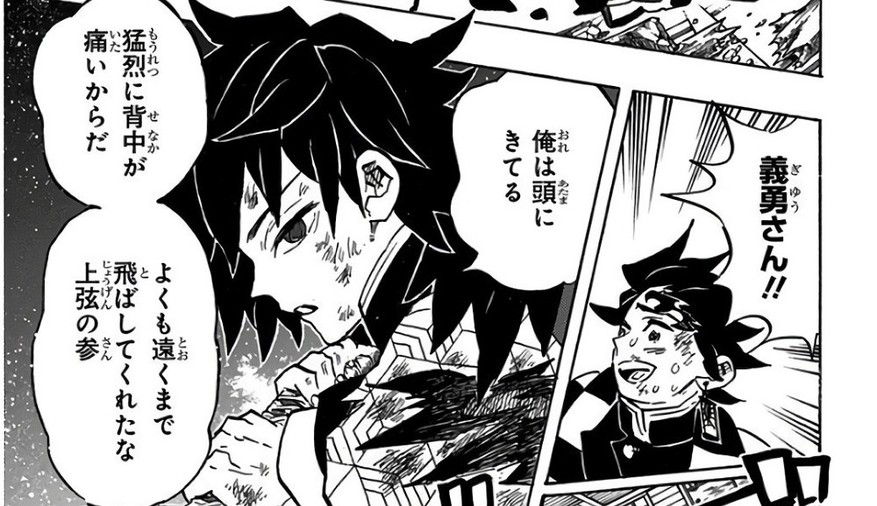
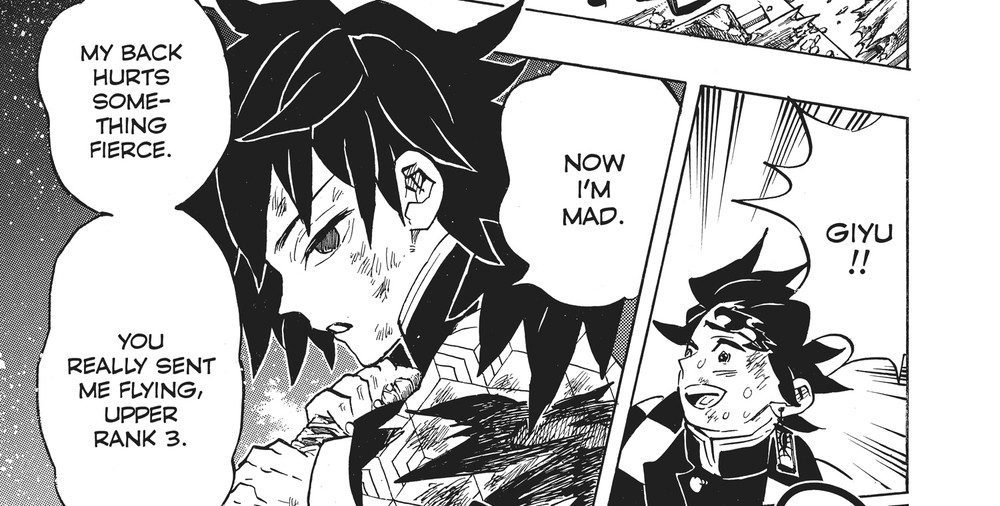
Vol.17, page 147 in the Japanese edition; VIZ Vol.17 at the corresponding panel. Mid-battle against Akaza, Upper Rank 3, Giyu has just been knocked flying into a pile of rubble. He picks himself up, and instead of a battle cry, delivers a diagnosis:
「俺は頭にきてる」 "NOW I'M MAD."
「猛烈に背中が痛いからだ」 "MY BACK HURTS SOMETHING FIERCE."
「よくも遠くまで飛ばしてくれたな上弦の参」 "YOU REALLY SENT ME FLYING, UPPER RANK 3."
Three lines, one deadpan register, delivered to an opponent who just launched him across a battlefield. The first line is the one worth stopping on.
The Original
頭にくる (head-to-come) is one of the standard idioms for anger in spoken Japanese: 頭 (head) + に (a directional particle, "to/toward") + 来る (to come, to arrive). きてる here is the casual contraction of 来ている — the resultative form, marking not the moment of arrival but the ongoing state of having arrived: anger has come to the head and is still there. The idiom sits in a small family of Japanese body-idioms for emotion — 腹が立つ ("the stomach stands," to get angry), 頭に血が上る ("blood rises to the head") — that all locate feeling somewhere in the body and describe it as movement, arrival, rising. It is casual, spoken, almost throwaway — the ordinary register anyone uses for everyday irritation, not an intensified or literary one.
VIZ's Choice
NOW I'M MAD.
As a translation of "I'm angry," this is correct and perfectly idiomatic English. The word "mad" is even a reasonable register match — casual, unremarkable, the way an American might actually say it. What it doesn't carry is the shape of the Japanese sentence: 頭にきてる is a report of something having happened to the speaker's body (anger arrived, and is sitting there, at the head), while "I'm mad" is a static predicate — a label for a state, with no verb of motion anywhere inside it.
The Gap
The physiology drops out. 頭にきてる and 猛烈に背中が痛いからだ are grammatically and tonally matched: both are reports of something happening in or to the body, delivered with the same flatness. In Japanese, Giyu describes his fury and his spinal pain as two symptoms in the same clinical register — as if his own anger were just one more thing his body is currently doing to him, alongside the ache in his back. "NOW I'M MAD" turns the first line into psychology (a mental state) while the second line stays physiology (a bodily fact), and the matched pair — this is a joke built entirely on two lines doing the same thing — comes slightly apart.
The idiom's ordinariness gets lost in translation logic, not in content. English readers who don't independently know 頭にくる have no way to sense that this is the default Japanese way of saying "I'm angry" — as reflexive and unremarkable as "I'm ticked off" — which matters for tone: Giyu isn't reaching for a dramatic or clever phrase, he's using the most boring possible idiom for fury, which is itself part of the joke of his understatement.
The direction and location disappear. 頭 (the head) is named; English's "mad" names no body part at all. Small, but it's the detail that makes the sentence a physical report rather than an emotional label — the anger has a place, the way the pain in the next line has a place (背中, the back).
What If
- "My blood's up." — an English body-idiom for anger, restoring the physicality and the location (blood, not a bare state), at some cost to the deadpan flatness of きてる's plain contracted register.
- "I'm seeing red." — vivid, physical, but pulls toward visual/optical imagery rather than 頭にきてる's arrival-at-a-location imagery.
- "Something's come to a boil." — keeps the sense of arrival/process, loses the specific location (head).
- "Now I'm mad" (VIZ's choice) — clean, idiomatic, register-appropriate; the one thing it can't do is match its own next line's physicality, because it isn't a physical sentence.
Take-away
Japanese anger-idioms are overwhelmingly bodily: things rise, arrive, stand, boil, over and over, describing fury as an event happening to a body rather than a state a mind is in. English has the same family of idioms available (blood boiling, seeing red, blowing a fuse) but doesn't reach for one by default the way spoken Japanese reaches for 頭にくる — so a flat, correct "I'm mad" is always available as an easy out, and it's easy to miss what specifically gets left on the table when a two-line joke depends on both lines sounding like symptoms. Giyu's flying-into-rubble deadpan works because he reports his own fury with the same clinical detachment as his own injury; watch for the moments a translation keeps one half of that parallel and drops the other.
Every Japanese and English line quoted above is a byte-exact capture from the cited edition — 鬼滅の刃 Vol.17 (Japanese) and Demon Slayer: Kimetsu no Yaiba (VIZ Media) at the corresponding panel — via our bilingual page database; see Sources below. Speaker attributions follow scene context; the bilingual data itself does not tag speakers.