The Moment
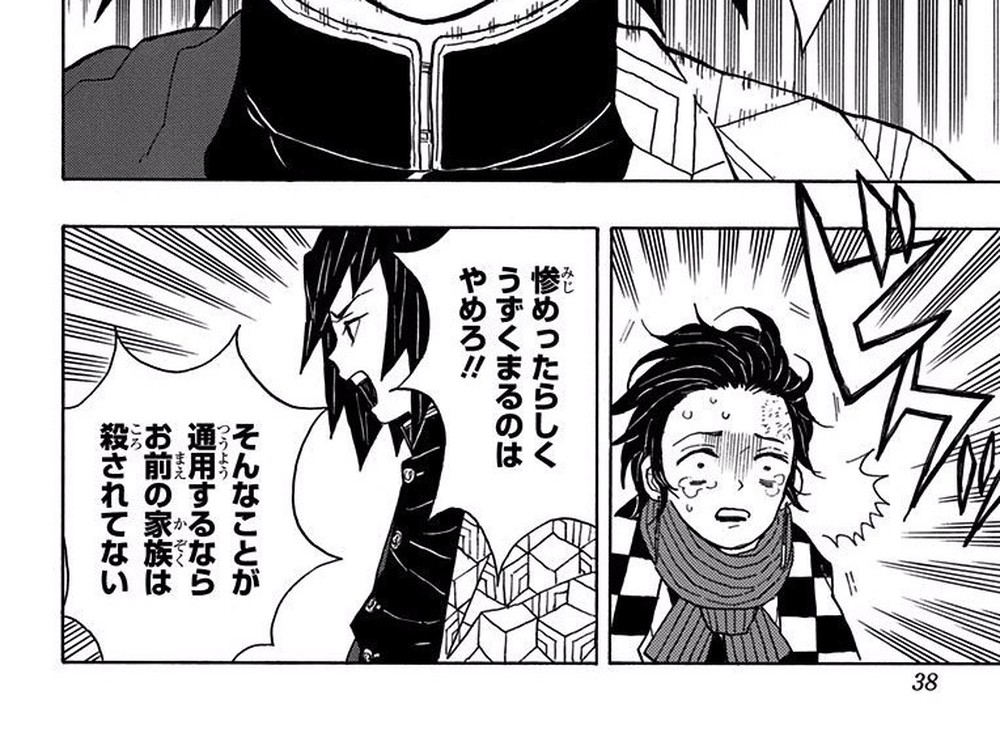
Vol.1, page 38 in the Japanese edition; VIZ Vol.1 at the corresponding panel. Giyu Tomioka has just stopped Tanjiro from being killed and finds him curled over Nezuko's unconscious body, begging for her life. His answer is two sentences, back to back, in the same outburst:
「生殺与奪の権を他人に握らせるな!!」 "NEVER LEAVE YOURSELF SO DEFENSELESS IN FRONT OF AN ENEMY!"
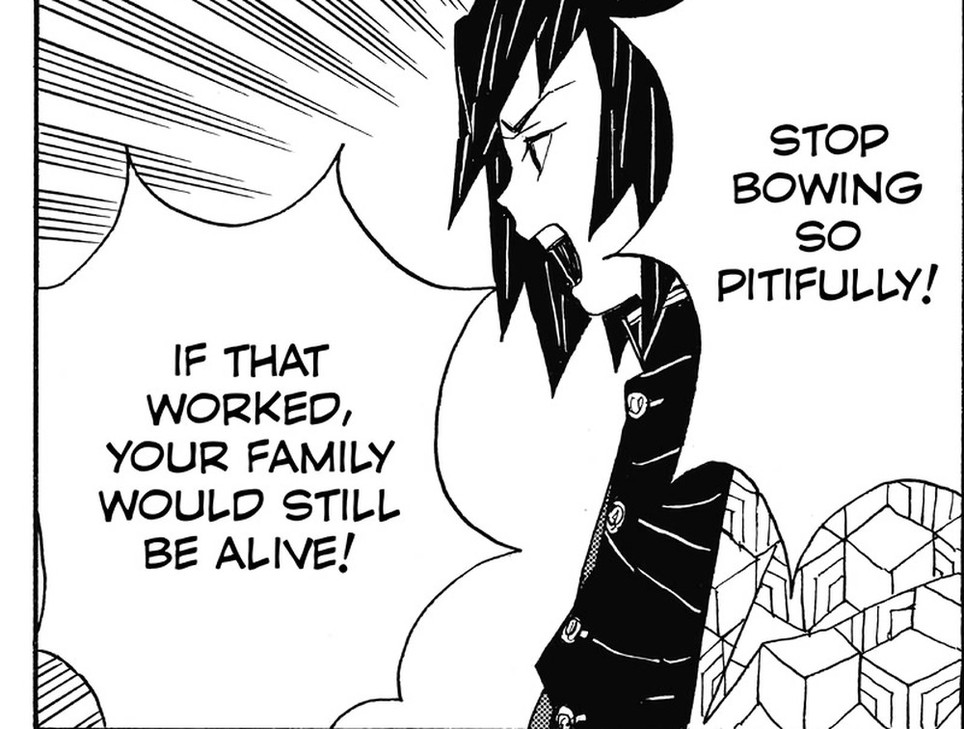
「惨めったらしくうずくまるのはやめろ!!」 "STOP BOWING SO PITIFULLY!"
The first line is the principle. The second is the diagnosis — Giyu pointing at what Tanjiro is actually doing on the page: hunched low, curled protectively, small. うずくまる is that exact posture's name.
The Original
蹲る (usually written in kana, as here: うずくまる) means to crouch, to hunch down, to curl the body low and in — knees drawn up, shoulders down, making oneself as small and low to the ground as possible. It is the posture of a person cowering, in pain, or protecting something under their own body; it carries no gesture of social respect whatsoever. Layered onto it: 惨めったらしく, where 惨め (miserable, pitiable) takes the suffix ったらしい — a piece of grammar that doesn't just intensify an adjective but mocks the visible performance of it, roughly "being all pathetic-looking about it." The whole line is contempt aimed at a posture: stop making yourself into that shape, and stop looking so wretched while you do it.
VIZ's Choice
STOP BOWING SO PITIFULLY!
"Bowing" is a real word for a real Japanese gesture — お辞儀, 頭を下げる — but it is not this word. Bowing bends at the waist and is, almost without exception, a gesture toward someone: greeting, apology, deference, respect. うずくまる has no direction and no social content; it is a body curling in on itself, not toward anyone. In the panel, Tanjiro is not bowing to the demon that just tried to kill his sister — he is physically wrapped around her, shielding her body with his own, exactly the shape of a person who has surrendered the initiative in a fight to the death. "Bowing" quietly relocates that image from a battlefield into a courtroom of manners.
The Gap
The two-sentence diagnosis stops matching. Giyu's rebuke works as principle-then-illustration: never leave yourself defenseless (abstract) → stop crouching like that (concrete, visible, exactly the shape defenselessness takes). Replace うずくまる with "bowing" and the illustration no longer illustrates the principle — a bow is not a defenseless posture, it is a polite one. The two lines, matched in Japanese, drift apart in English: one about combat readiness, the other about manners.
The mockery in the grammar disappears. ったらしい is not decoration; it is the suffix doing the sneering, turning "miserable" into "look-at-you-being-so-miserable." "So pitifully" states the same fact in a flat, adverbial register — accurate as information, but missing the jeer that makes the line land as contempt rather than commentary.
The register slides from battlefield to etiquette. うずくまる belongs to the vocabulary of bodies under duress — fear, pain, collapse. お辞儀 belongs to the vocabulary of social ritual. Trading one for the other doesn't just blur a verb; it moves the entire sentence into the wrong part of the language.
What If
- "Stop cowering there so pathetically!" — keeps the physical crouch and restores something of ったらしい's sneer; "cowering" reads slightly more fear-forward than うずくまる's neutral-physical crouch, but far closer than "bowing."
- "Stop curling up there like that!" — the plainest, most physically accurate option; loses ったらしい's mockery entirely.
- "Stop making yourself small and pathetic!" — carries the contempt and the smallness, at the cost of うずくまる's specific bodily image (any reader pictures something, but not necessarily this posture).
- "Bowing" (VIZ's choice) — clean, readable English; the wrong gesture, and the wrong register, for the wrong reason.
Take-away
うずくまる is a lesson in how specific Japanese posture-verbs can be: it names one shape a body makes, precisely, with no social content at all. English "bow" is equally precise in the other direction — a specific, freighted social gesture — which makes it a false friend for any Japanese verb of merely physical lowering. When a line's whole force depends on a character's literal on-page posture matching the words describing it, swapping a body-verb for an etiquette-verb doesn't just lose nuance — it points the reader's eye at the wrong picture. Giyu is diagnosing a corpse-to-be, not a poor guest; the crouch he's naming is the last thing standing between Tanjiro and a demon's claws, not a breach of manners.
Every Japanese and English line quoted above is a byte-exact capture from the cited editions — 鬼滅の刃 Vol.1 (Japanese) and Demon Slayer: Kimetsu no Yaiba (VIZ Media) at the corresponding panel — via our bilingual page database; see Sources below. Speaker attributions follow scene context; the bilingual data itself does not tag speakers.