Translation Gem · Kyojuro Rengoku
Why VIZ's 'Become Hashira and Be the Pillars' Nails そして君たちが柱となるのだ
VIZ nails a brilliant semantic doubling: it preserves the Japanese rank term 'Hashira' while simultaneously unpacking it as 'Pillars,' revealing that rank and structural function are one thing. The parallel syntax makes this move audible and memorable.

Japanese (manga)
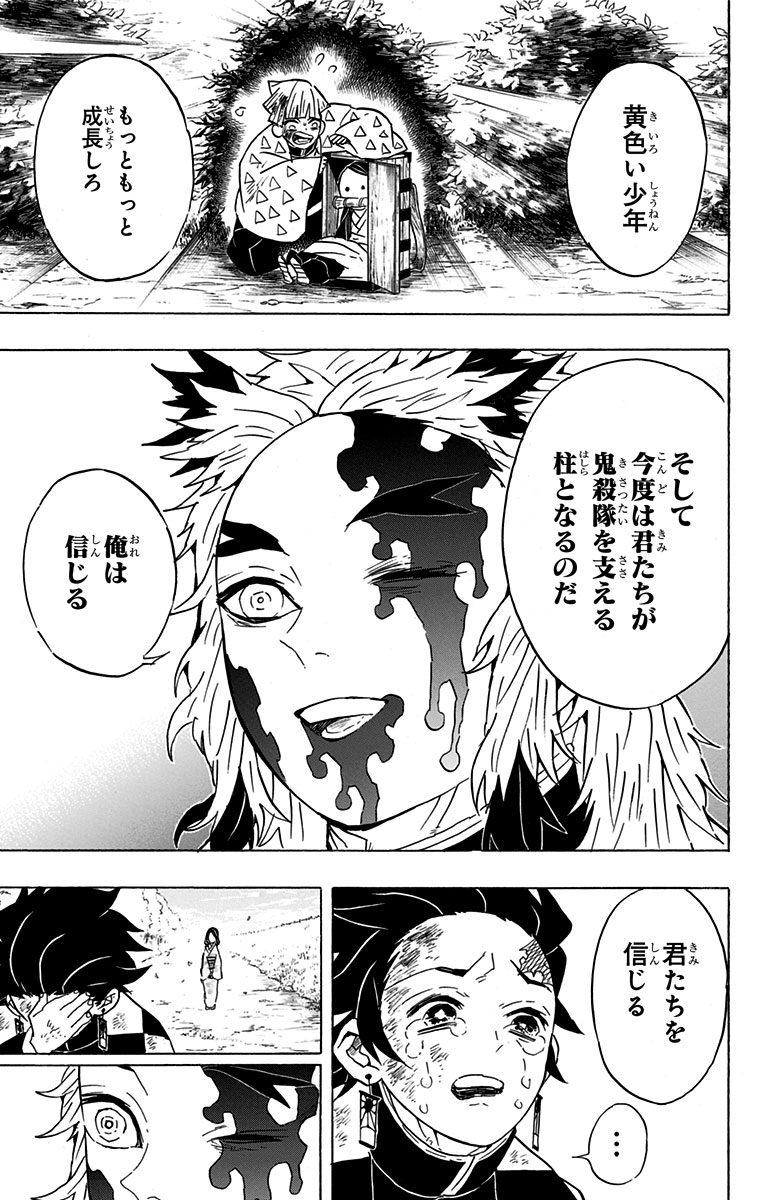
鬼滅の刃 第8巻 p.95 ©吾峠呼世晴/集英社
English (VIZ official)
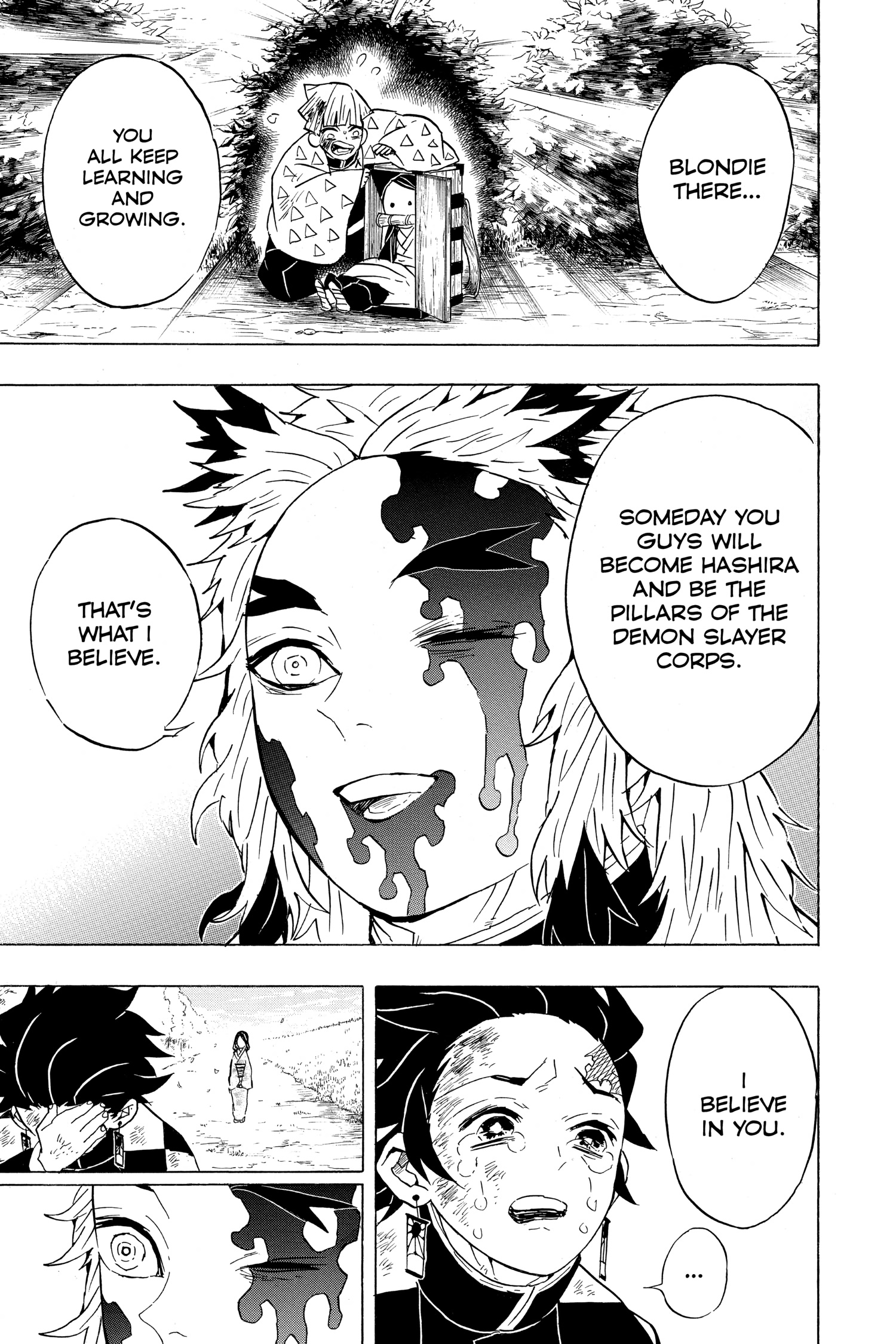
Demon Slayer Vol. 8 (VIZ Media), p.95 ©Koyoharu Gotouge/VIZ Media
Japanese (manga)
そして今度は君たちが鬼殺隊を支える柱となるのだ
Soshite kondo wa kimi-tachi ga oni-koroshi-tai o sasaeru hashira to naru no da
鬼滅の刃 Vol. 8, p.95
English (VIZ official) — ✓ nails it
"SOMEDAY YOU GUYS WILL BECOME HASHIRA AND BE THE PILLARS OF THE DEMON SLAYER CORPS."
Demon Slayer Vol. 8 (VIZ), p.95
Literal meaning
The sentence breaks down as: And (そして) this-time (今度は) you-guys (君たちが) demon-slayer-corps (鬼殺隊を) support (支える) pillar (柱) become (となる) [emphatic] (のだ). The particle を on 鬼殺隊 marks the Demon Slayer Corps as the object of support; 柱 is the predicate nominative—you will *become* pillars. Future tense combines となる (to become) with the emphatic のだ particle, creating directiveness and certainty. Temporally, 今度は (this time / your turn now) establishes succession: whereas current Hashira bear the burden, the next generation will assume this role.
Why this translation works
The VIZ rendering unpacks a crucial semantic ambiguity in Japanese. The word 柱 (pillar) carries both literal meaning (structural support) and figurative meaning (the Hashira rank itself). The phrase 支える柱 (supporting pillar) leverages this doubling—to be a Hashira is to literally embody the structure upholding the organization. VIZ captures this via 'BECOME HASHIRA AND BE THE PILLARS': first naming the rank, then unpacking the metaphor. A flatter single-clause translation like 'become the pillars supporting the Corps' would bury the crucial terminology and lose the formal dignity of the promise. The parallel structure creates rhythmic and sonic resonance absent from simple renderings. The mirrored stress patterns (HASH-i-RA / PILL-ars) and parallel verbs (become / be) reinforce an ideological equation: Hashira rank *is* the support function. Capitalization combined with Rengoku's mentorship context elevates this into something like a manifesto of succession.
Translation techniques used
The translation employs foreignization—preserving 'Hashira' as an untranslated rank term—paired with immediate semantic clarification via parallel second clause. This parallel structure itself is a translation technique: 'BECOME HASHIRA AND BE THE PILLARS' echoes antimetabolic effect (grammatically mirrored, semantically identical), reinforcing that rank and support are coextensive. Capitalization of both terms gives equal visual weight and rhythmic stress, compensating for the emphatic のだ particle that signals command and gravity in Japanese.

Register & tone alignment
Rengoku's original carries formal, directive tone of senior mentorship; the emphatic のだ particle adds urgency and certainty. VIZ preserves this register through capitalization, parallel syntax, and end-stopped phrasing that mimics spoken gravitas. Both occupy formal, prescriptive register—a statement of role and expectation, not suggestion. The emotional register is mentorship and torch-passing, though 'SOMEDAY' subtly shifts weight from prescriptive command ('it will be your role') toward inspirational encouragement ('you will eventually become').
One small thing the English doesn't carry
The addition of SOMEDAY reframes 今度は's temporal force. The original's prescriptive 'it will be your role' becomes the English's more speculative 'you will someday become,' trading directiveness for inspirational tone.
Honesty hedge: we flag this only because it's there — not because the translation falls short.

Sources
Linguistic analysis grounded in primary sources
- [manga_volume] 鬼滅の刃 Vol. 8, page 95
How this was made: a Japanese Demon Slayer otaku hand-picked the insight from a massive bilingual database pairing every original Japanese line with its official English edition. AI then translated and wrote up the analysis from those source quotes — every Japanese / English excerpt above is a byte-exact capture from the cited manga editions, not invented.