Translation Pitfall · Kyojuro Rengoku
"Aging and Dying Are Beauty"—Why VIZ's "Gives Meaning" Loses the Paradox
A direct assertion that human beauty *is* aging and dying—and why VIZ's abstract phrasing misses the emotional paradox and the doubled repetition that intensify the claim.

Japanese (manga)
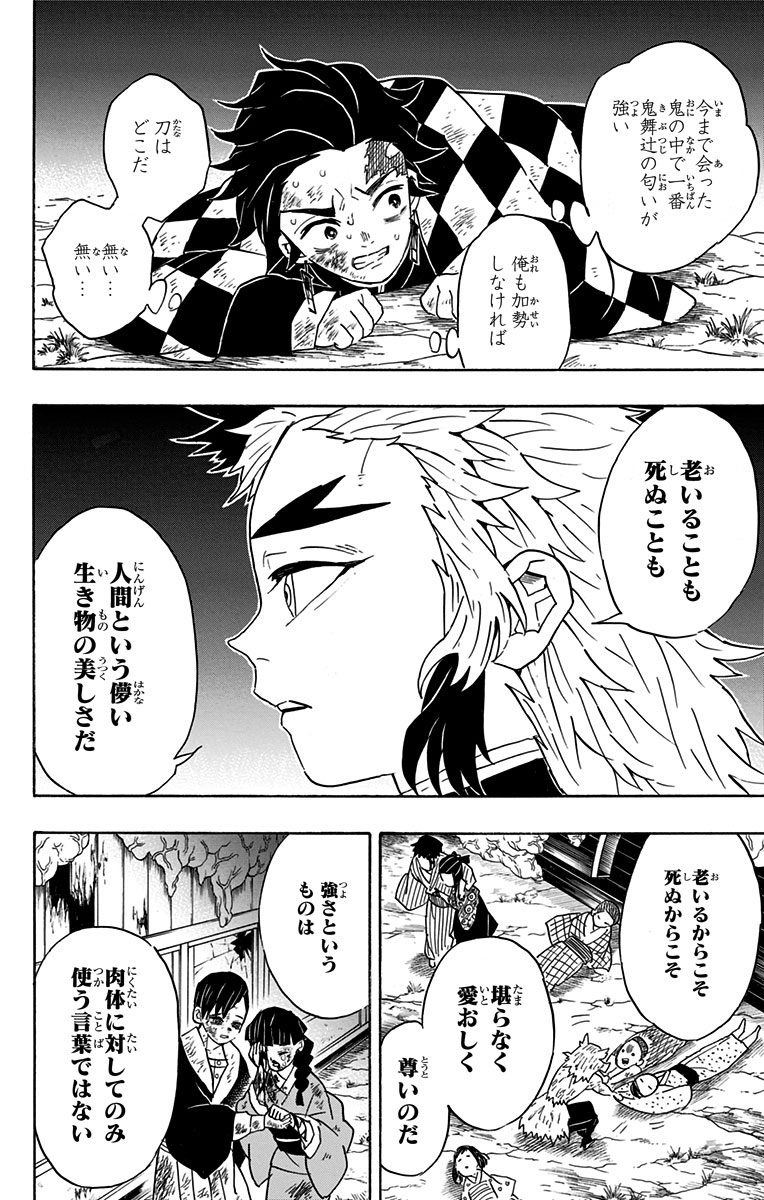
鬼滅の刃 第8巻 p.36 ©吾峠呼世晴/集英社
English (VIZ official)
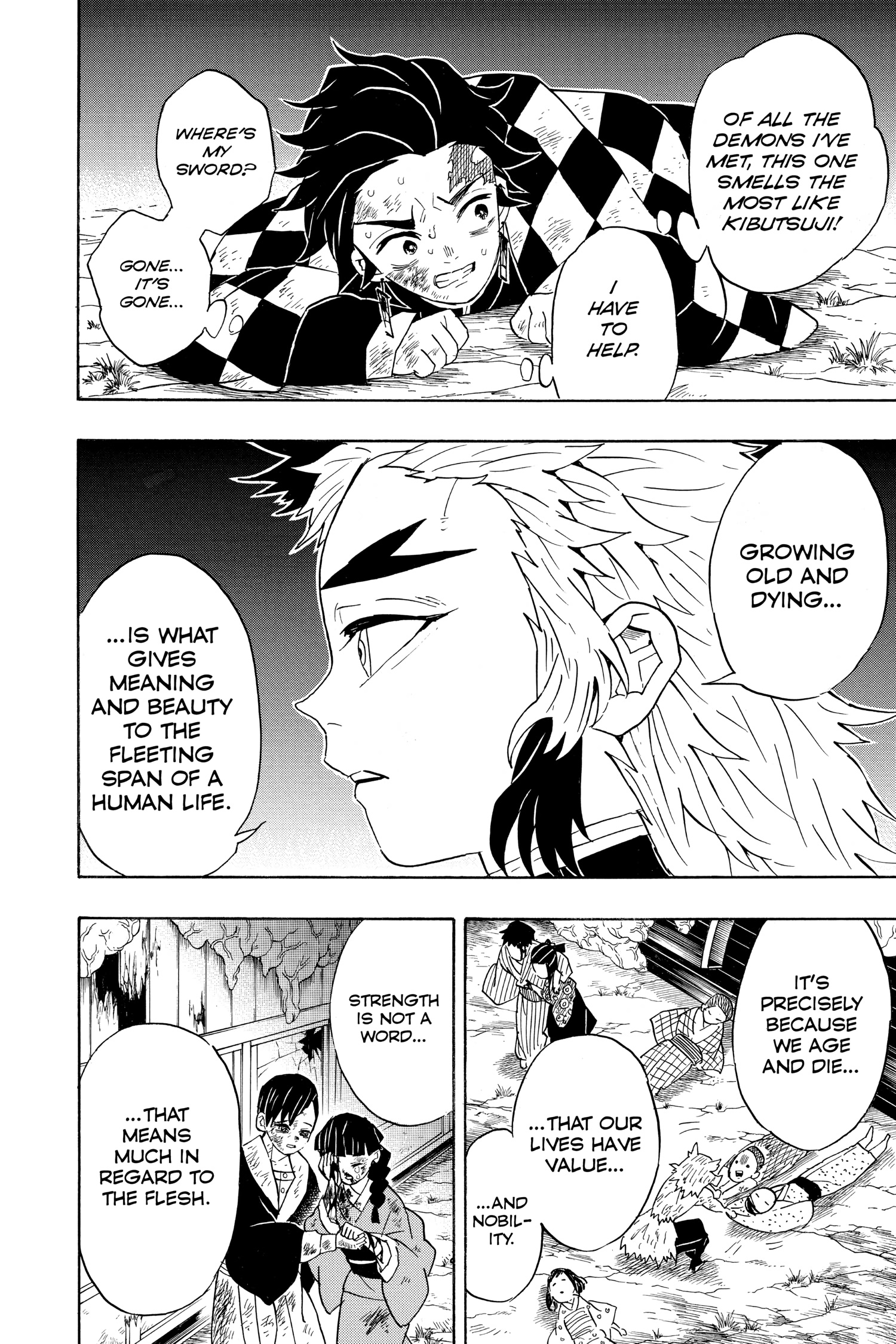
Demon Slayer Vol. 8 (VIZ Media), p.36 ©Koyoharu Gotouge/VIZ Media
Japanese (manga)
老いることも死ぬことも 人間という儚い生き物の美しさだ 老いるからこそ死ぬからこそ堪らなく愛おしく尊いのだ
Oi-ru koto mo shinu koto mo, ningen to iu hakanai ikimono no utsukushisa da. Oi-ru kara koso shinu kara koso tamaranaku itoshiku toutoi no da.
鬼滅の刃 Vol. 8, p.36
English (VIZ official)
"GROWING OLD AND DYING... IS WHAT GIVES MEANING AND BEAUTY TO THE FLEETING SPAN OF A HUMAN LIFE. ITS PRECISELY BECAUSE WE AGE AND DIE THAT OUR LIVES HAVE VALUE"
Demon Slayer Vol. 8 (VIZ), p.36
Literal meaning
Breaking down word-by-word: 老いることも死ぬことも (aging and dying, both) are 人間という儚い生き物の美しさだ (the beauty of humans—those fleeting creatures). The second sentence mirrors and intensifies: 老いるからこそ死ぬからこそ (precisely *because* we age, precisely *because* we die) 堪らなく愛おしく尊いのだ (life becomes unbearably precious, deeply beloved, and sacred). The structure is a paradox—transience and mortality are not obstacles to beauty but the very *source* of it. The doubled parallel (aging *and* dying) emphasizes both mortality's inescapability and the emotional response it demands.
Register & tone
The register is formal and declarative, with the copula だ (da) at the end, typical of assertive, proclamatory speech. The tone is passionate and almost meditative—not cold philosophy but lived conviction. The doubled structure with からこそ (kara koso, "precisely because / it is exactly this that") creates rhythmic emphasis, suggesting a speaker who has wrestled with the reality of mortality and come to an emotional truth. The use of 愛おしい (itoshiku, tenderly beloved) and 尊い (toutoi, sacred/noble) as adverbial conclusions adds emotional weight and reverence. This is characteristic of a character who views transience not as tragedy but as a source of beauty and dignity.
Cultural context
This reflects the Japanese aesthetic tradition of 儚さ (hakanai-sa, transience as beauty), which connects to the classical concept of もののあわれ (mono no aware, the pathos or poignancy of things). Rooted in Buddhism's doctrine of anicca (impermanence, 無常 / mujo in Japanese), this aesthetic celebrates finding profound beauty precisely in what is temporary and unrepeatable. The Edo and earlier literary traditions (evident in works like *Kenko's Essays in Idleness*) valorized accepting mortality with grace and even joy. The philosophy also echoes samurai ideals: acceptance of death not as defeat but as the condition that gives life meaning. For Hashira (the elite swordsmen of the work), fighting demons while accepting one's limited lifespan becomes an expression of this aesthetic—living fully *because* life is finite.
Why the English version misses the mark
The VIZ translation shifts from direct assertion to abstract causation: "GROWING OLD AND DYING... IS WHAT GIVES MEANING AND BEAUTY" frames transience as a *mechanism* for producing value, whereas the Japanese makes a bolder, more paradoxical claim—beauty *is* aging and dying; they are identical. Additionally, 堪らなく愛おしく (tamaranaku itoshiku) carries irresistible emotional intensity—"unbearably precious," "desperately beloved"—that "have value" flattens into neutral, utilitarian language. The doubled repetition of からこそ (aging *and* dying, parallel emphasis) is completely lost in VIZ's single clause. Finally, 尊い (toutoi, sacred/noble) suggests reverence and dignity beyond mere "value," implying a spiritual or ceremonial quality. The English rendering reads as philosophical explanation; the Japanese reads as passionate declaration.
Alternative translations
- Aging and dying—both are the beauty of us humans, those fleeting creatures. It is precisely *because* we age and die that life becomes unbearably precious and sacred.
- Human beauty *is* transience itself. We grow old, we perish—and from that very necessity springs an irresistible tenderness and dignity.
- In aging and dying, humans find their greatest beauty. The inevitability of death is what renders our lives so desperately beloved and worthy of reverence.
- The fleeting span of human life—aging, dying—is its truest beauty. We age, therefore we cherish. We die, therefore we are sacred.
- Beauty dwells in human mortality: we age, we die, and that is exactly why existence becomes unbearably precious and worthy of honor.
- Aging and dying are not life's tragedy but its poetry—the source of beauty itself. Only because we must age and die does life become so desperately, devotedly sacred.

Sources
Linguistic analysis grounded in primary sources
- [manga_volume] 鬼滅の刃 Vol. 8, page 36
How this was made: a Japanese Demon Slayer otaku hand-picked the insight from a massive bilingual database pairing every original Japanese line with its official English edition. AI then translated and wrote up the analysis from those source quotes — every Japanese / English excerpt above is a byte-exact capture from the cited manga editions, not invented.