The Moment
Vol.2, page 9 in the Japanese edition; VIZ Vol.2, page 9 — no repagination between the two editions here. Ten years earlier, on the last page of Volume 1's opening chapter, Shanks handed a crying boy his own straw hat and told him to keep it safe until he'd earned the right to give it back (Vol.1, pp.50–51 — see Section 2 below). Volume 2 opens with that boy, grown into the manga's protagonist, meeting the thief who will become his navigator.
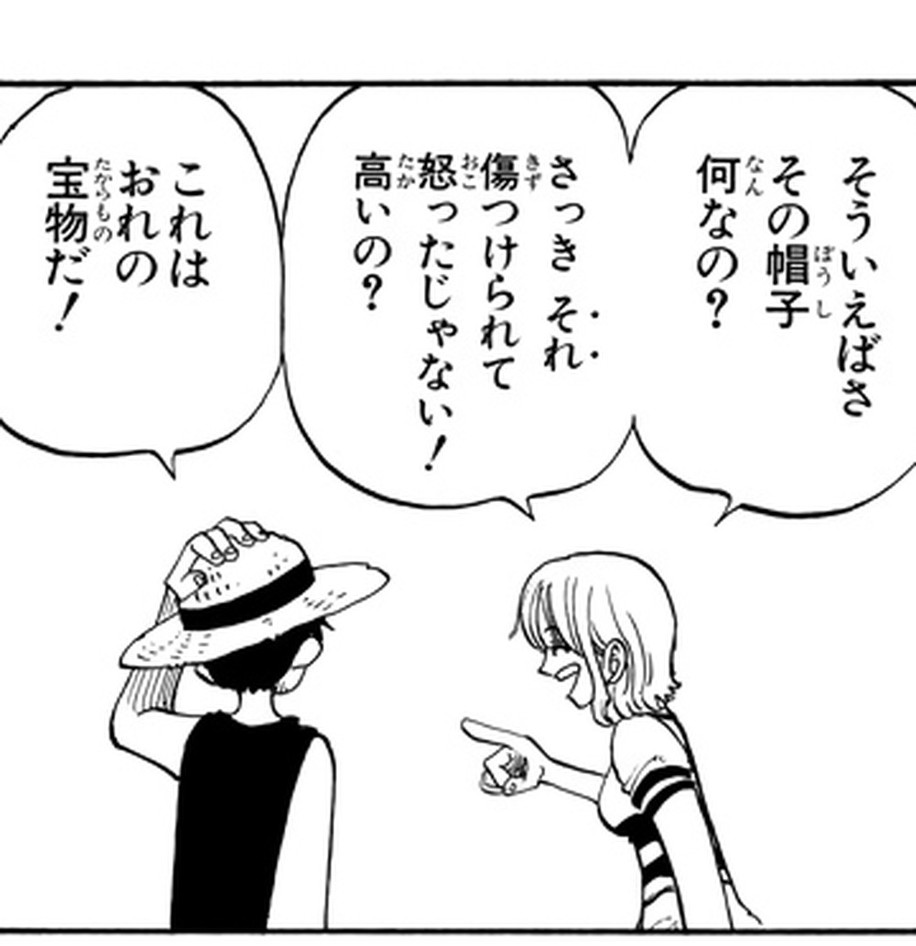
They are walking through town. Nami has just noticed something: earlier, when a stranger touched Luffy's hat, he got angry — genuinely angry, out of proportion to the moment. She circles back to it here, two questions stacked in one balloon:
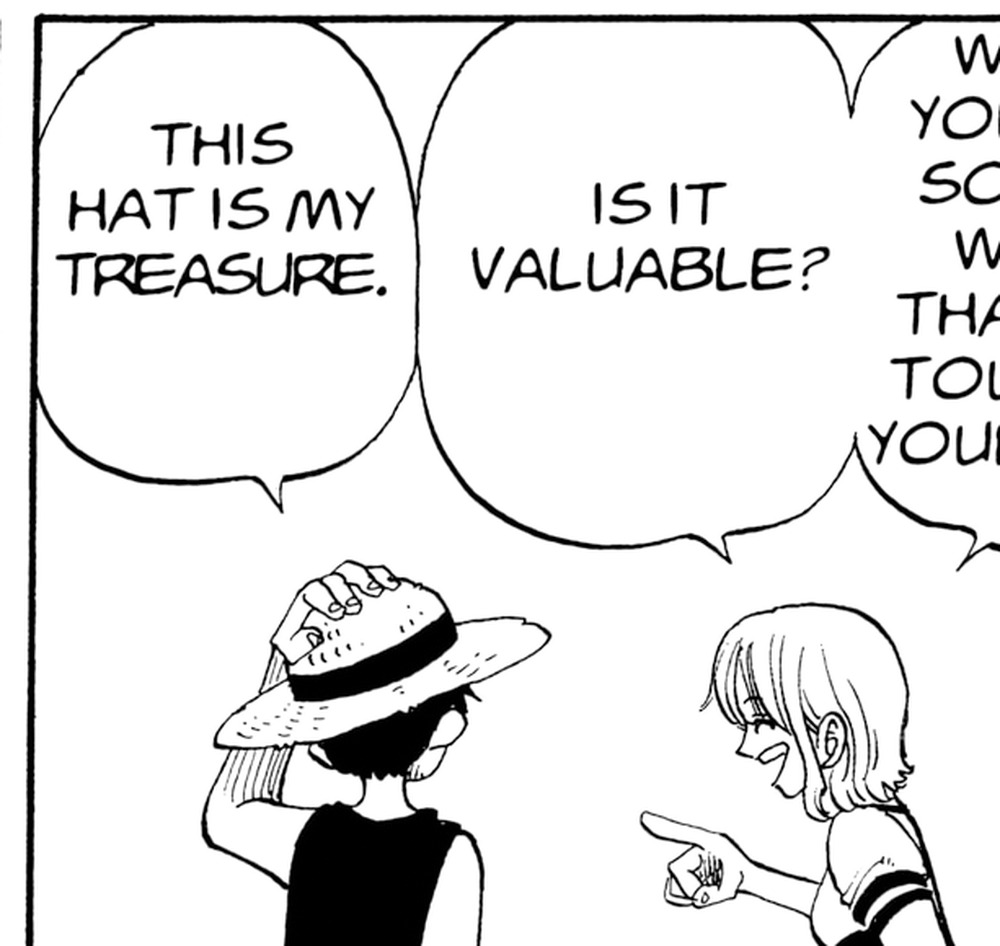
「そういえばさその帽子何なの?」「さっきそれ傷つけられて怒ったじゃない!高いの?」 "WHY'D YOU GET SO MAD WHEN THAT GUY TOUCHED YOUR HAT?" "IS IT VALUABLE?"
And Luffy, hand on the brim, gives an answer that in Japanese does something quietly strange: it never says the word hat.
「これはおれの宝物だ!」
VIZ's page renders it: "THIS HAT IS MY TREASURE." Five words where the Japanese has, structurally, four — and the fifth word, the one VIZ adds, is the entire subject of this Gem.
Nami doesn't get an explanation. She guesses — jewels? a treasure map? — and gets no answer either; the page simply cuts to a different location. Whatever the hat means, Luffy isn't going to say more than this one sentence about it, not here, not to her, not yet.
The Original
これはおれの宝物だ! — Kore wa ore no takaramono da! [this-TOP I-GEN treasure COP]
Word by word: これ — "this," a bare demonstrative pronoun. は — topic marker. おれの — "my." 宝物 — takaramono, "treasure" in its ordinary, everyday register: the word a child uses for a favorite marble or a grandmother's ring, not the elevated register of 秘宝 or the series' own 大秘宝 ("great secret treasure" — the phrase that gives One Piece its title; see the prologue's echo). だ — the plain copula.
Now notice what the sentence does not contain: any noun for the object being discussed. No 帽子 ("hat"). Luffy's answer to "what's with that hat?" is, structurally, "this is my treasure" — a sentence that is grammatically complete and referentially empty on its own. Its entire meaning depends on これ pointing back one balloon, to Nami's 「その帽子」. Read in sequence, inside the panel, this costs a Japanese reader nothing; the antecedent is right there. Lift the sentence out of that sequence, though, and it dissolves — これ refers to nothing, is nobody's business, is just a word pointing at an absence.
This is not an accident of grammar; it is a feature of how Luffy talks about the hat throughout the rest of the story. He almost never volunteers its origin. He states its value and stops. The pronoun does the same work as his silence after the sentence: the object is so given, so completely there to him, that it does not require a noun any more than his own hand does.
The scene this callback compresses is worth having open: ten years earlier, a very young Luffy, freshly saved from a sea monster and devastated that his hero is leaving, declares he'll surpass the Red-Hair Pirates — and Shanks, instead of laughing it off, takes off his own hat:
「この帽子をお前に預ける」「おれの大切な帽子だ...いつかきっと返しに来い立派な海賊になってな」 "DO ME A FAVOR... KEEP THIS HAT SAFE FOR ME?" "THIS HAT MEANS A LOT TO ME. PROMISE THAT YOU'LL GIVE IT BACK TO ME SOMEDAY... ...WHEN YOU'VE BECOME A GREAT PIRATE." (Vol.1, pp.50–51)
Shanks's own sentence does name the hat — 大切な帽子, "hat that means a lot to me" — twice, with an adjective. Luffy's answer to Nami, a decade of in-story time later, strips the noun and the adjective both, leaving only これ and 宝物. The boy has had ten years to turn a gift with an explicit backstory into an object that doesn't need one.
VIZ's Choice
"THIS HAT IS MY TREASURE."
VIZ restores the noun the Japanese omits. Where the source sentence is built entirely to be read in sequence — これ costing nothing because Nami's question is one balloon away — the English sentence is built to survive on its own: a complete noun phrase, a complete claim, needing nothing before or after it to mean what it means.
The restraint in the addition matters as much as the addition itself. VIZ supplies exactly the missing noun and nothing else — no "Shanks," no "a friend gave me this," no gloss on why it matters. The withholding that is the scene's real point (Luffy states the value and refuses to explain it; Nami is left to guess and gets nothing) survives completely intact. This is a translator adding precisely one word and stopping.
The noun choice for 宝物 also lands correctly for register: "TREASURE," not "prized possession" or "most valuable thing" — an everyday noun matching an everyday noun, keeping this sentence in a different register bracket than the series' actual mythic treasure vocabulary. A reader who later hits Coby's "WEALTH, FAME, POWER" speech, or the words "ONE PIECE" spoken as a proper noun for the first time, is not primed by this earlier line to expect a connection — because there isn't one. Luffy's hat is not a clue to the plot. It's a hat.
Why It Works
Portability was never available to the Japanese sentence, and it is the whole value of the English one. This is, by a wide margin, the most-quoted line in English-language One Piece fandom about the straw hat — printed on merchandise, captioned under fan art, deployed in isolation with no panel, no Nami, no question attached. That is only possible because VIZ named the object. 「これはおれの宝物だ!」 cannot do this job; read alone, it is not about anything. "THIS HAT IS MY TREASURE." can be lifted whole. The addition did not just clarify a pronoun — it built the sentence's entire second life outside the page.
The flatness survives the addition. Nothing about VIZ's version dramatizes what the Japanese doesn't dramatize: no exclamation beyond the source's single 「!」, no adjective borrowed from Shanks's earlier and more explicit 大切な, no editorializing. "THIS HAT IS MY TREASURE." ends on a period. It is a fact stated once, the way a boy states a fact he's never had reason to doubt.
The silence after the line does the rest of the work, in both languages. Nami guesses jewels; she guesses a treasure map; she gets no answer, and the page moves on. Neither edition explains the hat here — because the explanation already happened, sixty-odd pages earlier, and neither Oda nor VIZ needed to restage it. A reader who remembers Shanks's hat-passing from a volume ago receives, in this one small sentence, a decade of unstated loyalty; a reader who doesn't remember it yet simply receives a boy refusing to elaborate. Both readings work, in both languages, and the noun VIZ added doesn't force either one.
It sets the bar the rest of the corpus is measured against. This is one of Luffy's very first pieces of unprompted self-disclosure to a future crewmate — spoken before any "nakama" declaration on this site (the vow to Coby comes only pages later in the same volume), before Zoro, before the word 仲間 has been used about anyone in the crew at all. Whatever Luffy will later say about people he calls family, the first thing establishing what "treasure" means to him is a hat, stated once, to someone who hasn't yet agreed to sail with him.
What If
- "THIS IS MY TREASURE." — Keeps the demonstrative pronoun, closest to a word-for-word rendering. Loses exactly the property that makes VIZ's version work: printed alone, "THIS" refers to nothing, and English relies far less than Japanese on readers tolerating an empty-referent sentence sitting on a printed page divorced from its panel.
- "IT'S MY TREASURE." — A slightly more natural English pronoun sentence than "THIS IS," but suffers the identical problem: portable grammar, unportable meaning.
- "THIS OLD HAT IS MY TREASURE." — Adds color (age, wear) that isn't in 宝物 and oversells a sentence whose power is its lack of ornament.
- "IT'S MY MOST PRIZED POSSESSION." — Correct sense, wrong register: 宝物 is a word a child reaches for; "most prized possession" is a museum placard. A translation that gets the meaning right and the voice wrong has still lost the scene.
The field narrows the same way it does throughout this collection: multiple options preserve sense; only the shipped line preserves sense, register, and the portability the scene's afterlife has actually depended on.
Take-away
The transferable point sits next to the added "NOW" in this collection's running observation about VIZ's early-era craft: sometimes the most consequential translation decision is not a rendering choice at all, but the decision to supply a word the source sentence structurally omits. Japanese, read in sequence inside a fixed panel order, can build a sentence that means everything in context and nothing outside it; English, printed for a readership that will requote, meme, and merchandise individual lines for twenty years, generally cannot afford that. VIZ's one added noun is a small, correct bet on how the sentence would actually be used — a bet that has, empirically, paid out.
For the moment the hat first changes hands, see the exchange above at Vol.1, pp.50–51; for the word the treasure vocabulary belongs to and the pun English can't carry, see the site's glossary entry on ワンピース itself. For the crew declaration this scene precedes by only a few pages, see "I'm gonna be King of the Pirates!!!".
Every Japanese and English line quoted above is a byte-exact capture from the cited editions — ONE PIECE Vol.1–2 (Japanese) and One Piece Vol.1–2 (VIZ Media) at the corresponding panels — via our bilingual page database; see Sources below. The corpus OCR record for the anchor line carries a scanning artifact (これはうしうおれの宝物だ!) reproduced verbatim in the citation; the page itself reads これはおれの宝物だ!, confirmed directly against the panel image reproduced with this article. Speaker attributions follow scene context; the bilingual data itself does not tag speakers.