Glossary · Monkey D. Luffy
ひとつなぎの大秘宝
One Piece
The legendary hoard left by the executed Pirate King at the end of the Grand Line; its in-world name literally means "the great treasure that is all one connected piece" — the same pun the English title keeps sealed.
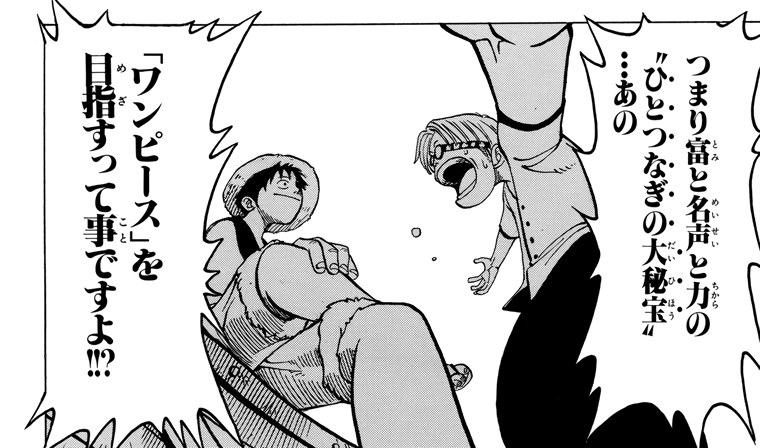 ONE PIECE 第1巻 p.72 ©尾田栄一郎/集英社
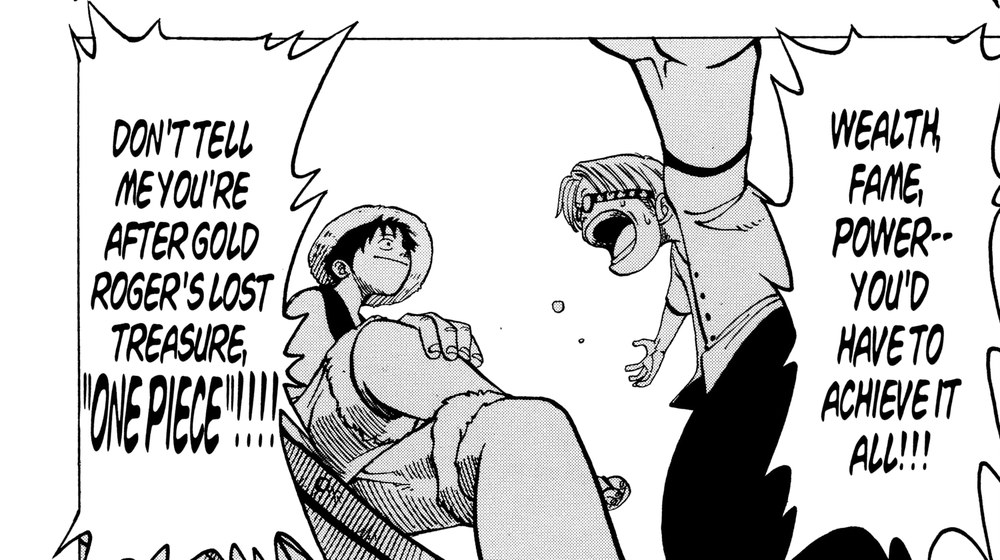 One Piece Vol. 1 (VIZ Media), p.72 ©Eiichiro Oda / Shueisha · VIZ Media
Coby does the math out loud, and it terrifies him. Luffy has just announced he will be King of the Pirates, and Coby spells out what that title actually costs: 「海賊王ってゆうのはこの世の全てを手に入れた者の称号ですよ!? つまり富と名声と力の〝ひとつなぎの大秘宝〟…あの「ワンピース」を目指すって事ですよ!!?」 — "'King of the Pirates' is the title of the one man who's gotten everything this world has to offer!? So you're saying you're going after the hitotsunagi no daihihō (ひとつなぎの大秘宝, "the great hidden treasure that is all one connected piece") of wealth, fame, and power — that 'One Piece'!?" (Vol. 1, p.72). This is the first time the treasure is named on the page, and the name is doing something the English title can only point at from outside.
What the name actually says
Take it apart. 宝 (takara) is treasure. 秘宝 (hihō) fuses 秘 (hi, "hidden, secret") to it: "a hidden treasure," the kind you need a legend to even know exists. 大秘宝 (daihihō) crowns that with 大 (dai, "great"): "the great hidden treasure," and the furigana printed beside the kanji confirm the reading — だ・い・ひ・ほう. That much is a straightforward superlative.
The load-bearing word is the one written in plain hiragana in front of it: ひとつなぎ. It is 一繋ぎ (hitotsunagi) — 一 (hito, "one") welded to 繋ぎ (tsunagi), the noun form of 繋ぐ (tsunagu, "to tie together, to link, to connect"). So ひとつなぎ is "one connected stretch," "all strung together as a single length," "one unbroken piece." Grammatically it is a noun modifying 大秘宝 through の, and the whole phrase reads, with almost no give in it, "the great hidden treasure that is all one connected piece." In the panel Oda sets emphasis dots (傍点, bōten) over each kana of ひ・と・つ・な・ぎ and wraps the phrase in the double quotation marks 〝 〟 that mark a coined term. He is telling the Japanese reader, in the typography itself, that this ordinary-looking word is the key.
Because the moment you hear "one connected piece," you have already heard the English title. ひとつなぎ is "One Piece," rendered into native Japanese: a single, unbroken, all-in-one-place hoard. The title and the in-world name are two translations of each other, and this panel apposes them directly — Coby names the ひとつなぎの大秘宝, then names it again as 「ワンピース」 in the next breath, the descriptor and the proper noun pointing at one object.
Two titles, pulling in opposite directions
Here is the split that makes this entry worth writing. The Japanese reader owns a title that means something. When they see or hear ひとつなぎの大秘宝, the ひとつなぎ tells them what shape the prize is — one connected whole — which quietly seeds a mystery the series spends its entire length circling: what is the thing that is all one piece? The name is a riddle you can start solving on page 72.
The English-language reader owns the opposite: a title that means nothing yet. "One Piece" on a book spine is pure enigma — two common words in an order that refuses to resolve. That is not a defect. It is arguably the better hook for a reader who does not yet speak the language: the phrase sits there, slightly wrong, daring you to find out what it names, and this very panel is where VIZ finally lets the English reader in on the joke by putting "ONE PIECE" in the character's mouth. Japanese front-loads the meaning and loses the mystery; English front-loads the mystery and postpones the meaning. Same two words, two completely different reading experiences — and the series is built to reward both, because ひとつなぎ turns out to be a promise about the world's shape, not just a pile of gold.
What VIZ does with the panel
Set the editions side by side and VIZ's choices come into focus. Coby's Japanese runs "the ひとつなぎの大秘宝… that 'One Piece'." VIZ prints: "WEALTH, FAME, POWER-- YOU'D HAVE TO ACHIEVE IT ALL!!!" and then "DON'T TELL ME YOU'RE AFTER GOLD ROGER'S LOST TREASURE, 'ONE PIECE'!!!!!" (Vol. 1, p.72). Two things happen. First, the phrase ひとつなぎの大秘宝 is gone — the descriptive name that carries the "one connected piece" meaning simply is not translated; VIZ keeps only the bare title "One Piece" in its quotation marks. Second, VIZ adds information that is not in Coby's balloon: "Gold Roger's lost treasure." The Japanese leaves the treasure's owner unstated in this line; the English pins it to Roger for a reader who may need the anchor.
Is that a loss? On the descriptive name, yes — the English reader never learns that the in-world word for the prize literally means "all one piece," so the title's pun stays sealed shut in Japanese. But it is not a botch, and the trade is defensible. "One Piece" already had to stay untranslated — it is the title of the book in the reader's hands — so glossing ひとつなぎ into English right here would have meant printing a translation of a title the cover leaves in English, an awkwardness with no clean fix. VIZ took the mystery and the clarity it could get — proper noun in quotes, plus a named owner — and let the etymology wait. The load-bearing beat of the panel is Coby's panic at the sheer size of the goal, and that lands identically in both languages.
The word Roger never says
Worth noticing: the man whose treasure this is never names it. The series opens on Gold Roger's execution and his famous last words, 「おれの財宝か?欲しけりゃくれてやるぜ… 探してみろ、この世の全てをそこに置いてきた」 — "My treasure? You want it? You can have it. Go find it — I left everything this world has in that one place." (Vol. 1, p.5; VIZ: "MY TREASURE? WHY, IT'S RIGHT WHERE I LEFT IT... IT'S YOURS IF YOU CAN FIND IT... BUT YOU'LL HAVE TO SEARCH THE WHOLE WORLD!"). Roger says 財宝 (zaihō, "riches, fortune"), the plain word for a hoard, and 「この世の全て」 ("everything in this world"). He does not say ひとつなぎの大秘宝 and he does not say ワンピース. The prize's name is other people's word for it — the world's, and Coby's on page 72 — which is why the name arrives as report rather than proclamation. The treasure is defined by everyone chasing it, not by the man who left it, and that is exactly the shape of the great era of piracy his death sets off — haran-banjo made into a plot engine.
For the learner
The useful residue is small and durable. 秘宝 (hihō) is a real word you will meet outside manga — museum exhibits, temple relics, adventure-game subtitles — always meaning "hidden/secret treasure." 繋ぐ (tsunagu, "to connect") and its noun 繋ぎ are everyday vocabulary, in everything from holding hands (手を繋ぐ) to a bridging loan. And once you can hear 一繋ぎ as "one connected stretch," the English title stops being arbitrary: One Piece is not "one item" or "a single fragment," it is "all of it, in one unbroken place." The pun that the grand-line-spanning quest turns on was sitting in a two-word title the whole time — but only in Japanese, and only if you knew to read the hiragana in front of the treasure.
First appearance
Vol. 1, ch. 1 (「Romance Dawn」), p.72 of the Japanese edition (ONE PIECE 第1巻) — Coby names the 「ひとつなぎの大秘宝」 (glossed in the same panel as 「ワンピース」) while spelling out what "King of the Pirates" would cost; the same panel falls on p.72 of VIZ's One Piece Vol. 1, where the descriptive name is dropped and only the title "ONE PIECE" is kept. Gold Roger's opening speech on p.5 sets up the treasure without ever naming it.
Related terms
Sources
- ONE PIECE 第1巻 p.72(集英社・日本語版)
- One Piece Vol. 1 (VIZ Media, English edition), p.72
- ONE PIECE 第1巻 p.5(集英社・日本語版)
- One Piece Vol. 1 (VIZ Media, English edition), p.5