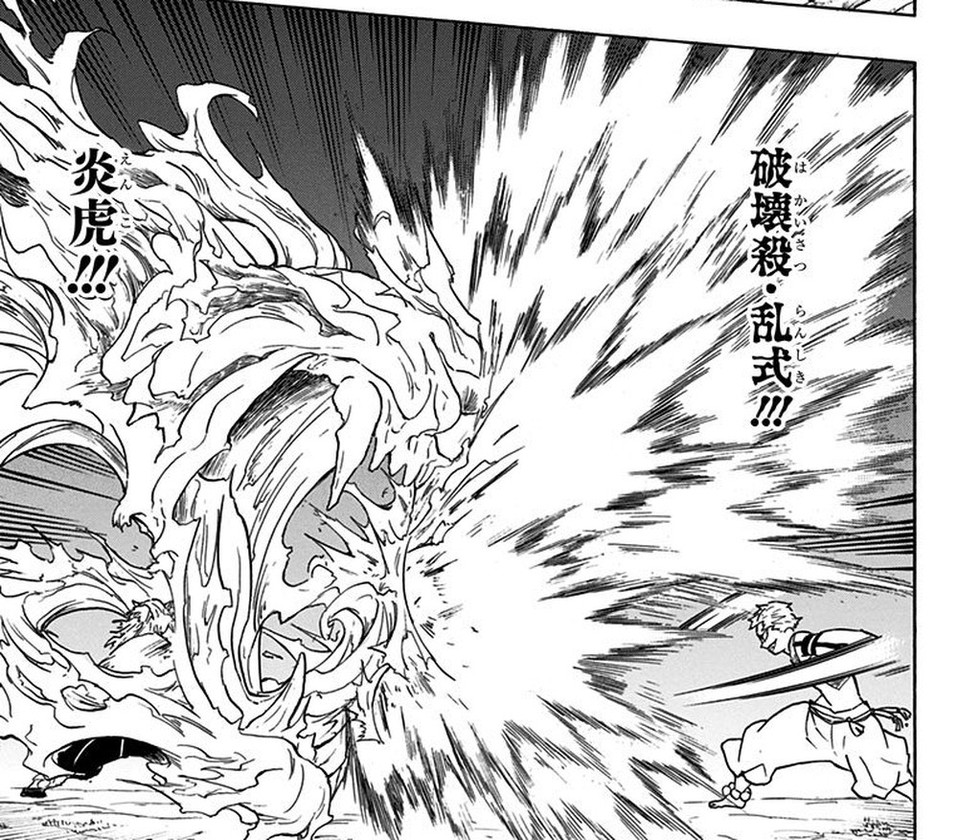
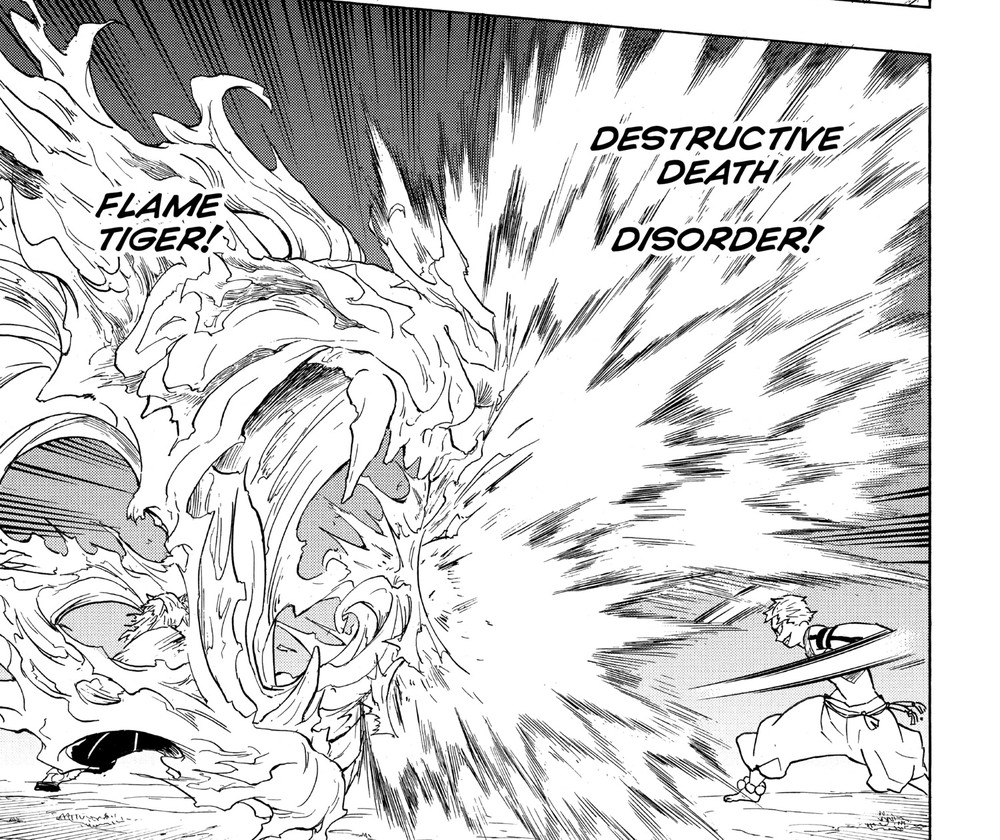
Most of Flame Breathing's named forms so far describe an action or an atmospheric phenomenon — a rising sun, a swelling wave, a fire that isn't known. 炎虎 breaks that pattern outright by giving the flame the shape and character of an animal, a naming convention this dictionary otherwise associates with Beast Breathing — Inosuke Hashibira's self-taught, animal-referencing style built with no dojo and no master behind it. It's a small but telling overlap: even a centuries-old, formally descended breathing style reaches for an animal image once its numbered forms get flashy enough, which suggests the "beast" naming impulse running through this manga's fight choreography isn't a quirk unique to Inosuke's invented vocabulary so much as a broader shorthand the author reaches for whenever an attack needs to look alive rather than merely sharp.
The fact that VIZ needed zero interpretive liberty here is itself worth flagging, precisely because it's the exception rather than the rule inside this style: 盛炎のうねり became "blooming" through a floral metaphor with no floral kanji behind it, 不知火 split into a personifying "Unknowing Fire," but 炎虎 is simply two nouns stacked in the ordinary way Japanese compounds tigers with elements (雷虎, 風虎, and so on would all parse the same way). "Flame Tiger" required no translation choice at all — which means the absence of friction here is itself data about how closely VIZ's decisions track the literalness of the underlying Japanese, not evidence of a single house style applied uniformly across the dictionary.
The technique also lands in one of this corpus's rare back-to-back named-attack exchanges: Akaza's own callout, "DESTRUCTIVE DEATH: DISORDER!" (破壊殺・乱式), appears in the same panel sequence as "FLAME TIGER!" — a Demon Slayer and a demon, each naming their own move in turn, printed almost on top of each other. A bystander's reaction ("WOW!"/すげぇ) on the same page belongs not to Akaza but to a nearby demon slayer trainee watching from a safe distance, a small reminder that even the Mugen Train's central duel has an audience embedded within the story itself.