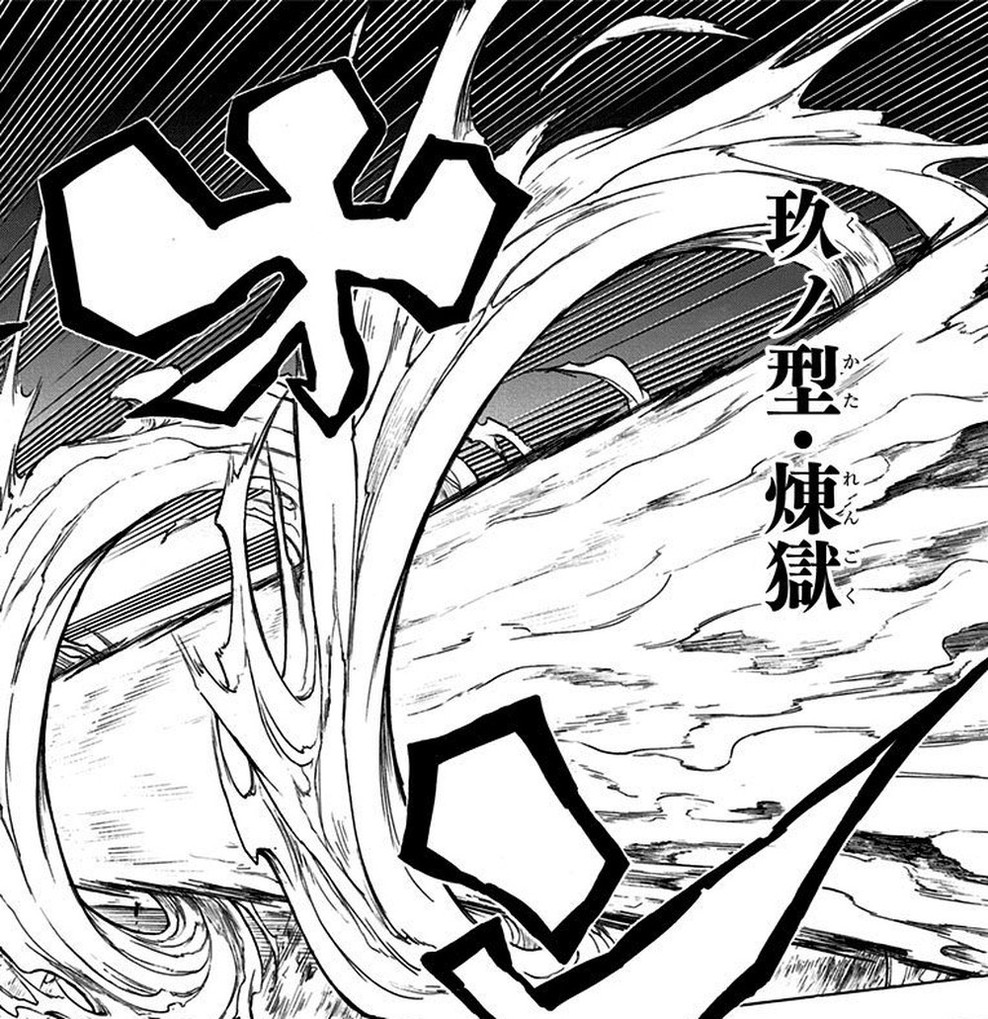
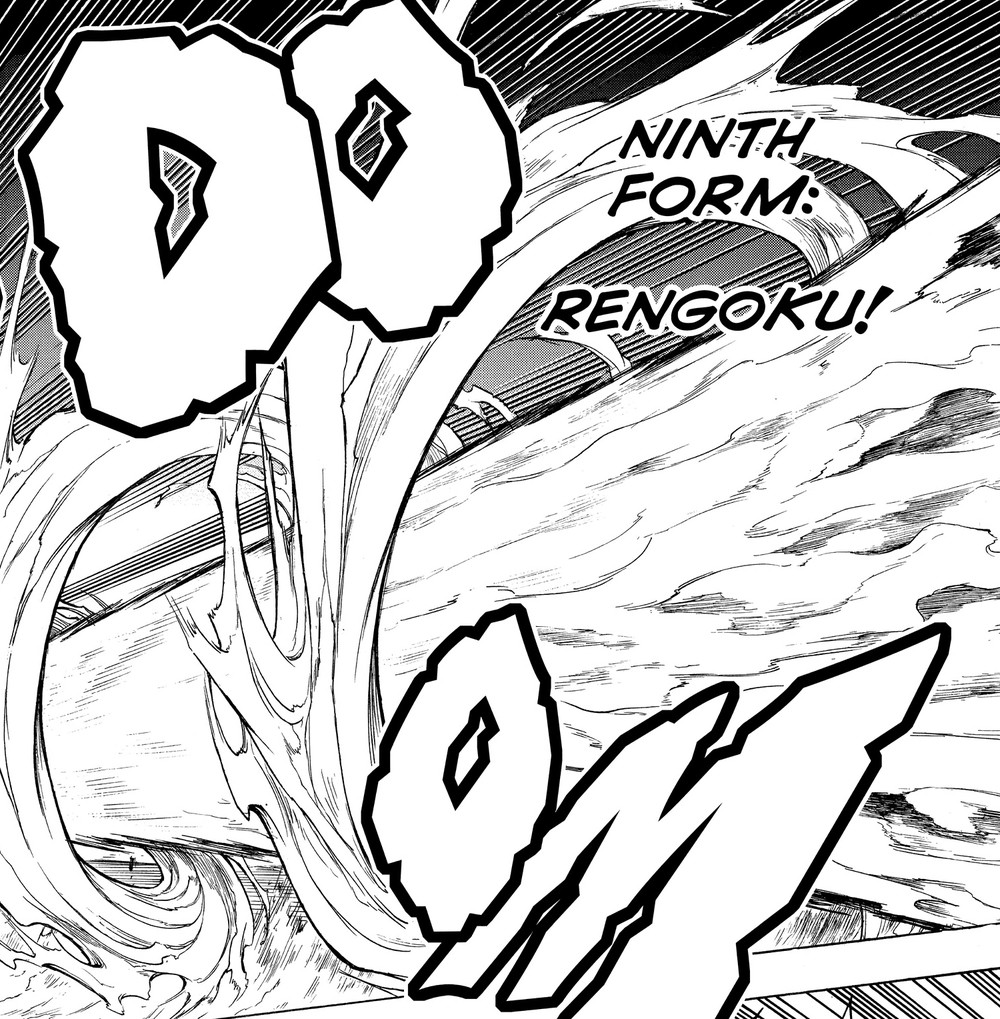
Every other named form in this dictionary can be translated because it describes an action or an image — a tiger, a rising sun, a fire nobody recognizes. Form Nine cannot be, because its "meaning" and its "identity as a family name" are the exact same two kanji doing two jobs at once. VIZ has only two real options for a pun built this way, and neither is free. Translate the meaning (something like "NINTH FORM: PURGATORY!") and the reader loses the fact that Rengoku's ultimate attack is, quite literally, named after himself. Keep the proper noun ("RENGOKU!") and the reader loses the fact that it is also a real word for a fire that purifies the soul before judgment. VIZ chose the name — almost certainly the right call in a manga where his surname has already been printed hundreds of times by page 56 of Volume 8 — but it does mean English-only readers permanently lose the theological pun sitting under the furigana れんごく hovering over 煉獄 in the original bubble.
奥義 (ougi), meanwhile, is doing real categorical work of its own. The panel explicitly announces "ESOTERIC ART!" one beat before the technique name itself, distinguishing this climactic move from Rengoku's numbered forms one through eight. 奥義 literally means something closer to "deep meaning" or "inner principle," the term traditionally reserved in Japanese martial-arts fiction for a school's single most guarded, most advanced technique — the one taught last, if it's taught at all. Every other numbered Flame Breathing form in this corpus is introduced as an ordinary 型 (kata); only this one is billed as 奥義, marking it as categorically different from the eight forms beneath it, not merely numerically after them.
The "purgatory" reading is also doing real narrative work, not just wordplay. Purgatory, in the doctrine the word translates, is a temporary refining fire a soul passes through before final judgment — and the kanji 煉 specifically means to temper or refine by fire, not merely to burn indiscriminately. Rengoku's own arc reads as a version of that idea even before this line is ever spoken: a Hashira who spends the entire Mugen Train fight explicitly arguing, to Akaza a few pages earlier, that aging and dying are what give a human life its "nobility." His family name has effectively always meant "the fire that purifies"; his last technique fires that meaning at the reader once, directly, using his own name as the delivery mechanism.
The corpus's automatic OCR pass renders 「玖ノ型・煉獄」as the garbled fragment "型・煉獄ユーザー" — visual confirmation on the page shows the correct text — one more instance of the same jagged, technique-lettering-defeats-OCR problem documented elsewhere in this dictionary (see the Beast Breathing entries), where the display font reserved for named attacks consistently breaks automated character recognition no matter which breathing style or artist's lettering is involved.