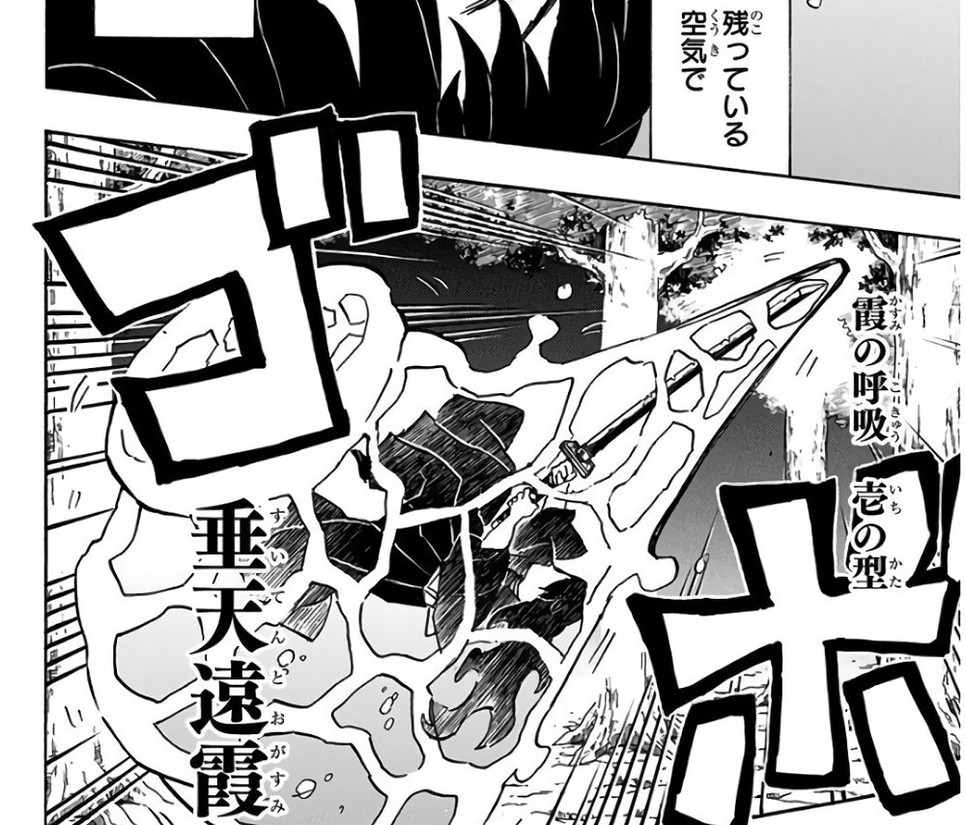
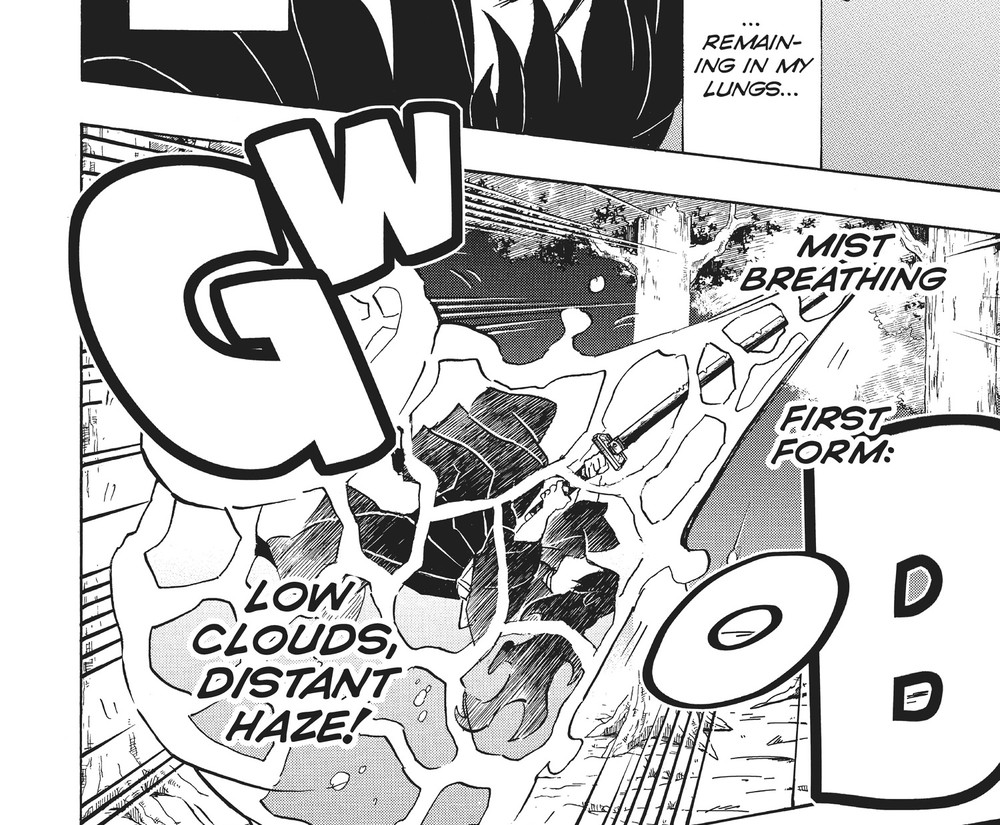
垂天遠霞 is the only Mist Breathing form the corpus shows Muichiro naming while genuinely on the back foot — not showcasing technique, but buying one more second of air. That context matters for how VIZ handles the line: "LOW CLOUDS, DISTANT HAZE!" is a plain, image-first translation with no verb at all, mirroring how the Japanese itself is just two noun phrases stacked together (a low sky; a far haze) rather than a description of an action. Water Breathing's Form One (水面斬り, "Water Surface Slash") names what the blade does; Mist Breathing's Form One names what the air looks like. That's the tell for the whole style: Mist Breathing forms are titled as weather-observations, not sword mechanics, and Suiten Ōgasumi sets that precedent from position one.
The kanji do real work that a reader skimming past the katakana might miss. 垂天 isn't ordinary Japanese for "low clouds" — it's a two-character lift from the Zhuangzi's opening image of a Peng-bird whose wings, spreading, are described as clouds that "hang from the sky" (垂天之雲). Attaching that classical-Chinese grandeur to a beginner's-anxiety first form is a small, deliberate irony: the name promises the scale of a mythic cloudbank; the panel shows a fourteen-year-old running on fumes. VIZ's rendering doesn't carry that literary echo — there's no equivalent English idiom that would fit a shout in a fight scene — so the allusion only survives for readers checking the raw kanji, which is exactly the kind of gap this dictionary exists to flag.
The corpus OCR on this page is badly garbled (the bilingual-pairs extraction misreads most of 垂天遠霞's bubble as unrelated characters), which is worth noting as a caution for anyone building on this data: the raw quote on file is not legible Japanese, but the manga page image itself is unambiguous — 霞の呼吸 壱の型 垂天遠霞, confirmed by direct visual check against both the Japanese and VIZ English tankōbon pages.