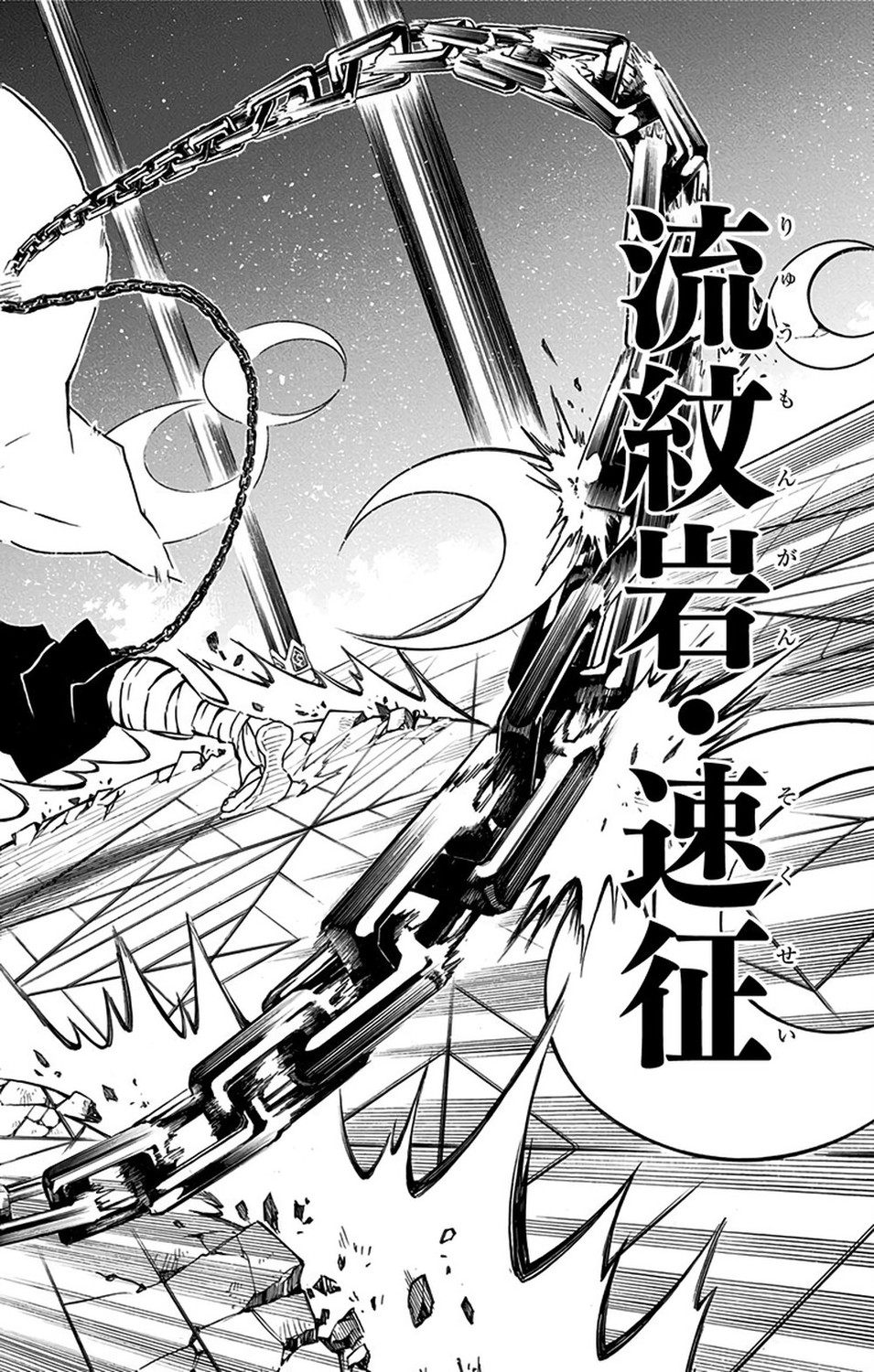
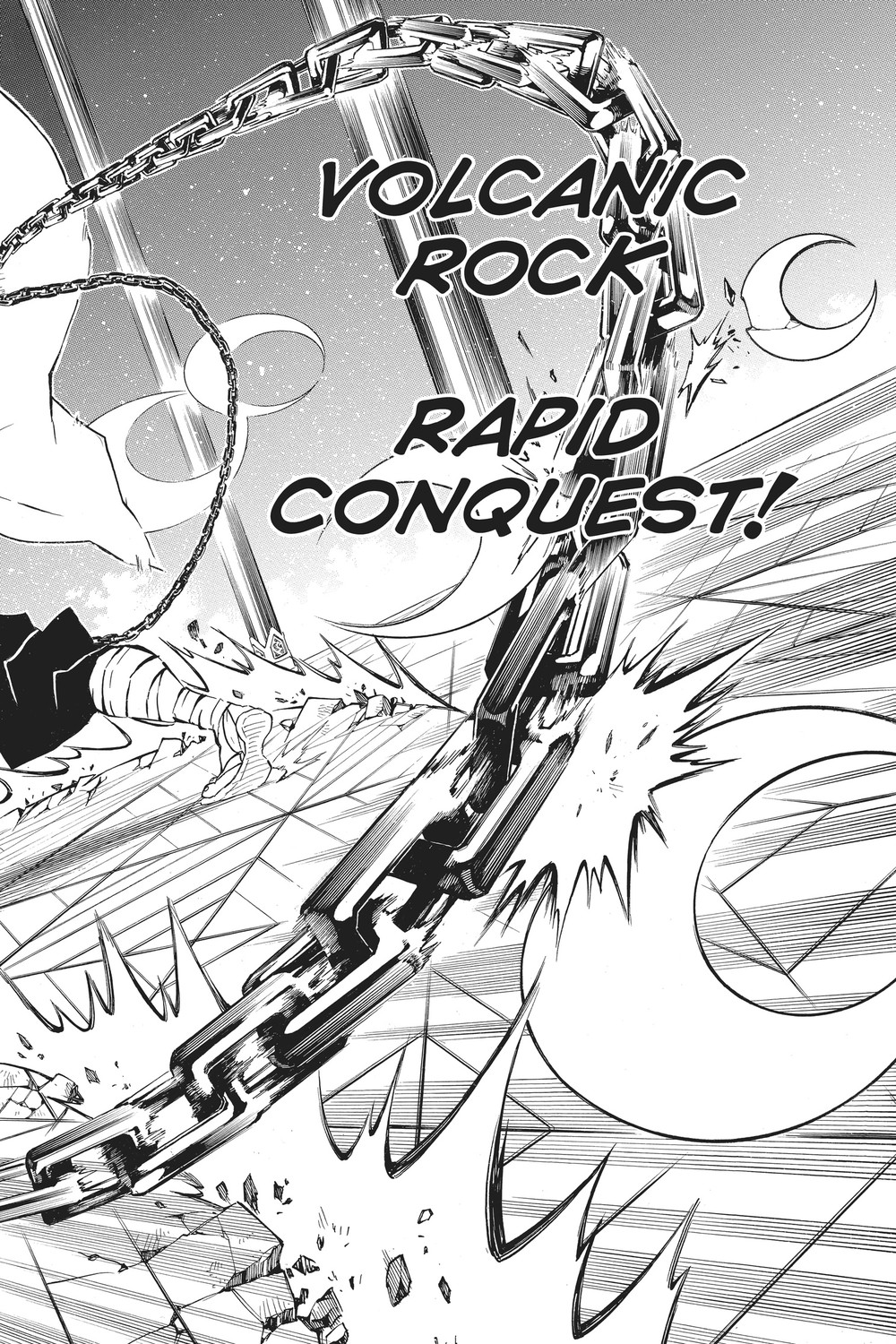
Like Form One's serpentinite, this technique is named after a real rock type defined by its visual texture — rhyolite's banded, flow-frozen pattern, the record of lava that was moving when it solidified. Naming a chain-weapon strike after a rock whose defining feature is captured motion is a neat piece of internal logic: the mineral itself is a geological record of speed, which is exactly what 速征 ("rapid conquest") names in the attack. VIZ's choice to generalize 流紋岩 to "volcanic rock" sacrifices that specific echo for broader accessibility — most English readers know "volcanic rock" as a category where "rhyolite" would need a footnote.
征, the second half of 速征, is a notably martial character — it's the same root as 遠征 (expedition/campaign) and appears throughout Japanese military vocabulary for an army marching out to conquer. That gives the technique a more aggressive charge than "conquest" alone suggests in English: less "defeat" and more "campaign," the sense of Gyomei's chain driving forward like an advancing army rather than a single strike.
This is also the one reference in this dictionary where the underlying corpus record needs an explicit caveat: the automated alignment engine's stored English for the first half of the name (pairs[0] on Vol. 19 p.187) reads "UPPER CONQUEST" — but the real VIZ page, confirmed visually on the two-page spread at Vol. 19 pp.187–188, actually letters "VOLCANIC ROCK" there, with "RAPID CONQUEST!" following. "UPPER CONQUEST" does not appear anywhere on the real page; it looks like bleed-through from the alignment engine matching the wrong nearby bubble inside this volume's known pagination-offset stretch. This entry's display fields use the visually confirmed real text; the raw corpus citation is preserved byte-for-byte in the references below for audit purposes, with the mismatch flagged rather than silently corrected.