Gaara is the Sand Village's one-tailed jinchūriki turned Kazekage, and his Japanese carries the clearest before/after split of any Naruto character. Pre-reform Gaara speaks in オレ (*ore*) stripped of all warmth — flat declaratives about existing only to kill, no particles softening a single line. Post-reform Gaara keeps the same オレ, but the sentences it now serves are about protection and love. The pronoun never changes; what it's used to say does. This page collects eight of his most-quoted lines — his existential monologue at the Chūnin exams, his silent collapse after losing to Naruto, and his vow to a fellow Kage — each checked against the original tankōbon page and its official VIZ English.
Gaara's quotes — Japanese vs official English
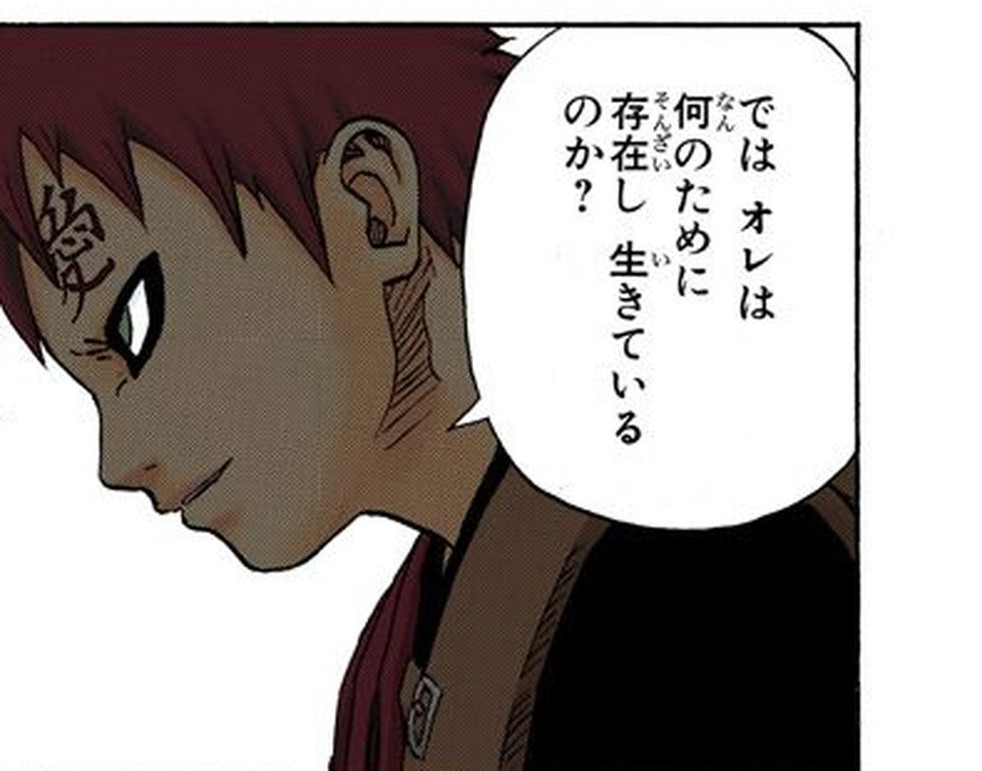
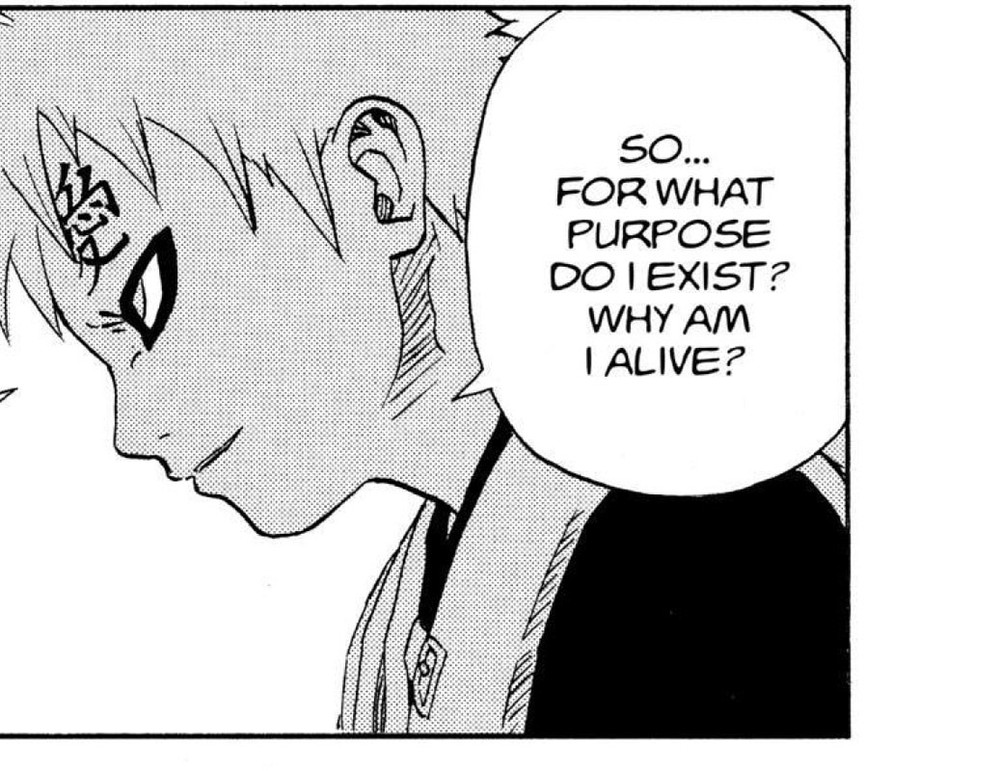
ではオレは何のために存在し生きているのか?
Dewa ore wa nan no tame ni sonzai shi ikite iru no ka?
“SO... FOR WHAT PURPOSE DO I EXIST? WHY AM I ALIVE?”
Literally: So, for what purpose do I exist and live?
Vol. 11, p.140 — asking Naruto and Shikamaru, unprompted, before answering his own question in the next breath
「オレはオレ以外全ての人間を殺すために存在している」
"Ore wa ore igai subete no ningen o korosu tame ni sonzai shite iru."
“I EXIST TO KILL ALL HUMANS OTHER THAN MYSELF.”
Literally: "I exist in order to kill all humans besides myself."
Vol. 11, p.141 — quoting his own settled conclusion back to himself, delivered flatly, with no hedge
オレの存在は消えない
Ore no sonzai wa kienai.
“...THEN I WILL NOT CEASE TO EXIST.”
Literally: My existence won't disappear.
Vol. 11, p.142 — the conclusion of his existential monologue — as long as there are people to kill, he continues to exist
お前はオレと同じ目をしている...!!
Omae wa ore to onaji me o shite iru...!!
“YOU'VE GOT EYES JUST LIKE MINE...”
Literally: You have the same eyes as me...!!
Vol. 14, p.154 — sizing up Naruto for the first time, recognizing a fellow jinchūriki by expression alone
一人ぼっちのあの地獄から救ってくれた...オレの存在を認めてくれた大切な皆だから...
Hitoribotchi no ano jigoku kara sukutte kureta... Ore no sonzai o mitomete kureta taisetsu na mina dakara...
“THEY SAVED ME FROM MY PIT OF LONELINESS... AND THEY UNDERSTAND ME...I COULDN'T LIVE WITHOUT THEM... I LOVE THEM.”
Literally: They saved me from that hell of being all alone... because they're the precious everyone who acknowledged my existence...
Vol. 16, p.64 — lying defeated in the dirt after his fight with Naruto, thinking rather than speaking
...自分の身近ににいる大切な人に尽くしてあげたいと慈しみ見守る心...愛情....
...Jibun no mijika ni iru taisetsu na hito ni tsukushite agetai to itsukushimi mimamoru kokoro... aijō....
“...THE FEELING THAT MAKES YOU WANT TO STRIVE FOR AND PROTECT THOSE AROUND YOU WHO ARE PRECIOUS TO YOU... ...LOVE....”
Literally: ...the heart that wants to devote itself to and watch over, with tenderness, the precious people close to you... love....
Vol. 16, p.64 — still lying in the dirt, arriving at last at the meaning of the kanji carved on his own forehead
...皆...チョバア様に祈りを
...Mina... Chobā-sama ni inori o.
“...EVERYONE. PRAY FOR GRANNY CHIYO.”
Literally: ...Everyone... prayers for Granny Chiyo.
Vol. 31, p.181 — addressing the assembled Sand villagers as Kazekage, after Chiyo's death
風影としてオレは命がけでお前を守る
Kazekage to shite ore wa inochigake de omae o mamoru.
“...AS KAGEKAGE, I WILL PROTECT YOU AT ALL COSTS.”
Literally: As Kazekage, I will protect you at the risk of my life.
Vol. 51, p.20 — vowing to Naruto at the Five Kage Summit, still using オレ despite the formal Kage role
All lines are byte-exact captures from a bilingual corpus of the Japanese tankōbon and the official VIZ Media edition.
オレ before and after: a pronoun that doesn't move, so the words around it have to
Where Naruto's オレ warms up over seventy volumes and Itachi's 私 curdles into something colder, Gaara's オレ is a constant — he never once reaches for the harder 俺 or the distanced 私, not as a genocidal chūnin candidate and not as a sitting Kazekage speaking to a rival village's jinchūriki. What changes is the predicate. Young Gaara's オレ governs sentences like 「オレはオレ以外全ての人間を殺すために存在している」 ("I EXIST TO KILL ALL HUMANS OTHER THAN MYSELF") — a clause with no politeness marker, no hedge, nothing but a subject and a verb of killing. Adult Gaara's オレ governs 「風影としてオレは命がけでお前を守る」 ("...AS KAGEKAGE, I WILL PROTECT YOU AT ALL COSTS") to Naruto at the Kage Summit — same pronoun, same blunt register, but 守る ("protect") has replaced 殺す ("kill") as the verb it reaches for. VIZ's "I" can't mark either the constancy or the shift; only the Japanese verb choice tracks the character's entire arc.
The existential monologue and the philosophy fans misquote
Gaara's single most-excerpted scene, delivered to Naruto and Shikamaru mid-Chūnin-exam, is worth reading in full because English pull-quotes usually clip it: 「では,オレは何のために存在し,生きているのか?」 ("SO... FOR WHAT PURPOSE DO I EXIST? WHY AM I ALIVE?") isn't rhetorical — it's the setup to an answer he already has. 「そしてオレはこう結論した:『オレはオレ以外全ての人間を殺すために存在している』」 ("AND SO I CAME TO THIS CONCLUSION: I EXIST TO KILL ALL HUMANS OTHER THAN MYSELF") is delivered with the calm of settled math, not rage — the same flat オレ register that will later carry his kindest lines. The forehead kanji 愛 ("love"), carved there by his own hand as a child, sits directly behind this speech in nearly every panel: the word he wears on his face and the philosophy coming out of his mouth are, at this point in the story, opposites.
Silence, then a single word: the turning point has almost no dialogue
After Naruto defeats him, Gaara's collapse scene — lying in the dirt, thought-bubbles instead of speech — runs almost entirely on sentence fragments: 「一人ぼっちのあの地獄から救ってくれた...」 ("THEY SAVED ME FROM MY PIT OF LONELINESS..."), 「オレの存在を認めてくれた」 ("AND THEY UNDERSTAND ME..."), 「大切な皆だから...」 ("I LOVE THEM."). Three short clauses, each trailing into an ellipsis, is a register Gaara has never used before this point — his sentences, pre-defeat, were complete and certain. Then, staring at his own reflected eye, he arrives at a single word standing alone in its own speech bubble: 「愛情....」 ("...LOVE...."), four full-width dots after it, the same 愛 that's tattooed on his forehead finally understood rather than just worn. It's the shortest line on this page and the one the whole arc turns on. For the boy on the other end of that fight, see the companion page: Naruto Uzumaki's quotes. A separate line from his Kazekage years, where someone calls him 腰抜け ("spineless") to his face, gets the full byte-level translation breakdown in 腰抜け and the spine English grows in its place.