The Moment
The Forest of Death, the Chunin Exam's second stage. Three genin — Kiba, Hinata, Shino — have taken cover in the undergrowth, watching the Sand siblings from a distance. It doesn't work. A silent panel shows all three flinching in unison, the sound effect doing the talking: シュドラー — "SHUDDER." Temari, on edge, wants to move on: 「もう止めよう...我愛羅」 — "COME ON, GAARA... LET'S GO." Kankuro is already spooked: 「ヤ...ヤバイ気付かれたか!?」 — "AW, MAN! DOES HE KNOW WE'RE HERE?!"
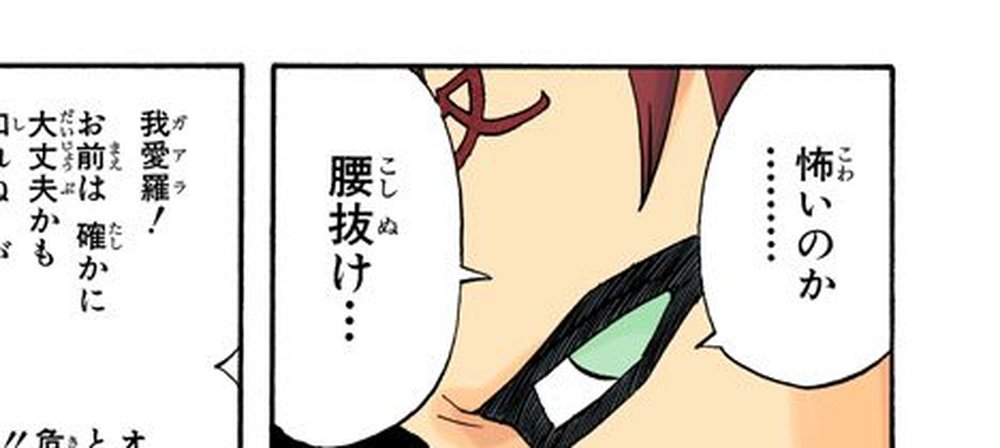
Gaara doesn't turn around. The panel narrows to a single close-up: one eye, the edge of the tattoo on his forehead, nothing else. He speaks without needing to look at what he's speaking to.
「怖いのか...腰抜け...」
Kowai no ka… Koshinuke…
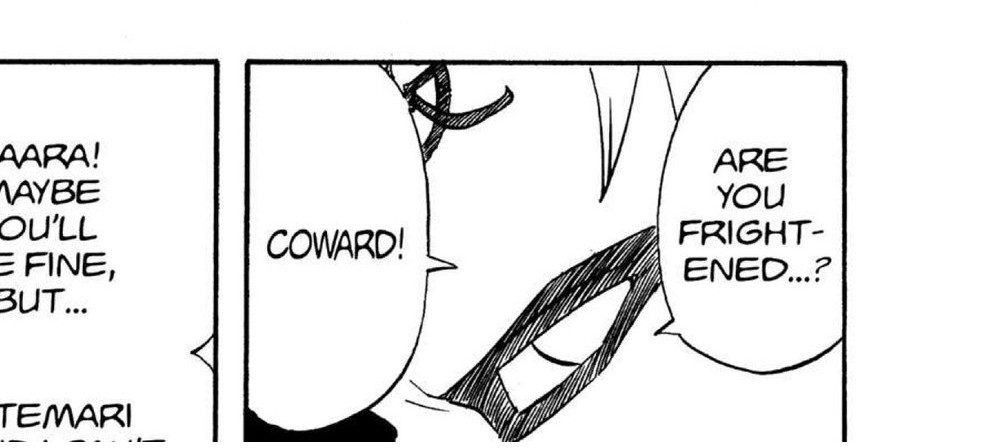
VIZ's English edition prints: "ARE YOU FRIGHTENED...?" / "COWARD!" (Vol. 7, p.99).
Grant the rendering its due — it's a good split. Two short bubbles, a question and a verdict, land with exactly the chill the panel wants, and "COWARD" is not wrong: it is, in fact, the dictionary gloss any Japanese-English dictionary will hand you for 腰抜け. But the dictionary gloss is also where the word's whole design disappears. 腰抜け isn't an abstract character judgment the way "coward" is. It's an anatomical diagnosis — Gaara isn't calling Team 8 cowards in the way an English speaker means the word. He's telling them, with total specificity, which joint has already failed.
The Original
腰抜け takes apart cleanly, and each half is worth its own look.
腰 (koshi) is "hips, lower back" — not a niche body part in Japanese but the pivot of the entire physical-culture vocabulary. Martial arts, dance, even posture-correction all run through 腰: 腰を入れる ("put your hips into it," commit your full weight to a stance or a swing), 腰高 ("hips riding high," a beginner's unstable stance in judo or kendo), 腰の入った (a strike or a stance with real weight behind it). If Japanese has a physical seat of readiness, it's here, not the chest.
抜け is the noun form of 抜ける (nukeru), "to slip out, fall away, come loose, go missing" — the verb behind 気が抜ける ("the tension slips out": to let one's guard down or lose focus) and 力が抜ける ("the strength slips out": to go limp, to lose the ability to hold yourself up). It is not a violent verb. Nothing is torn or broken; something that was properly seated simply stops being seated.
Put them together and 腰抜け names a very specific failure: the hips have slipped their mount. This is the fossilized noun-form of a verb phrase, 腰を抜かす (koshi o nukasu), "to lose the use of one's hips" — the everyday idiom for the full-body collapse of shock or terror, the instant your legs simply stop being legs and you sit down on the ground whether you meant to or not. It happens to old men who see ghosts and grandmothers who win the lottery — it is not gendered, not always fear-specific, just: system failure, lower body. 腰抜け takes that one-time event and freezes it into a permanent character trait: a person whose hips are presumed unreliable at all times. Not "a coward" in the abstract. Someone whose hips have already given out once, and everyone assumes they will again.
VIZ's Choice
Every occurrence of 腰抜け in the volumes on file, speaker included:
| Vol. / p. | Speaker | Japanese | VIZ English |
|---|---|---|---|
| 6 / 56 | Naruto, to a fear-frozen Sasuke | こんなバカで腰抜けヤローは...ぜってーオレの知ってるサスケじゃねー!! | AND YOU'RE THE IDIOT, IDIOT!... YOU'RE A COWARD. WHICH SASUKE ISN'T. SO YOU'RE NOT HIM!!! |
| 6 / 72 | Sasuke, replaying Naruto's words mid-rampage | (same line, recalled as flashback) | (same lines, recalled as flashback) |
| 6 / 117 | Shino, to a rival team hunting for scrolls | お前達みたいな腰抜けから巻物を奪っても... | I WOULDN'T DEMEAN MYSELF BY TAKING A SCROLL FROM LOSERS LIKE YOU. |
| 7 / 99 | Gaara, to the hidden Team 8 | 腰抜け... | COWARD! |
| 26 / 182 | Shikamaru, to a comrade ready to quit | てめーはただの腰抜けだ | YOU'RE JUST A COWARD. |
| 26 / 184 | Shikamaru, still not done | この腰抜けが! | MILKSOP? |
Six hits, and the scatter is immediate: "coward" twice, "losers" once, and — on p.184 — the genuinely startling "MILKSOP?", an archaic English word (bread soaked in milk; a weak, unmanly softie) that VIZ reaches for instead of repeating itself. It's a good word. It's also nobody's second guess for what a translator would pick, which is exactly the point: faced with the same Japanese noun for the third time in one scene, English goes hunting for variety rather than repetition, and the reader loses the one signal Japanese was sending on purpose — this is the same insult, again.
The Vol. 6 row deserves a closer look, because it's the corpus catching a translator in the act of solving a problem. Naruto's original two Japanese bubbles run こんなバカで腰抜けヤローは (bubble one) and ぜってーオレの知ってるサスケじゃねー!! (bubble two) — "such a stupid, koshinuke bastard... is definitely not the Sasuke I know!!" VIZ's English splits differently: bubble one becomes "AND YOU'RE THE IDIOT, IDIOT!" — doubling バカ into "idiot, idiot" and dropping 腰抜け entirely — while bubble two absorbs the missing word: "YOU'RE A COWARD. WHICH SASUKE ISN'T. SO YOU'RE NOT HIM!!!" The insult didn't vanish; it got relocated one bubble over, restructured into its own declarative sentence because English's "coward" needed room the compressed first line didn't have. It's a small, telling admission: this particular Japanese noun doesn't fit for free next to another insult in the same breath. English needs a whole extra clause to carry what Japanese does in one compound word.
The Gap
English isn't bodyless here — it's differently bodied, and the translator declines the match anyway. "COWARD" is an abstract Latinate noun with no anatomy left in it at all. But English has body-based cowardice vocabulary sitting one shelf over — "spineless," "gutless," "no backbone" — any of which would have kept a physical collapse in the sentence, just relocated to a different organ. Choosing the abstraction over the available body-word, six times running, is the real translation decision here, not an unavoidable gap.
The scatter erases the recurring insult. Five speakers across four volumes — Naruto, Shino, Gaara, Shikamaru twice — throw the identical two-morpheme noun, and English answers with four different strings. A Japanese reader clocks 腰抜け every time as the same word, returning like a drumbeat through the Chunin Exam and beyond. An English reader gets "coward," "losers," "coward" again, and "milksop," and has no way to notice the manga keeps reaching for one specific insult.
"Milksop" solves for freshness, not fidelity. Facing a third occurrence in one scene, VIZ's instinct is to vary the English rather than repeat it — which is good editorial craft in isolation, and exactly backwards for what the Japanese text is doing. Repetition was the point. Shikamaru calling someone 腰抜け twice in three pages is a character bearing down on the same accusation; "coward" then "milksop" reads, in English, like two different insults from two different tempers.
The hips only survive as a bubble-boundary workaround, not a translation. Vol. 6's restructuring — moving "coward" into its own sentence because it wouldn't fit compressed next to "idiot" — proves the noun is doing real, non-negotiable work. But that workaround preserves the word "coward," not the hips. English solved a space problem, not an anatomy problem.
What If
For Gaara's line — a single word, trailing into silence — the menu and its cost:
- "SPINELESS..." — swaps hips for spine, English's own default courage-bone, so the insult keeps a body part instead of losing one. Cost: "spine" suggests failed posture or resolve, not the specific hips-buckling collapse Gaara is diagnosing in three hidden genin.
- "GUTLESS..." — belly-based, closer kin to Japanese's own 肝/腹 courage-vocabulary than the fully abstract "coward." Cost: "guts" implies missing willpower more than a joint physically giving out from fear.
- "YOUR LEGS WON'T EVEN HOLD YOU..." — closest to the literal event behind the word, 腰を抜かす. Cost: far too long for a bark trailing into silence; the fossilized-noun punch disappears into a full sentence.
- Keep "COWARD," but keep it everywhere — never let it drift into "losers" or "milksop" — Cost: doesn't restore the body, but it restores the one thing the current scatter erases: the fact that this is the same word, said again.
Take-away
腰抜け is easy vocabulary hiding a real fault line between the languages: Japanese locates failed nerve in a joint — the hips — while English locates the identical failure in a completely different set of organs, and never once in the hips. A translator reaching for "coward" isn't wrong about the meaning; they're just standing somewhere else on the body.
Three rules of thumb to carry off this page:
- When a Japanese insult names a body part, ask which organ English uses for the same job — then notice they're never the same one. Japanese keeps courage in the hips and belly (腰, 肝, 腹); English keeps it in the spine, the gut, and the liver. Different anatomy, same emotional job.
- 抜ける is a slipping-loose verb, not a breaking one. 気が抜ける, 力が抜ける, 腰が抜ける — nothing tears; something that was seated simply comes unseated. That gentler mechanism is worth keeping distinct from English's more violent "snap" and "break" vocabulary for the same feelings.
- When one Japanese word recurs across a scene or a cast, treat the recurrence as the message. A translator who varies the English for freshness — "coward," then "milksop" — is solving a different problem than the one the author posed.
This is the Naruto branch of a body-idiom family that runs through the whole hub: Sakura's 足手まとい ties failure to the hands and feet, Rock Lee's 歯が立たない puts it in the teeth, and Jiraiya's 手に負えない puts it in the hands. Demon Slayer runs the identical hip-joint idiom on the other side of the same body-map, in the sister expression 肝が据わる・腰を抜かす, where a mother's famously steady liver gives way to lost hips in a single sentence — courage and collapse measured on the same anatomical scale this article's word comes from. For more of what Naruto's translators quietly relocate, browse the full Naruto translation notes index.
Every Japanese and English line quoted above is a byte-exact capture from the cited editions — NARUTO―ナルト― Vol. 6, 7 & 26 (Japanese) and Naruto (VIZ Media) at the corresponding panels — via our bilingual page database; see Sources below.