Shanks — "Red-Haired" Shanks — is the pirate captain who spent a year drinking in a backwater harbor town and, without meaning to, raised the boy who'd become the Pirate King. He appears for barely fifty pages in Volume 1, but every one of Luffy's grammatical habits — the plain おれ, the bare だ, the imperative dressed up as a promise — is Shanks' voice first. His own Japanese runs warm and dismissive at the same time: teasing, unhurried, never once raising its register for anyone, villager or bandit. This page collects eight signature lines from that single volume — the promise made over a straw hat, the understatement over a lost arm, and the two words that stop a sea monster cold — verified against the Japanese tankōbon and paired with VIZ's official English.
Shanks's quotes — Japanese vs official English
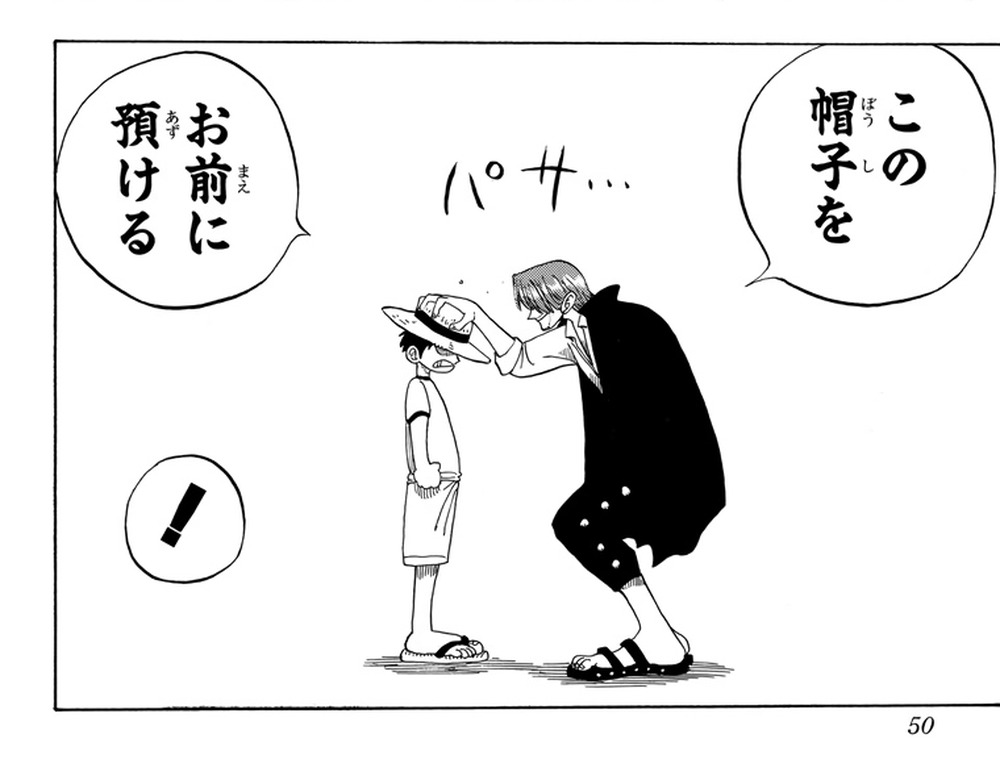
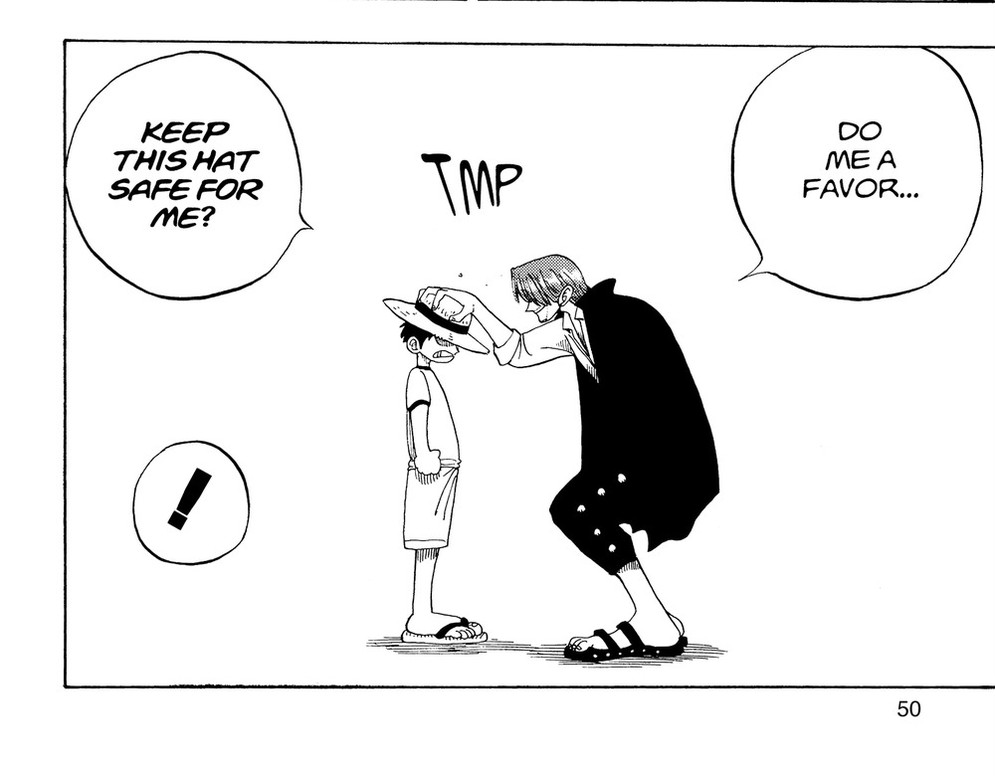
この帽子を...お前に預ける
Kono bōshi o... omae ni azukeru
“DO ME A FAVOR... KEEP THIS HAT SAFE FOR ME?”
Literally: This hat... I'm leaving it in your keeping — 預ける (azukeru) is "entrust," not "give": the promise to reclaim it is built into the verb itself
Vol. 1, p.50 — Placing his own straw hat on young Luffy's head as his crew prepares to leave the village for good
おれの大切な帽子だ
Ore no taisetsu na bōshi da
“THIS HAT MEANS A LOT TO ME.”
Literally: It's my precious hat — plain だ, no hedge, stating its worth as settled fact
Vol. 1, p.51 — Continuing the same moment, telling Luffy exactly what he's now responsible for
いつかきっと返しに来い 立派な海賊になってな
Itsuka kitto kaeshi ni koi, rippa na kaizoku ni natte na
“PROMISE THAT YOU'LL GIVE IT BACK TO ME SOMEDAY... ...WHEN YOU'VE BECOME A GREAT PIRATE.”
Literally: Someday, without fail, come return it to me — having become a splendid pirate. 来い is the bare command form of "come," a promise phrased as an order
Vol. 1, p.51 — The condition attached to the hat: not a gift, a challenge with a return date
安いもんだ...腕の一本くらい...無事でよかった
Yasui mon da... ude no ippon kurai... buji de yokatta
“IT'S A SMALL PRICE TO PAY... JUST AN ARM... I'M JUST GLAD YOU'RE OKAY.”
Literally: It's a cheap thing... about one arm... glad you're safe — もん (mono) contracted casual, the same understatement register you'd use about a scraped fender
Vol. 1, p.48 — Dismissing the loss of his own arm to the Lord of the Coast, moments after saving Luffy's life
失せろ
Usero
“GET OUT OF HERE!”
Literally: Scram / vanish — the bare imperative of 失せる, no pronoun, no object, two morae total: the shortest sentence he speaks in the entire volume
Vol. 1, p.46 — Facing down the sea monster that nearly killed Luffy, his crew and the village behind him — the one moment his joking baseline fully drops
おれは友達を傷つける奴は許さない!!!
Ore wa tomodachi o kizutsukeru yatsu wa yurusanai!!!
“NOBODY HURTS A FRIEND OF MINE!!!!”
Literally: I don't forgive anyone who hurts a friend!!! — his one raised-voice declaration in the volume, aimed at the mountain bandits threatening the village
Vol. 1, p.37 — Standing between Higuma's bandit crew and the villagers who'd just been threatened for his sake
せめてあと10歳年とったら考えてやるよ
Semete ato jussai toshi tottara kangaete yaru yo
“MAYBE IN 10 YEARS I'LL GIVE YOU A CHANCE.”
Literally: At the very least, once you've aged another ten years, I'll consider it — a dismissal that quietly marks the exact future age he'd say yes
Vol. 1, p.13 — Turning down young Luffy's request to join the crew, at the tavern counter
そりゃいい事だな!勝手にがんばれ
Sorya ii koto da na! Katte ni ganbare
“THAT'S GOOD KID... DO WHATEVER YOU WANT.”
Literally: That's a good thing! Do your own thing as you please — brusque encouragement dressed as indifference
Vol. 1, p.16 — Responding to Luffy's vow to practice swimming before the crew's next departure
ああ...なんせおれのガキの頃にそっくりだ
Aa... nanse ore no gaki no koro ni sokkuri da
“YEAH... HE ACTS JUST LIKE I DID WHEN I WAS A KID.”
Literally: Yeah... after all, he's the spitting image of me as a kid — the only line in the volume where Shanks talks about his own past
Vol. 1, p.51 — Watching Luffy's boat recede from the departing ship, agreeing with Benn Beckman that the boy will amount to something
All lines are byte-exact captures from a bilingual corpus of the Japanese tankōbon and the official VIZ Media edition.
Shanks' baseline is flat, democratic おれ-speech — the same plain pronoun and bare だ/ぜ endings he uses on a terrified village boy, a captured bandit, and his own first mate, with no register shift for any of them. That's easy to miss because Luffy inherits the exact same grammar wholesale two hundred pages later and readers meet the student before they clock the teacher; Volume 1 is really the only place in the corpus where you can hear the source. When young Luffy calls him「このケチシャンクスめ!!」— "you cheapskate Shanks!" — the diminutive め tacked onto his own captain's name is an insult a crewman would never risk, and Shanks' answering grin instead of a rebuke tells you everything about how little rank matters at that bar counter.
The hat scene turns on one verb most translations blur past. Shanks doesn't say くれてやる or あげる, the ordinary verbs for "give" — he says 「この帽子を...お前に預ける」, kono bōshi o... omae ni azukeru, "I'm leaving this hat in your keeping." 預ける is the verb for a coat check, a bank deposit, a child dropped at daycare — something entrusted, not surrendered, with the entruster's return built into the word itself. VIZ's "keep this hat safe for me" gets the sense exactly right through context, but the promise is smuggled inside the verb in Japanese in a way no single English verb carries on its own. He follows it with an order, not a request: 「いつかきっと返しに来い」— "someday, definitely, come return it" — 来い is the bare imperative of 来る, the same grammatical mood Luffy will spend the whole series aiming at friends instead of enemies (see how that same imperative-as-affection shows up when Luffy orders Coby to give up rather than asks him to). A promise phrased as a command is Shanks' native dialect, and it's the dialect his protégé grows up speaking.
The missing-arm scene runs the opposite direction: maximum event, minimum grammar. 「安いもんだ...腕の一本くらい...無事でよかった」— literally "it's a cheap thing... about one arm... glad you're safe," もん a casual contraction of もの that any adult would use about a scraped fender, never about a severed limb. VIZ's "IT'S A SMALL PRICE TO PAY" is a fair, readable line, but it adds an explicit price/payment frame — a transaction being weighed — that the Japanese doesn't state; 安いもんだ just declares the matter cheap and closes the subject, no scale, no ledger, the same stoic understatement Japanese reaches for whenever a speaker wants a wound to sound smaller than it is. Two pages earlier, Shanks' whole crew answers a monster's approach with real panic; Shanks himself never raises his voice once in the entire scene.
Which makes the one time he does raise it the loudest silence on the page. Facing down the Lord of the Coast with his crew and Luffy behind him, Shanks says exactly one word: 「失せろ」— usero, the bare imperative of 失せる, "get lost, vanish, scram." No pronoun, no object, no politeness marker, two morae total — the shortest sentence he speaks anywhere in the volume, and by far the most frightening one; the panel is nothing but his face. VIZ's "GET OUT OF HERE!" is accurate and still can't shrink an English sentence down to a single flat command the way Japanese can drop everything but the verb. Compare that economy to the one line where Shanks does raise his voice in words rather than presence — 「おれは友達を傷つける奴は許さない!!!」, "I don't forgive anyone who hurts a friend!!!", flung at the same bandit crew a few pages earlier — and the range of his register becomes the whole character: motormouth generosity right up until the instant it isn't, and then almost nothing at all.
Everywhere else, the teasing does the work that a declaration of affection would do in a less embarrassed language. 「せめてあと10歳年とったら考えてやるよ」— "give it ten more years and I'll think about it" — and 「そりゃいい事だな!勝手にがんばれ」— "that's good, kid — go on and do your own thing" — are both dismissals on their surface and small, deliberate promises underneath: a captain telling a child no while quietly marking the exact age he'd be old enough to say yes. Ten years later, to the day, Shanks keeps a promise nobody in the text ever heard him make out loud — which is the most Shanks possible way to have made one.