The Moment
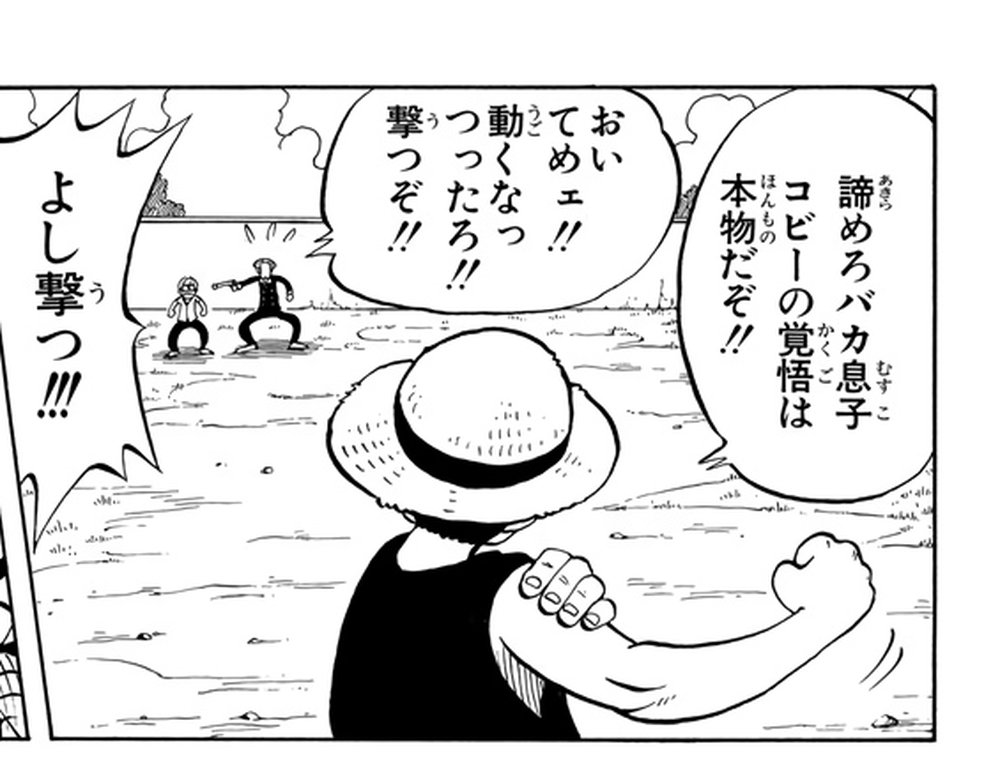
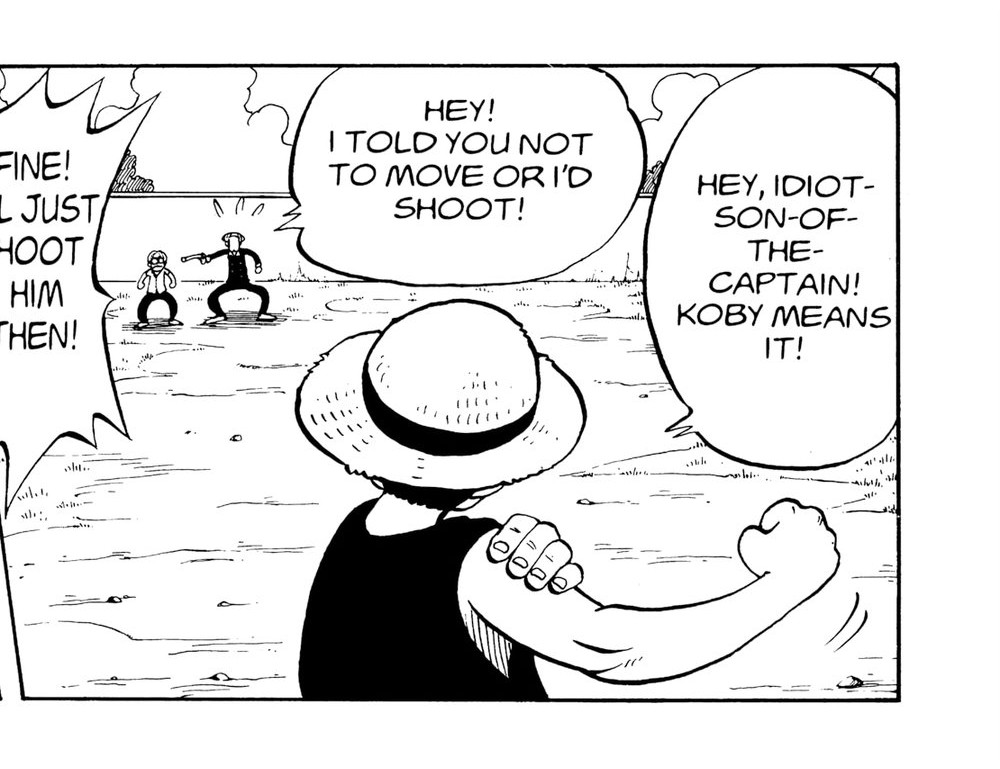
Shells Town, East Blue, the earliest pages of the whole saga. Coby — the timid boy who has spent years serving under the pirate Alvida — has just declared, in front of the tyrannical Marine captain Morgan and Morgan's son Helmeppo, that he intends to become a Marine regardless of what it costs him. Helmeppo, cornered, is threatening to shoot him for it. Luffy plants himself between them, fist already cocked back, and warns:
「諦めろバカ息子コビーの覚悟は本物だぞ!!」
Akiramero baka musuko Kobī no kakugo wa honmono da zo!!
VIZ's English edition prints: "HEY, IDIOT-SON-OF-THE-CAPTAIN! KOBY MEANS IT!" (Vol. 1, p.165).
Grant the rendering its due first. "IDIOT-SON-OF-THE-CAPTAIN," hyphenated into one battle-shout compound, is genuinely good English lettering — it lands with a punch a literal "you foolish son of the captain" never would, and "KOBY MEANS IT!" is tight, forceful, exactly the kind of line a hot-blooded teenager throws mid-punch. This is not a clumsy translation.
But set the two lines side by side and count. The Japanese opens with an actual command — 諦めろ, "give it up" — aimed squarely at Helmeppo's whole scheme of terrorizing Coby. Read the English again: there is no command in it anywhere. "HEY" occupies the slot where 諦めろ used to be. We checked this against the page art on both editions (see the panel crops below) to rule out a corpus alignment error — it is not one. The pairing is correct; VIZ's translator simply cut the verb and kept the insult wrapped around it. Luffy's actual demand — stand down — never reaches the English reader at all.
The Original
諦める is one kanji, 諦, plus the verb ending める — and that single kanji carries two lives at once.
Read tai/tei, 諦 is Buddhist vocabulary, straight out of the sutras. It is the "truth" in 四諦 (したい, shitai) — the Four Noble Truths: 苦諦 (the truth of suffering), 集諦 (the truth of suffering's origin), 滅諦 (the truth of its cessation), 道諦 (the truth of the path that ends it). And it is the 諦 in 諦観 (ていかん, teikan), "to see through to the truth" — the serene, clear-eyed acceptance a practitioner is said to reach once they truly perceive how things are. Not resignation as defeat. Resignation as clarity.
Read as the everyday verb あきらめる, 諦める comes down from an older verb, あきらむ, which is cognate with 明らむ/明らか (akiraka, "clear, obvious") — the very same root that gives you 明日 read as "clear" in some etymologies, and definitely gives you "to make a matter clear, to see a thing plainly for what it is." Put the two halves together and the semantic bridge is short and almost logical: to see the truth of a hopeless situation clearly is, eventually, to stop fighting it. A verb that once meant "to clarify" wore down, over centuries of ordinary use, into a verb that means "to quit." The kanji never changed. Only the half of its meaning that survived into daily conversation did.
Grammatically there is nothing exotic in the headline line: 諦めろ is the bare imperative of the ichidan verb 諦める (stem 諦め + ろ), the same blunt, zero-politeness imperative family as 死ね, 黙れ, and — for readers of our companion piece — 往生しろ. As vocabulary, 諦める itself sits around N4, core textbook material. The Buddhist weight is not in the word's difficulty. It's in what the kanji quietly remembers and the dictionary entry doesn't mention.
VIZ's Choice
諦める and its noun form 諦め turn up roughly 29 times across the volumes we have on file — too many to table in full, so here are six occurrences we verified against the actual page art, chosen to span the word's emotional range from battle threat to quiet grief:
| Vol. / p. | Japanese | VIZ English |
|---|---|---|
| 1 / 165 | 諦めろバカ息子コビーの覚悟は本物だぞ!! | HEY, IDIOT-SON-OF-THE-CAPTAIN! KOBY MEANS IT! |
| 8 / 13 | おれは諦めが悪いんだ | I DON'T GIVE UP SO EASY. |
| 15 / 53 | 諦めろ | RESIGN YOUR- SELF. |
| 23 / 171 | 諦める... | ...LET IT GO... |
| 25 / 50 | "空島”を諦めよう!! | LET'S FORGET SKYPIEA! |
| 35 / 16 | 諦めて新しい船を買って行け | JUST ACCEPT IT, AND BUY A NEW SHIP. |
Six appearances, six different English verbs: dropped outright, "give up," "resign yourself," "let it go," "forget," "accept it." Nothing on the English page tells a reader these all translate one Japanese word.
Look at the outliers, though, because they're the interesting case. In Vol. 15, Zoro — sword drawn, mid-crisis, addressing a panicking Usopp as the ship sails into a whale's mouth — snaps 諦めろ, and VIZ reaches for "RESIGN YOUR-SELF." In Vol. 35, a dockworker trying to talk Luffy into scrapping his crew's aging ship says 諦めて新しい船を買って行け, and VIZ writes "JUST ACCEPT IT, AND BUY A NEW SHIP." Of the six, these two land closest to 諦める's buried "see the truth clearly" sense — "resign" and "accept" both carry a whisper of acknowledging reality rather than merely quitting on it. But nothing suggests the translator was chasing 諦観 or 四諦 to get there; English simply happens to own a small cluster of near-synonyms for "stop fighting it" that differ along exactly this axis, and two of the six rolls landed on the etymologically lucky side. The other four — the dropped command, "give up," "let it go," "forget" — didn't, and there's no way for an English-only reader to tell which of the six is which.
The Gap
The command disappears completely. The headline case isn't a stylistic softening — it's total omission. 諦めろ is a direct order; "HEY" is not. Of all six sampled lines, this is the one where English keeps zero percent of the original verb.
"Give up" erases the seeing. Even where VIZ translates the sense correctly — "I DON'T GIVE UP SO EASY," "LET'S FORGET SKYPIEA" — the English names only the behavior (stopping) and never the perception that, in Japanese, is supposed to license it (seeing clearly that stopping is warranted). "Give up" can describe a coward bailing on a fight he was winning; 諦める, read against its own kanji, can't quite mean that without irony.
The scatter hides the pattern. Twenty-nine occurrences of one Japanese verb become half a dozen unrelated English ones. A reader who notices One Piece keeps circling back to giving up — as threat, as confession, as reluctant wisdom — in Japanese has no way to notice the same thing in English, because the word never looks the same twice.
The accidental hits go uncredited. "RESIGN YOURSELF" and "JUST ACCEPT IT" are, if anything, the two best-aimed renderings in the sample — and nothing marks them as such. They read as ordinary word choice, not as the moments English happened to brush against a Buddhist etymology twenty-six centuries old.
What If
For the headline line, the menu and its prices:
- "GIVE IT UP, YOU IDIOT SON — KOBY MEANS IT!!" — restores the actual command and keeps Luffy shouting an order, not just an insult. Cost: loses VIZ's punchy compound epithet "IDIOT-SON-OF-THE-CAPTAIN," which does real character work of its own.
- "BACK DOWN, IDIOT-SON-OF-THE-CAPTAIN — KOBY MEANS IT!!" — keeps VIZ's epithet intact while giving Luffy something closer to an imperative. Cost: "back down" narrows 諦めろ from "give up your whole scheme" to a simple physical retreat.
- "SEE IT CLEARLY, IDIOT SON — KOBY ISN'T BLUFFING!!" — leans all the way into the buried etymology. Cost: too literary and expository for a fist mid-swing; nobody expects philosophy inside a battle shout, least of all from Luffy.
- Keep VIZ's line exactly as printed, but notice, reading it beside the Japanese, that none of the four syllables of 諦めろ survive. Cost: fixes nothing — useful only as a diagnostic for how total the omission really is.
Every option that keeps the command trades away some of VIZ's punch; every option that keeps the punch trades away the command. That is the whole shape of translating an imperative built on a word this dense: something has to give, every time.
Take-away
諦める looks like the simplest word in this whole series of articles — no four-character compound, no obscure reading, a verb any first-year learner meets early. But its kanji is doing quiet, heavy work: 諦 is "truth," not "surrender," and the word technically names an act of seeing before it names an act of quitting. Twenty-nine times in the corpus we checked, that seeing goes unmentioned in English — most completely in the one place a character actually commands someone to do it.
Three rules of thumb to carry off this page:
- When you meet 諦める, remember the kanji first: 諦 = truth, not defeat. The verb's oldest sense is "to see clearly," and "to give up" is what's left after centuries wore the seeing away.
- Watch 諦めろ's imperative form specifically — as a blunt command it's one of the easiest verbs for a translator to swap for a vaguer epithet, or drop outright, exactly as happened on this page.
- Collect 諦観 and 四諦 as 諦める's high-register Buddhist relatives — they keep the "truth" sense audible that everyday 諦める buries.
For the other side of this same coin — a villain's taunt built from the Buddhist idea of dying badly rather than accepting your end — see the Buddhist death buried in 往生際が悪い, whose own similar-expressions list points back at this very word. For two more places where Buddhist vocabulary hides inside ordinary-looking dialogue, see the karmic tie English splits five ways in 因縁 and the karmic verdict that becomes battle tactics in 自業自得. Or browse the One Piece translation notes index.
Every Japanese and English line quoted above is a byte-exact capture from the cited editions — ONE PIECE Vol. 1–35 (Japanese) and One Piece (VIZ Media) at the corresponding panels — via our bilingual page database; see Sources below.