The word he actually says
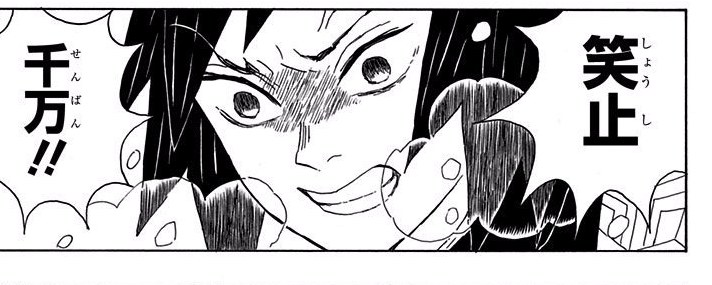
A boy is kneeling in the snow, having just begged for his sister's life and for help curing her. The swordsman standing over them is not moved. Giyu runs through the boy's hopes one at a time — 「妹を治す?」「仇を見つける?」 ("cure his sister? find his enemy?") — and then, across two balloons and a close-up of his contemptuous face, delivers the verdict: 「笑止」「千万!!」 (shōshi / senban!!) (Vol. 1, p.39 in both editions). The furigana on the panel read しょうし・せんばん. It is one of the rare places a four-character compound (yojijukugo) lands verbatim on a Demon Slayer page, and it belongs to Giyu at his coldest.
Shōshi senban (笑止千万) means, roughly, "laughable in the extreme" — utterly absurd, contemptible. Giyu is saying that the very idea a weakling who bows instead of fighting could save anyone is a joke. It caps the same speech whose opening line — don't leave the power over your life and death in someone else's hands — is the most quoted thing he ever says, and it is worth noticing that this early Giyu, scornful and talking at length, sounds nothing like the near-silent man he settles into later.
Two halves: the scoff and the multiplier
笑止 (shōshi) is the contempt. On its face the kanji read "laugh" (笑) plus "stop" (止), but that spelling is ateji — characters assigned to a word for their sound and rough sense rather than their literal meaning — and the etymology is not settled. The most commonly cited account derives shōshi from 勝事 (shōji, with 事 taken in its shi reading), a word that first meant a rare or extraordinary matter and then drifted, through "unusual," toward "strange" and "troubling." The reading split as it drifted: しょうじ kept the older admiring sense, while しょうし collected the negative ones. Only later were the characters 笑止 fixed to it, and once the "laugh" kanji was in place it pulled the meaning toward "ridiculous," a sense well established by roughly the mid-Muromachi period. (A quieter older sense, "pitiable, a shame" — 笑止な — still survives in dictionaries, a reminder that the word did not always mean scorn.) The takeaway: don't over-read the literal "laugh + stop." The mockery came partly from the kanji, not the other way round.
千万 (senban) is the multiplier. Literally "thousand" (千) and "ten thousand" (万) — but the same 千万 that means "ten million" when read senman becomes, read senban, a pure intensifier stuck onto a handful of judgment-words: 迷惑千万 (meiwaku senban, "exceedingly annoying"), 遺憾千万 (ikan senban, "utterly regrettable"), and here 笑止千万, "laughable to the ten-thousandth degree." It does not add content; it adds volume. Read together the compound is せんばん-tailed, seven mora, しょうしせんばん — a scoff with an amplifier bolted on.
What VIZ did with it
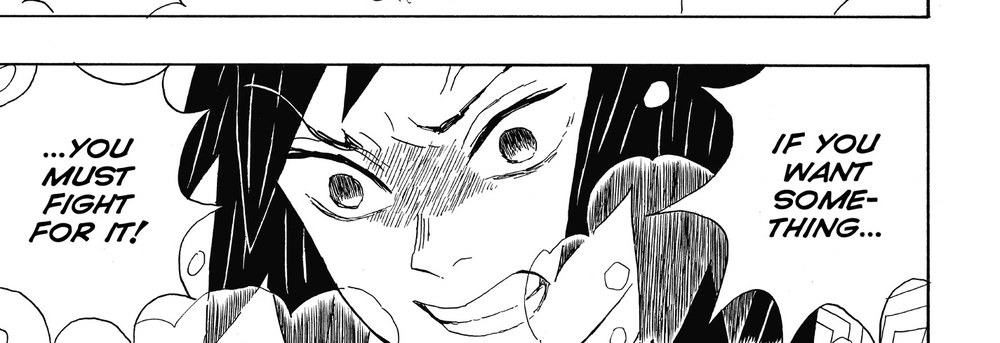
Here is the striking part. VIZ does not translate 笑止千万 as "laughable" or "absurd" at all. In the same two balloons — the ones that in Japanese say shōshi / senban over Giyu's sneer — the English edition reads "IF YOU WANT SOME-THING..." / "...YOU MUST FIGHT FOR IT!"
That is not a rendering of the compound; it is a replacement of it. Where the Japanese hands you a two-word dismissal — your hope itself is a joke — the English hands you a maxim, a piece of brutal counsel about how the world works. The contempt is gone. The classical, faintly archaic register of a yojijukugo is gone. And a first-time English reader never learns that at this moment Giyu is not advising Tanjiro but mocking him.
It would be easy to call that a straight loss, and something real is lost. But the choice is defensible, and in one way it is doing the surrounding page a favor. The balloons on either side spell out exactly the philosophy VIZ folds into those two: 「弱者には何の権利も選択肢もない」 ("the weak have no rights and no choices") and, a beat later, the warning that no demon will respect a weakling's wishes. "IF YOU WANT SOMETHING, YOU MUST FIGHT FOR IT" is the honest logical core of the whole speech — VIZ moved the thesis into the emphatic panel where Japanese put the scorn, and the English monologue reads as one continuous, legible argument rather than an argument with an untranslatable interjection dropped into the middle of it. A reader who knows no Japanese loses the sneer but keeps the sense, and keeps it flowing. Not wrong. Colder in Japanese, clearer in English.
What each reader ends up with
The gap here is unusually clean, because the compound is right there on the page instead of hovering off it. A Japanese reader gets a specific, cutting word — shōshi senban — and with it a whole register: this is not street slang but a hard, almost formal put-down, the kind of phrase that tells you the speaker has decided you are beneath argument. That register is a character note. The man who will later be too withdrawn to defend himself when the corps calls him unpleasant (taizen-jijaku) is, in his first real scene, articulate and merciless, and the scorn is aimed less at the boy than at the boy's helplessness.
An English reader trades that away and receives, in its place, a clean statement of the might-makes-right creed the scene is built on — arguably a more immediately useful thing to hand a reader who has to absorb a stranger's worldview in four panels. What no translation could keep is the small pleasure of watching a set phrase land at exactly the moment it is coined for: 笑止千万, a stock expression of contempt, deployed by a man whose contempt is, this once, fully in words. A page later he goes quiet, and mostly stays that way.