The face that doesn't move
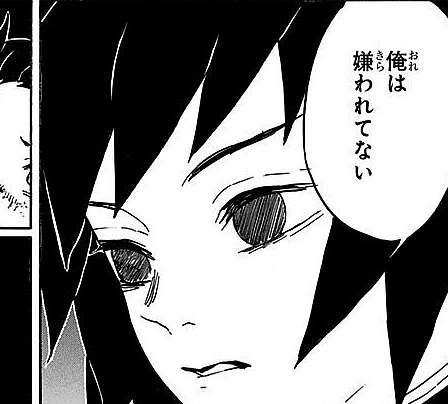
Shinobu Kocho has just told Giyu, more or less to his face, that the entire corps finds him unpleasant to be around. His reply is four flat words with no change of expression behind them: 「俺は嫌われてない」 (ore wa kirawarete-nai — "I'm not disliked") (Vol. 6, p.10 in both editions). He does not argue it, raise his voice, or look stung. He states it the way you would report the weather, and Shinobu — genuinely thrown — can only apologize for having brought it up: 「嫌われている自覚が無かったんですね」 ("so you never even realized people disliked you").
Japanese has a compound for a person who cannot be knocked off balance: taizen jijaku (泰然自若). Watching this exchange, it is the obvious word — and also, by the end of the scene, exactly the wrong one.
Four kanji, held steady
The compound is two halves, each a small claim about composure:
- 泰然 (taizen) — 泰 (tai, "peaceful, settled, broad") plus 然 (zen), the suffix that turns a root into a manner, like English "-ly." The 泰 is the everyday one you meet in 泰平 (taihei, "peace") and 安泰 (antai, "security, safety"). Together: a settled, unhurried bearing.
- 自若 (jijaku) — 自 (ji, "self, one's own nature") plus 若, read here not as "young" but in its classical sense "as, thus, like." "Like oneself" — remaining unchanged from one's original state, unaltered by what is happening.
Put the halves together and you get "outwardly settled, inwardly unchanged": self-possessed. It reads たいぜんじじゃく, seven mora, and attaches with たる or する (泰然自若とした態度, "a self-possessed manner").
One association to handle with care. The 泰 here is the same character that names 泰山 (Taizan, Mount Tai), the great sacred peak of the Chinese fengshan imperial rites and a stock byword for permanence and immovable weight. It is tempting to read "steady as the mountain" straight into 泰然 — but the dictionaries don't derive the compound from Mount Tai. They gloss 泰 by its plainer sense of "peace, stability," and note that 泰然 and 自若, both old words on their own, were welded into this fixed four-character phrase only in the modern period. The mountain is a resonance the shared kanji invites, not the etymology. Worth flagging, because the connection is easy to assert and hard to source.
What the idiom praises, and what Giyu gets instead
Taizen jijaku is admiring. It is the word for the commander who doesn't flinch when the line breaks, the surgeon steady inside the emergency — composure that is constitutional rather than performed, holding under a shock that would rattle anyone. Point it at a crisis and it is pure heroism: when a Hashira refuses a demon's offer of immortality without so much as a hitch in his breathing, taizen jijaku names the state where there is simply nothing to negotiate.
Giyu wears the same unmovable surface — but pointed at ordinary life, where nothing is exploding, and there it does not read as heroism. It reads as coldness, arrogance, a man who can't be bothered with the rest of the hashira or the ranks below them. The corps has quietly concluded that he looks down on everyone. What they are actually looking at is a face that does not move. The idiom's unshakenness, carried out of the battlefield and into the barracks, curdles into the very thing that leaves him with no place among his own comrades and, by his own flat account, disliked — a fact he had not registered until Shinobu said it out loud.
That last detail is the part taizen jijaku cannot cover. The idiom assumes the composed person knows he is composed and is choosing it — poise held on purpose over an interior he has mastered. Giyu's flatness isn't quite that. A good deal of it is that the interior has gone quiet on its own, under years of grief and survivor's guilt, the same stilled surface that earns meikyo-shisui its entry. He is not performing calm over a storm. Much of the storm has simply stopped reaching his face. Self-possessed, in his case, shades toward self-erased.
The declarative that VIZ turned into a question
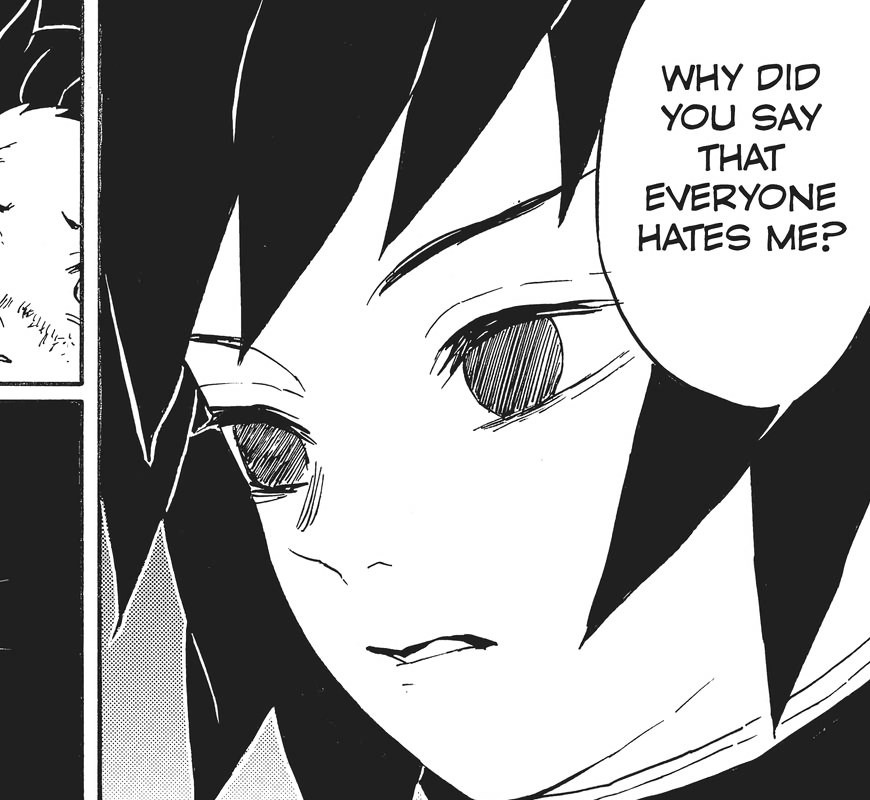
The scene is also a small, exact translation fork. In Japanese, 「俺は嫌われてない」 is a bare declarative — subject, negated verb, full stop. That flatness is the joke: told he is universally disliked, Giyu neither defends himself nor wobbles; he overwrites the claim with a counter-fact and moves on, taizen jijaku in miniature and completely mistaken. VIZ renders the same balloon as a question: "WHY DID YOU SAY THAT EVERYONE HATES ME?"
That is a real shift. A question has a crack in it — it concedes the premise, asks for a reason, tilts a little toward the other person. The English Giyu sounds a shade defensive, even hurt; the Japanese Giyu sounds like a man reading a label aloud. VIZ trades away the deadpan unshakenness that makes the panel funny. But it is not a careless trade, and it buys something back: the question lets an English reader feel, this early, the loneliness the series will only confirm much later — that Giyu is walled off by grief rather than aloof by choice. The flat Japanese line hides that entirely; the VIZ question lets a little of it leak through ahead of schedule. (A beat earlier the softening runs the other way: Shinobu's pointed-but-polite 「どいてくださいね」 flattens into the brusque "NOW MOVE, TOMIOKA," so the two edits roughly cancel — she loses a little courtesy where he gains a little vulnerability.)
Composure you can't spend
The Japanese reader gets 泰然自若 as unbroken praise and then watches the manga quietly short it out: here is the unmovable calm the phrase celebrates, worn by a man it has cost nearly everything. The English reader loses the four-kanji word and its Mount-Tai overtone, but VIZ hands over a substitute the Japanese page withholds — a first, early hint that the still face is not indifference. It is the rare case where the composure the idiom admires is exactly the problem: a mirror-flat surface its owner would trade, if he had any idea how, for the ordinary ability to be liked.