Translation Pitfall · Kyojuro Rengoku
Duty vs. Gifts — How VIZ Reframes Rengoku's Final Question
Rengoku's final question asks whether he fulfilled his duties and obligations, not whether he used gifts wisely—a crucial distinction VIZ's translation obscures.

Japanese (manga)
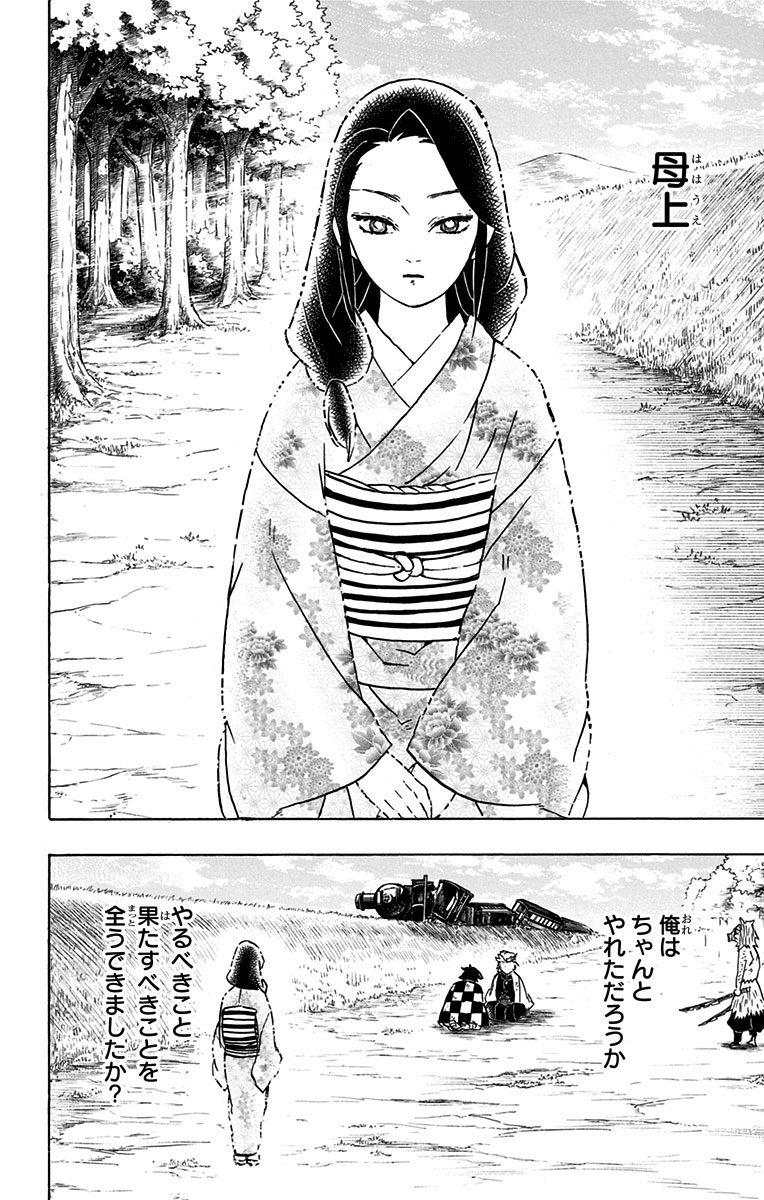
鬼滅の刃 第8巻 p.96 ©吾峠呼世晴/集英社
English (VIZ official)
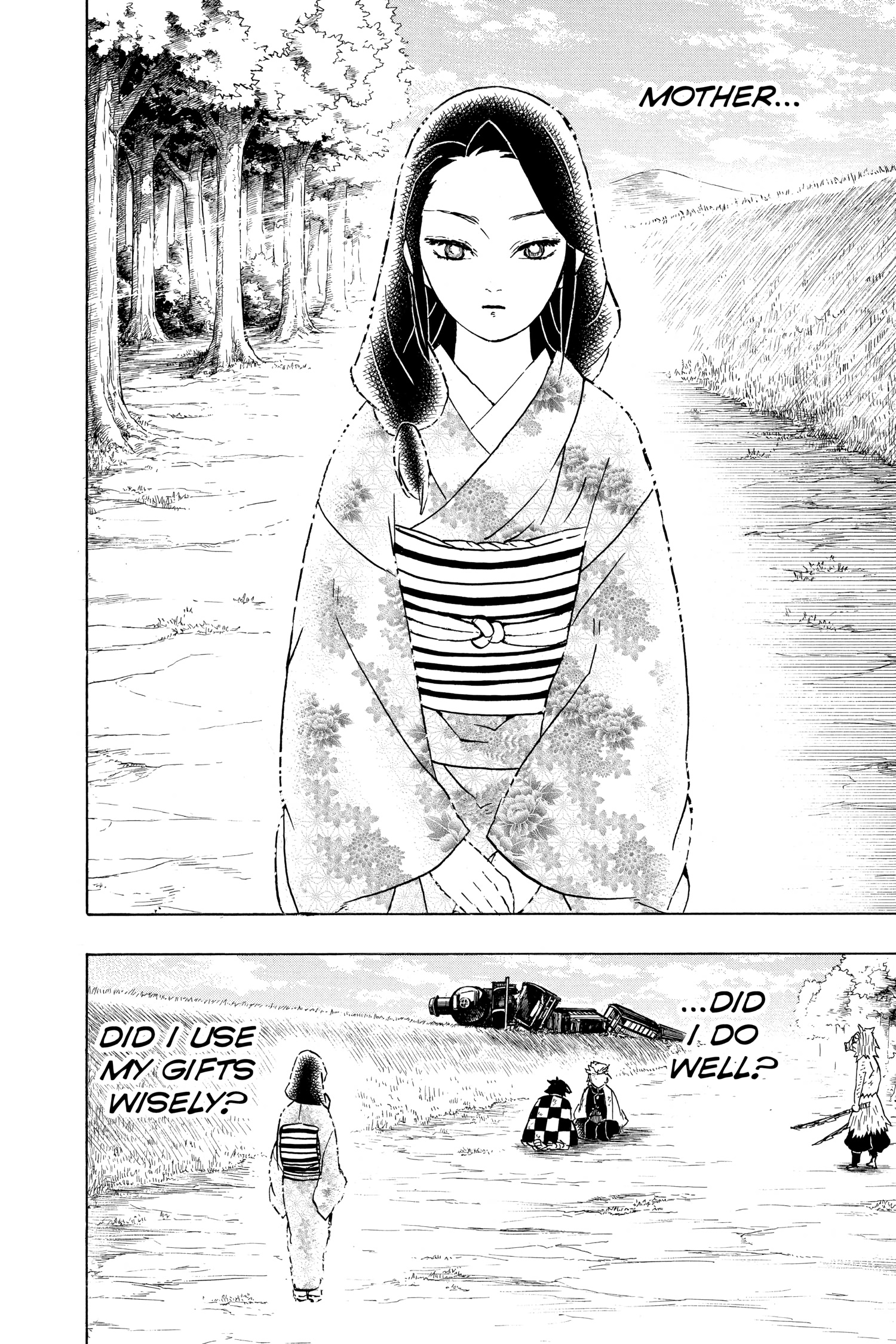
Demon Slayer Vol. 8 (VIZ Media), p.96 ©Koyoharu Gotouge/VIZ Media
Japanese (manga)
やるべきこと果たすべきことを全うできましたか?
yaru beki koto, hatasu beki koto wo mattō dekimashita ka?
鬼滅の刃 Vol. 8, p.96
English (VIZ official)
"DID I USE MY GIFTS WISELY?"
Demon Slayer Vol. 8 (VIZ), p.96
Literal meaning
The expression consists of two parallel obligation clauses joined by a completion verb. Yaru beki koto (やるべきこと—'things that should be done') pairs with hatasu beki koto (果たすべきこと—'things that should be fulfilled/accomplished'). This doubled structure is grammatically emphatic: not one category of duty but two layers—immediate tasks and deeper callings. Wo mattō (を全う) means 'to complete perfectly' or 'to carry through to fulfillment,' with mattō carrying the specific sense of seeing one's duties through with integrity. Dekimashita ka (できましたか) is the past-tense polite question form of 'to be able to'—posing this as a reflective self-assessment. Literal unpacking: 'the things I should do / the things I should accomplish—was I able to carry them to completion?'
Register & tone
The register is formally reflective, marked by the auxiliary べき (beki—'should/ought'), a structure that sounds weighty and solemn rather than casual. The sentence-final particle か forms a genuine question, suggesting someone in vulnerability taking serious stock. The doubled structure with 全う (mattō) carries echoes of duty fulfillment rhetoric—not asking 'Did I win?' but 'Did I see my role through?' The polite past tense (dekimashita) combined with the formal construction suggests either someone of high station reflecting on their duties, or someone speaking in a profoundly serious moment. Overall tone: grave self-reckoning measured not against personal success but against one's assigned responsibilities.
Cultural context
This phrase embodies Japanese concepts of giri (義理—duty/obligation) and the idea that a life is measured by whether one fulfilled one's assigned role. The verb 全う (mattō—to accomplish completely, to fulfill) carries specific cultural weight in samurai and bushido traditions, where a warrior's honor depends not on winning but on seeing one's obligations to the end. The doubled structure ('things I should do' plus 'things I should accomplish') reflects hierarchical layers of responsibility: immediate tasks and deeper callings rooted in one's station. This self-questioning echoes the samurai deathbed poem tradition, where final words often assess whether one has properly met one's duties. The underlying philosophy is role-based ethics: life is fundamentally about meeting obligations to others, to one's position, and to one's calling—not about personal optimization or resource management.
Why the English version misses the mark
VIZ's 'DID I USE MY GIFTS WISELY?' fundamentally reframes the question from duty-ethics to talent-management. The original centers on obligation and what 'should' be done (べき), while VIZ shifts focus to innate abilities and their optimization. 'Gifts' presupposes personal talents, whereas the original asks about meeting prescribed duties and role-based responsibilities—philosophically opposite frameworks. The addition of 'wisely' introduces a judgment-about-judgment element (decision quality) that isn't explicit in the original. Most critically, VIZ discards 全う (mattō), the verb meaning 'to see one's duties through to completion with integrity.' The original asks: 'Did I fulfill my assigned role to the end?' VIZ asks: 'Did I use my potential optimally?' These are different ethical systems—the first deontological (duty-based), the second consequentialist.
Alternative translations
- Did I fulfill all the duties I was supposed to perform?
- Have I accomplished everything I should have and seen it through?
- Was I able to complete both my responsibilities and my deeper calling?
- Did I carry my obligations through to their proper end?
- Have I lived up to everything I should have accomplished?
- Was I able to fully meet the weight of my responsibilities?

Sources
Linguistic analysis grounded in primary sources
- [manga_volume] 鬼滅の刃 Vol. 8, page 96
How this was made: a Japanese Demon Slayer otaku hand-picked the insight from a massive bilingual database pairing every original Japanese line with its official English edition. AI then translated and wrote up the analysis from those source quotes — every Japanese / English excerpt above is a byte-exact capture from the cited manga editions, not invented.