Glossary · Monkey D. Luffy
覇気
Haki
Latent will-energy introduced much later in the series, projected as armor, observation, or pure conqueror's intent.
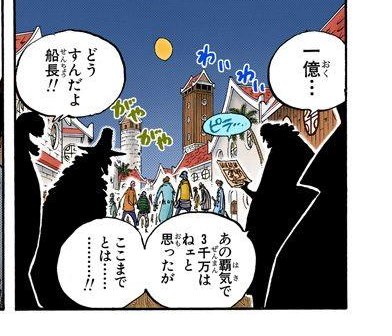 ONE PIECE 第25巻 p.158 ©尾田栄一郎/集英社
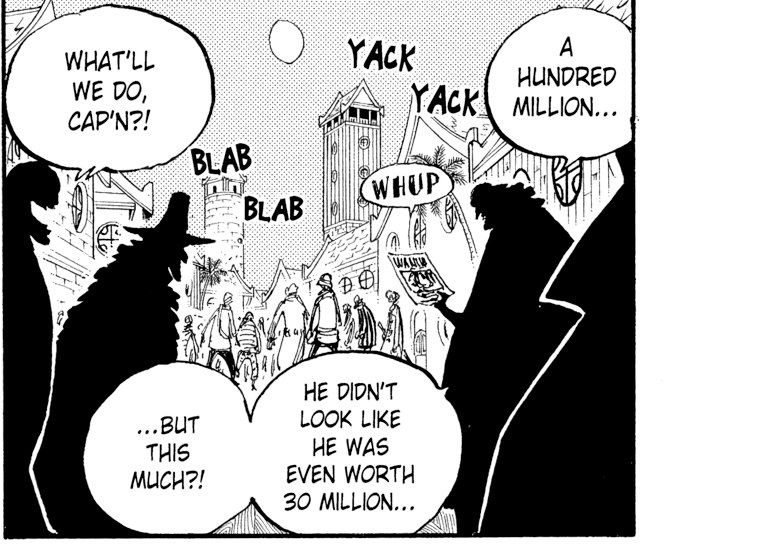 One Piece Vol. 25 (VIZ Media), p.163 ©Eiichiro Oda / Shueisha · VIZ Media
Twenty-eight volumes before anyone teaches Luffy to harden his fist, the word is already on the page. In Mock Town, Blackbeard's silhouetted crew watches the news of Luffy's new bounty ripple through the street, and one balloon reads 「一億…あの覇気で3千万はねェと思ったが…ここまでとは……!!」 — roughly, "A hundred million... with that haki of his I figured thirty million was off... but this much?!" (Vol. 25, ch. 234, Japanese edition p.158). Open VIZ's Vol. 25 to the same panel (p.163) and you will find no Haki at all: "A HUNDRED MILLION... HE DIDN'T LOOK LIKE HE WAS EVEN WORTH 30 MILLION... BUT THIS MUCH?!"
VIZ did not miss anything. In 2002 there was nothing to miss. That is the whole story of this word, and it is worth telling slowly.
An ordinary word first
Haki (覇気, furigana はき in the manga) is not an invented power-system name the way Kamehameha or Bankai are. It is an ordinary, slightly bookish Japanese noun meaning "ambition, drive, will to dominate." Its most common real-life appearance is negative: 覇気がない (haki ga nai, "he's got no drive") is the kind of thing a manager mutters about a listless new hire. No Japanese reader in 2002 blinked at Blackbeard sizing up a rookie's 覇気 — it read as "that force of personality," an appraisal, not a stat.
The kanji carry more voltage than the everyday usage lets on. 覇 ha is the character of supremacy and hegemony: 覇者 (hasha, "conqueror, champion"), 制覇 (seiha, "domination of a field"), and above all 覇王 (haō, "supreme king"). 気 ki is the all-purpose spirit-energy character of 元気 (genki, "vigor"), 気合 (kiai, "fighting spirit"), 気配 (kehai, "felt presence"). So even as a common noun, 覇気 is literally "supreme-ruler spirit." The word came pre-loaded. Oda did not so much invent a term later as detonate one that Japanese had been storing for him.
The cameo, read closely
Look again at the Mock Town line, because it is a nice little lesson in how much Japanese can leave unsaid. あの覇気で3千万はねェ literally gives you "with that haki, thirty million — no way," and the direction of the "no way" is left to context: no way that low (his presence screamed a bigger number), or no way that high (he didn't look the part)? The colloquial negative ねェ — the same rough contraction covered in the ねェ orthography pitfall — carries the whole judgment. VIZ committed to one reading: "he didn't look like he was even worth 30 million." A reader tracking Blackbeard's fascination with Luffy may prefer the other one. But the panel's job is disbelief at a bounty that more than tripled, and that lands identically in both languages. Not wrong. Just one door closed where Japanese leaves two open — and, since the word was still furniture at this point, translating 覇気 as an impression rather than a keyword was the only sane choice.
Vol. 45: the quotation marks arrive
The Japanese text itself tells you when the word stops being furniture. When Shanks walks aboard Whitebeard's ship in ch. 434 and crewmen start dropping unconscious around him — bojaku-bujin made flesh — a veteran mutters 「相変わらず…スゲェ〝覇気〟だ」, and for the first time the word wears Japanese quotation marks (〝 〟), the typographic signal for "this is now a term." Whitebeard throws it back a page later, needling Shanks for showing up with his 〝覇気〟 bared. VIZ's Vol. 45 answers in kind: "AS ALWAYS... HIS HAKI POWER IS OVERWHELMING." (p.73) — the first time the romanized word appears in VIZ's English edition. Notice the training wheels: "Haki power," a little apposition to tell you this foreign word is a noun of ability. English gets the term and its definition smuggled into three words. From this volume on, VIZ treats Haki as untranslatable and capitalizes it like a proper noun, which is exactly the right call for a system name.
Rayleigh's off-hand knockout of an auction house in Vol. 51 (「今のは〝覇気〟」, "that just now was 'Haki'") keeps the quotation marks on, and by Amazon Lily in Vol. 53 the women of the island use it as casually as counting: they note with alarm that Luffy beat their beast without using any Haki, and mid-duel one of the Boa sisters points out that he can't use it at all. On an island where everyone has it, Haki is the default and the devil-fruit user is the oddity — a neat inversion of the series so far, and bad news for a gomu-gomu-no-mi body whose one defensive boast (blunt attacks bounce off rubber) stops working the moment an attacker coats a strike with will.
Colors of a king
Vol. 53 also names the first subtype. When Luffy's burst of will knocks out half the arena, the sisters gasp 「〝覇王色〟の覇気…!!!」 — haōshoku no haki, "Haki of the Supreme-King color," the rarest kind, the one you are born with. VIZ (p.146): "THAT HAKI JUST NOW... WAS THAT OF THE SUPREME KING!! THAT'S THE HAKI OF THE CHOSEN ONES! ONLY ONE IN MILLIONS HAS THAT SPIRIT!!" There is the 覇王 buried in the everyday word, finally stepping into the light — and it is no accident that the boy who ends every argument with 「海賊王におれはなる」 turns out to carry the king's variety.
The full taxonomy waits for Rayleigh's beach lecture in Vol. 61 (ch. 597): Haki is 「全世界の全ての人間に潜在する力」 — "a power latent in every person in the world" — no different in kind from ordinary presence and fighting spirit, which retroactively blesses every casual use of the word since Vol. 25. The three named types, furigana confirmed on the Japanese pages: 見聞色 (kenbunshoku, "Observation color"), 武装色 (busōshoku, "Armament color"), and 覇王色 (haōshoku, "Supreme-King color"). VIZ renders the trio as "the Color of Observation, the Color of Arms and the Color of the Supreme King" (Vol. 61, p.66), keeping the 色 "color" metaphor intact where a lazier localization would have flattened it to "types." Rayleigh even folds in a retcon with lexicographic charm: what Skypiea called 心綱 — kanji "heart-rope," force-read as Mantra, a furigana stunt visible as far back as Vol. 26 — "is what we call Observation." Japanese readers had thus already watched Haki live under an alias for thirty-five volumes. The word has a double life inside Japanese, not just across the translation gap.
What each side of the page gets
The Japanese reader's privilege is the slow burn. For twenty-eight volumes 覇気 hides in plain sight as ordinary vocabulary, then the quotation marks arrive, then the kanji pay off: 覇気 → 覇王色 → 海賊王 is a single family of 覇-adjacent ambition, visible at a glance. When Rayleigh says the power is just ordinary willpower trained, the noun agrees with him — that is what 覇気 always meant.
The English reader gets something Japanese cannot offer: a clean technical term. "Haki" is capitalized, searchable, and never once means "my nephew lacks drive." The system reads more crisply in English than in Japanese, where a sentence like ルフィは覇気がある is genuinely ambiguous between a personality compliment and a combat spec. Translation lost the double life and bought clarity with it — a local loss and a local gain, which is the usual exchange rate.
For the learner, the payoff runs in both directions. Meet 覇気 in the wild — a job posting, a scouting report, a sports column — and you now know it is not an anime power; meet it in One Piece before Vol. 45 and you know it is not yet a system. One word, two registers, and the exact volume where it changes clothes.
First appearance
Vol. 25, ch. 234, p.158 of the Japanese edition (ONE PIECE 第25巻) — a casual, unmarked use by Blackbeard's crew; the same panel falls on p.163 of VIZ's One Piece Vol. 25, where the word is translated away. VIZ first prints "Haki" in Vol. 45 (p.73).
Related terms
Sources
- ONE PIECE 第25巻 p.158(集英社・日本語版)
- One Piece Vol. 25 (VIZ Media, English edition), p.163
- ONE PIECE 第45巻 p.72–73(集英社・日本語版)
- One Piece Vol. 45 (VIZ Media, English edition), p.73
- ONE PIECE 第53巻 p.144–145(集英社・日本語版)
- One Piece Vol. 53 (VIZ Media, English edition), p.146
- ONE PIECE 第61巻 p.60–65(集英社・日本語版)
- One Piece Vol. 61 (VIZ Media, English edition), p.66
- ONE PIECE 第26巻 p.188(集英社・日本語版)