Glossary · Monkey D. Luffy
悪魔の実
Devil Fruit
Mysterious "treasures of the sea" that grant supernatural powers at the cost of ever swimming again; where they come from is one of the series' longest-guarded mysteries.
 ONE PIECE 第1巻 p.25 ©尾田栄一郎/集英社
 One Piece Vol. 1 (VIZ Media), p.25 ©Eiichiro Oda / Shueisha · VIZ Media
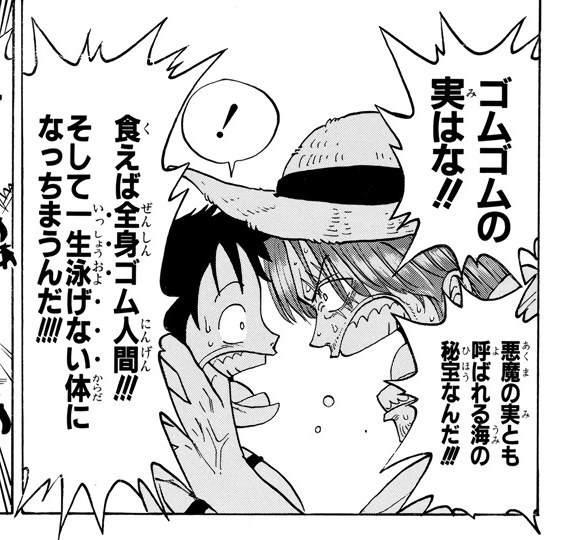
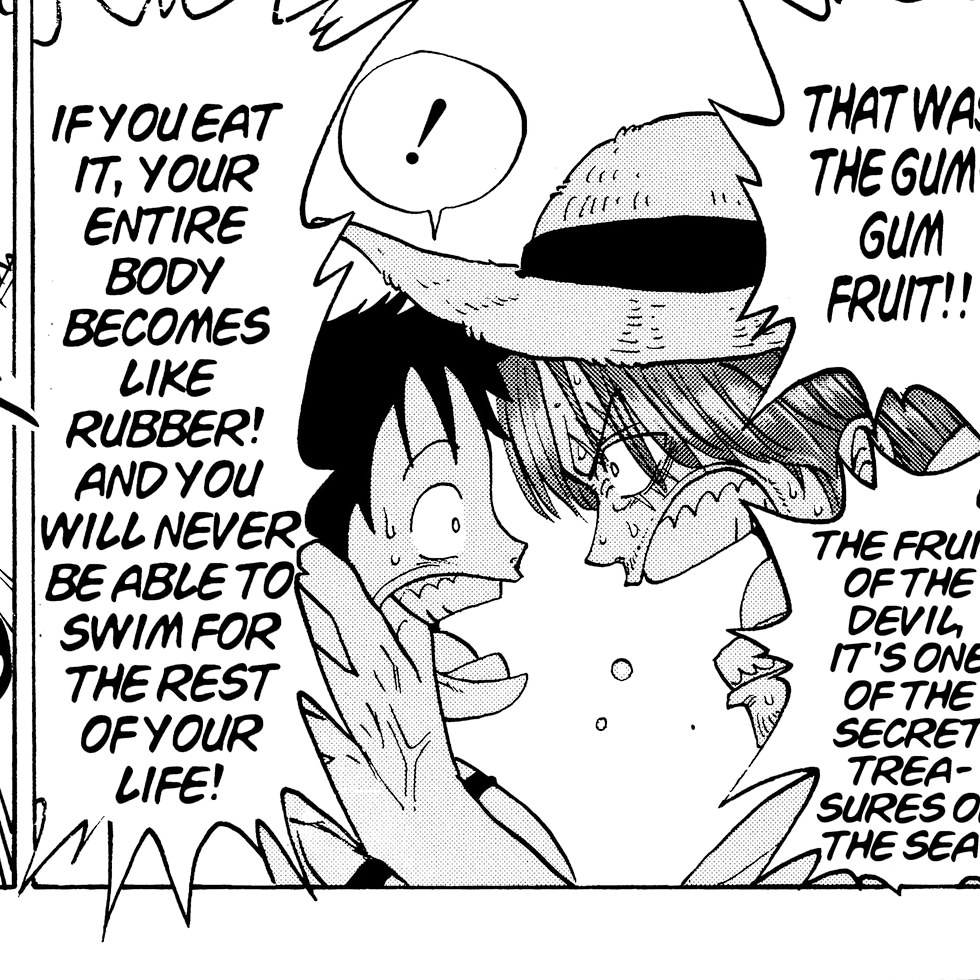
Shanks pins the straw hat back onto a panicking Luffy and lays out the bad news in one breath: 「ゴムゴムの実はな!! 食えば全身ゴム人間!!! そして一生泳げない体になっちまうんだ!!!! 悪魔の実とも呼ばれる海の秘宝なんだ!!!」 — "That was the Gum-Gum Fruit!! Eat it and your whole body turns to rubber! And you'll never swim again as long as you live! It's one of the sea's hidden treasures, the thing they call a akuma no mi (悪魔の実, "devil's fruit")." (Vol. 1, p.25; VIZ Vol. 1, p.25: "THAT WAS THE GUM-GUM FRUIT!!... THE FRUIT OF THE DEVIL, IT'S ONE OF THE SECRET TREASURES OF THE SEA!"). It is the first time the phrase 悪魔の実 lands on the page in One Piece, and it arrives already doing three jobs at once: it names a category, it prices it, and it curses it.
The fruit is a fruit
Start with the small word doing the heavy lifting. 実 (mi) is the plain, everyday noun for the edible fruit of a plant — an apple, a berry, the thing a tree bears. Every Devil Fruit is built on it: the pattern is X-X-no mi, "the such-and-such fruit." Luffy ate the ゴムゴムの実 (gomu gomu no mi, "gum-gum fruit"), and the manga furigana over 実 is plainly み — this is produce, not metaphor. Sitting on top of the whole class is 悪魔の実 (akuma no mi): 悪魔 (akuma, "devil, demon") + の + 実, so literally "the devil's fruit," a fruit you would be wiser not to eat.
VIZ splits its strategy along exactly this seam, and the split is worth watching. The individual fruit gets Englished — ゴムゴムの実 becomes "Gum-Gum Fruit," a name a reader can taste. The category gets calqued into a fixed label. But that label wobbles for a few volumes before it sets. Here in Vol. 1 it is descriptive prose, "the fruit of the devil, one of the secret treasures of the sea." By Vol. 2, when a henchman recognizes what Luffy is, he gasps 「バギー船長と同じ〝悪魔の実〟の能力者…!!!」 and VIZ prints "You ate the Devil's Fruit, like Captain Buggy!?" (Vol. 2, p.107) — now a proper noun, and now with an apostrophe-s. Only later does the edition settle on the bare compound "Devil Fruit," the form fans reach for today. This is not an error to catch VIZ in; it is a house style finding its feet. The Japanese was a fixed term from its first panel — 悪魔の実, unchanged — and English simply took a few volumes to decide whether 悪魔 was a possessive ("the Devil's fruit") or an attributive ("Devil Fruit"). Both are honest readings of the の. VIZ tried each and kept the tighter one.
The eater has a name too
There is a second noun the English reader half-meets and rarely sees labeled. A person who has eaten one is a 能力者 (nōryokusha, "ability-holder, power-user"): 能力 (nōryoku, "ability") + 者 (sha, "person"). It is a standing category — once you eat, you are a 能力者, the way English speakers might permanently be "a mutant." Japanese keeps that noun in circulation for hundreds of chapters. VIZ tends to dissolve it into a verb: in the Buggy line above, 「悪魔の実の能力者」 ("a Devil-Fruit power-user") collapses into "you ate the Devil's Fruit," and the standing identity evaporates into a single past action. The panel's beat is the accusation, and "you ate it" carries the shock cleanly, so this is a fair trade rather than a loss to complain about. But the English reader has to assemble the category "Devil Fruit user" out of context over many volumes, where the Japanese reader was handed the noun the first time anyone pointed a finger.
The bill comes due in seawater
The price Shanks names is the one bill every fruit charges regardless of what power it grants: 一生泳げない体 (isshō oyogenai karada, "a body that can never swim again"). The next page hammers it home when the villagers needle Luffy for becoming a permanent カナヅチ (kanazuchi, literally "iron hammer," the ordinary idiom for someone who drops straight to the bottom). A Devil Fruit user sinks; deep water saps their strength on contact and drowning is the flat, unglamorous counterweight to any supernatural gift. That single rule is what makes the gomu-gomu-no-mi a mixed blessing rather than a free win — Luffy's rubber body shrugs off bullets on land, but the same body is a stone in the sea — and it is why the ocean of the grand-line is not just a setting but a standing threat to half the cast.
Luffy's answer, delivered the moment the villagers mock him, is the whole character in one line: 「いいんだ!一生カナヅチでもおれは一生海から落ちない海賊になるから!」 — "That's fine! Even if I sink like a hammer forever, I'll just be a pirate who never falls off his ship!" It is futo-fukutsu before he has the vocabulary for it: the cost is real, permanent, and he simply routes around it. VIZ keeps the shape ("If I sink like an anchor, then I'll just be a pirate that never falls overboard!"), swapping the hammer for an anchor because English has no live "iron hammer = non-swimmer" idiom to lean on. Anchor sinks; the joke survives; the specific metaphor changes clothes at the border.
Three houses under one roof
When the powers finally get sorted, they sort into three 系 (kei, "lineage, family, type"), and each type name is written the way Oda loves to write his coinages — kanji for the meaning, furigana for the label:
- 超人系 (chōjin-kei, "superhuman type"), furigana-labeled パラミシア (paramishia, "Paramecia"): bodies and matter bent to odd rules, the catch-all house. Luffy's rubber is a Paramecia.
- 動物系 (dōbutsu-kei, "animal type"), labeled ゾオン (zoon, "Zoan"): powers that turn the eater into a beast. The term is spoken plainly the first time it matters — 「これが…動物系〝悪魔の実〟の…」, which VIZ renders "That's the Devil Fruit of the Zoan family" (Vol. 15, p.206).
- 自然系 (shizen-kei, "nature type"), labeled ロギア (rogia, "Logia"): the eater becomes an element — smoke, fire, ice — the rarest and, on the page, the most feared (Vol. 29, p.41).
Here the translation gap is at its widest and its fairest. In Japanese, 超人系 quietly tells you the fruit is "superhuman-class," 動物系 that it is "animal-class," 自然系 that it is "nature-class" — meaning and jargon stacked on the same word. English cannot print two words at once, so VIZ keeps the katakana labels: Paramecia, Zoan, Logia. The English reader memorizes three opaque loanwords with no built-in hint of what each does. That is a genuine local loss. But it buys a matching local gain, and VIZ made the right call taking it: "Logia" is a unique, searchable, unmistakable term, where a bare "nature type" would collide with every ordinary sentence about nature. The names were designed to feel like coined jargon — the katakana is the point — and flattening them into transparent English glosses ("Superhuman/Animal/Nature type") would have made the system read cheaper than it is.
What each side of the page walks away with
The Japanese reader gets a small, permanent pun. 実 is the fruit you bite, but it is also the 実 of 結実 (ketsujitsu, "coming to fruition") and 実力 (jitsuryoku, "real ability") — so 悪魔の実, the thing that bears your power, hums faintly with "substance" and "the real thing" underneath the produce. Pair that with 悪魔, and the category name is ominous and organic at once, every time it is spoken.
The English reader gets something the Japanese cannot quite offer: a clean, capitalized handle. "Devil Fruit" is crisp, unambiguous, and never accidentally means "a fruit that happens to be wicked." The system reads as system in English, three proper-noun classes and a proper-noun category, precisely because the transparent meanings were sanded off. Japanese kept the meaning and paid in ambiguity; English bought clarity and paid in mystery — the usual exchange rate, run here across a whole taxonomy. For the learner, the takeaway is concrete: meet 実 in a grocery store and it is just fruit; meet 能力者 in a news column and it is just "a capable person"; meet either inside One Piece and Oda has quietly loaded both. Same words, two registers, and now you can hear both at once.
First appearance
Vol. 1, ch. 1 (「Romance Dawn」), p.25 of the Japanese edition (ONE PIECE 第1巻) — Shanks names the 悪魔の実 as he explains the Gum-Gum Fruit to a young Luffy; the same panel falls on p.25 of VIZ's One Piece Vol. 1, where it is rendered "the fruit of the devil... one of the secret treasures of the sea." The compound recurs, now printed as a proper noun "the Devil's Fruit," in Vol. 2, p.107 (VIZ Vol. 2, p.107); VIZ later standardizes on the bare form "Devil Fruit."
Related terms
Sources
- ONE PIECE 第1巻 p.25(集英社・日本語版)
- One Piece Vol. 1 (VIZ Media, English edition), p.25
- ONE PIECE 第1巻 p.26(集英社・日本語版)
- ONE PIECE 第2巻 p.107(集英社・日本語版)
- One Piece Vol. 2 (VIZ Media, English edition), p.107
- ONE PIECE 第15巻 p.206(集英社・日本語版)
- One Piece Vol. 15 (VIZ Media, English edition), p.206
- ONE PIECE 第29巻 p.41(集英社・日本語版)
- ONE PIECE 第35巻 p.142 SBS(集英社・日本語版)