Glossary · Monkey D. Luffy
偉大なる航路
Grand Line
The sea route where the One Piece waits — "we're headed for the Grand Line!" (Luffy, Vol. 1, p.172).
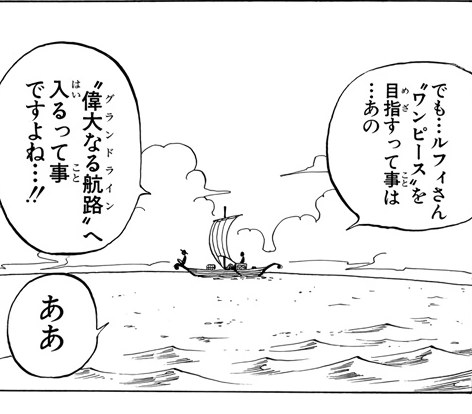 ONE PIECE 第1巻 p.81 ©尾田栄一郎/集英社
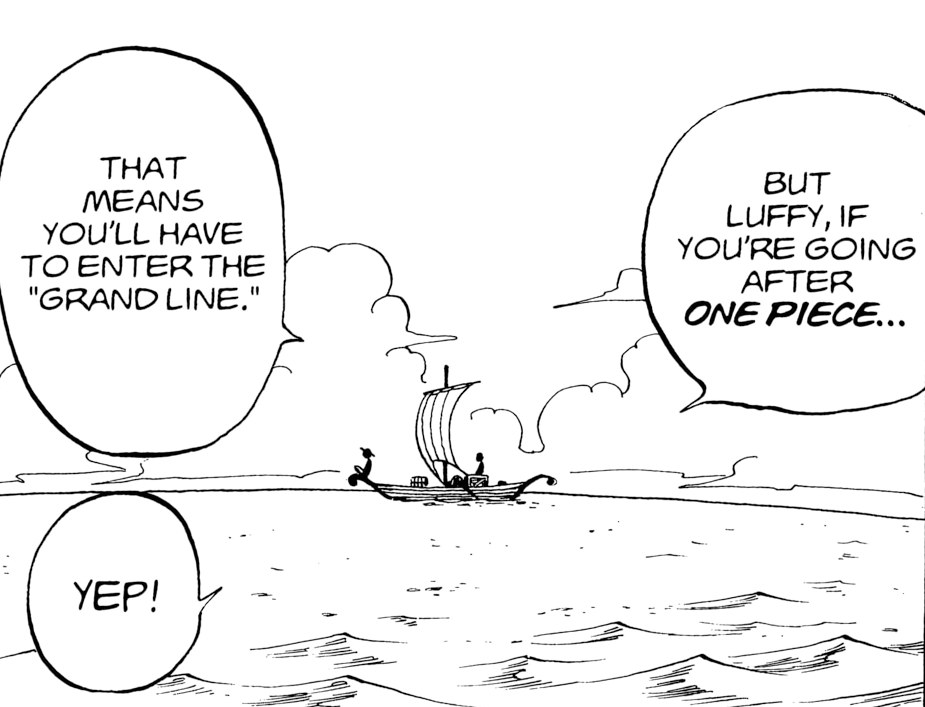 One Piece Vol. 1 (VIZ Media), p.81 ©Eiichiro Oda / Shueisha · VIZ Media
A warning with two readings
The name arrives as a warning, not a promise. Luffy and Coby are drifting toward the naval base in a boat barely big enough for two, and Coby has just worked out what chasing the one-piece-treasure actually implies: 〝偉大なる航路〟へ入るって事ですよね…!! (Gurando Rain e hairu tte koto desu yo ne, "that means you'll have to enter the 'Grand Line'"; Japanese edition Vol. 1, p.81, and the same panel falls on p.81 of VIZ's Vol. 1). A moment earlier he was marveling that Luffy had eaten the gomu-gomu-no-mi; now he is naming the place he fears most, and on the same page he tells you why: あそこは海賊の墓場とも呼ばれる場所で… (asoko wa kaizoku no hakaba to mo yobareru basho de, "they call it the pirates' graveyard").
Look closely at Coby's balloon in the Japanese panel. The large characters read 偉大なる航路, kanji that mean, roughly, "the great sea route." Running beside them in small katakana is the reading: グランドライン, Gurando Rain. One word, printed on two tracks at once. That typographic device, more than the geography, is what this entry is about.
How the double track works
Furigana (振り仮名) are the small kana printed beside kanji to show how they are read. Usually they give the standard reading, and in Weekly Shōnen Jump they are applied liberally so young readers can follow along: on this very balloon, even the everyday words 入る (hairu, "to enter") and 事 (koto, "thing, fact") carry their ordinary ruby はい and こと.
But furigana can also be commandeered. Print 偉大なる航路 and set グランドライン beside it, and you have told the reader two different things at once: what the thing is (a great sea route) and what it is called (the Grand Line). Assigning kanji a reading they don't normally have is an old device (dictionaries file it under gikun, 義訓, "meaning-based reading"), and manga has turned it into a house style: the kanji carry the sense, the katakana carry the name.
Read straight, without the ruby, 偉大なる航路 would be idai naru kōro: 偉大 (idai, "great, mighty") plus 航路 (kōro, "sea route, shipping lane"), joined by なる, the literary attributive form of the classical copula nari. That なる is not fossil Japanese; it survives in modern set phrases like 母なる大地 (haha naru daichi, "Mother Earth"), where it dresses a noun in ceremonial clothes. So the kanji layer is not a neutral gloss. It is an epithet, "the Great Route," pitched in the register of legend.
The katakana layer pulls the other way. Katakana is the script Japanese uses for foreign words, so グランドライン reads as imported, adventurous, a name that could sit on an English sea chart. A Japanese reader meeting this balloon gets both layers in a single glance: the meaning of the place and the foreign sound of its name.
What English readers get
VIZ prints: "THAT MEANS YOU'LL HAVE TO ENTER THE 'GRAND LINE.'" (Vol. 1, p.81). One layer, no gloss. Something real is lost there: the "great sea route" meaning never reaches English readers as text. They learn what the Grand Line is from the story, never from the word.
But be precise about the other side of the ledger, because English readers gain something Japanese readers don't have. To a Japanese eye, グランドライン is foreign sound; the meaning has to be supplied by the kanji underneath. An English reader hears the actual words. "Grand" does natively what 偉大なる does in kanji, and "line" is genuine chart-room vocabulary: shipping lines, lines of latitude. Sailors traditionally call the equator "the Line" (crossing it for the first time comes with a shipboard ceremony), and the Grand Line is, in-world, exactly that kind of belt around the globe. In other words, the English reader is the one who hears the name the way a sailor would. Japanese readers get two layers; English readers get one layer with its lights on.
Both editions, incidentally, flag the coinage the same way: the Japanese text sets the term inside 〝 〟 quotation marks, and VIZ wraps "GRAND LINE" in quotes. Each page tells you, typographically, that a term of art has just entered the story.
When the name dissolves back into a word
The double track is not just decoration; the Japanese text can play with it. On p.172 of both editions, Luffy stands up in the tiny boat and declares "偉大なる航路"へ向かおう (Gurando Rain e mukaou; VIZ: "WE'RE HEADED FOR THE GRAND LINE!"). Coby erupts: two of them, in that boat, is suicide (VIZ: "YOU'LL JUST BE SAILING TO YOUR DEATHS!"). Two panels down, Zoro shrugs: まァどの道〝ワンピース〟を目指すからには その航路をたどるしかねェんだ…いいだろう (mā dono michi Wan Pīsu o mezasu kara ni wa, sono kōro o tadoru shika nee n da… ii darō, "well, if we're going after the One Piece anyway, that's the route we'll have to follow… fine by me").
Look at the ruby on Zoro's 航路: it reads こうろ, kōro, the plain common noun. The grand name has dissolved back into ordinary sailor vocabulary. For Zoro, the pirates' graveyard is just a stretch of water between him and a goal, and the grammar itself does the shrugging.
VIZ renders the line "WELL, I GUESS IF WE'RE AFTER THE 'ONE PIECE'… THE GRAND LINE IS WHERE WE HAVE TO GO" (p.172). The proper noun comes back. Not wrong — English has no way to let a name melt into a common noun and trust you to keep the referent, so naming it outright is the clear call, and VIZ keeps Zoro's deadpan fatalism fully intact. What thins out is the move inside the word: Japanese lets 偉大なる航路 and その航路 rhyme on the page, name and noun, myth and route.
The exchange matters because of who is having it. This is the freshly formed two-man ichimi, with Zoro only just aboard (You're one of us now), and the route is the first thing captain and first crewman agree on. Two pages later Luffy closes the loop: だからおれは〝偉大なる航路〟へ行くんだよ ("THAT'S WHY I'M GOING TO THE GRAND LINE!", p.174 in both editions), the same engine that drives his standing declaration about the Pirate King.
Reading it yourself
When you spot kanji with katakana ruby anywhere in One Piece, slow down and read both tracks: the kanji are a message to your eye, the katakana to your ear. This one gives you three useful dictionary words in passing, 偉大 (idai, "great"), 航路 (kōro, "sea route"), and 墓場 (hakaba, "graveyard"), plus a live example of gikun naming you will meet again and again in the series. And it hands you a small superpower over anime-only viewers: in the spoken dialogue you only ever hear Gurando Rain. The "Great Route" layer exists on the printed page alone.
First appearance
Vol. 1, p.81 of the Japanese edition (ONE PIECE 第1巻), in Coby's warning 〝偉大なる航路〟へ入るって事ですよね…!!; the same panel falls on p.81 of VIZ's One Piece Vol. 1.
Related terms
Sources
- ONE PIECE 第1巻 p.81, p.172, p.174(集英社・日本語版)
- One Piece Vol. 1 (VIZ Media, English edition), p.81, p.172, p.174