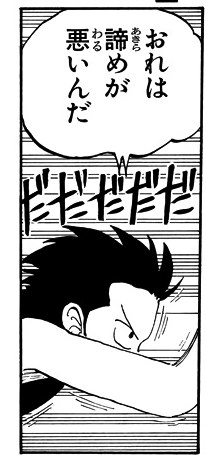
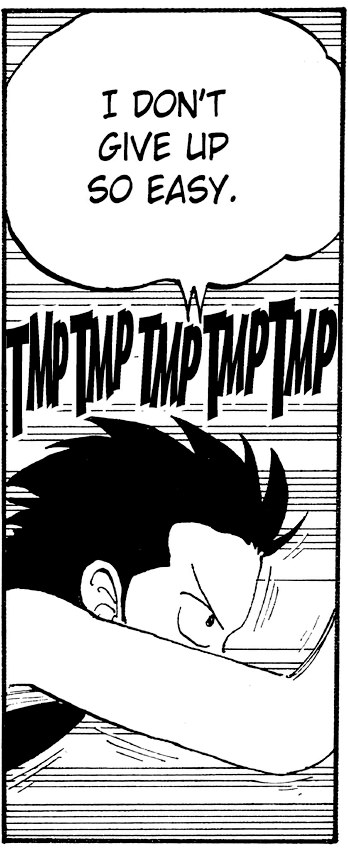
Poisoned, outmatched, and standing on a wrecked restaurant-ship in front of the most heavily armored pirate he has ever faced, Luffy takes a breath and states a fact about himself: ore wa akirame ga warui n da (おれは諦めが悪いんだ, "I'm bad at giving up"). VIZ: "I DON'T GIVE UP SO EASY." Don Krieg answers that even a monkey can learn, and that Luffy, who keeps charging the same wall he has already failed to clear twice, is dumber than a monkey. The insult is beside the point. The line has already told you the one thing the fight will prove, and it is the exact thing four old characters were invented to name.
The word Japanese reviewers reach for
Futō fukutsu (不撓不屈) is the phrase that turns up in essays and blurbs about characters like this — six morae, ふ・と・う・ふ・く・つ, and a compact definition of a spine that will not give. It comes out of classical Chinese, where it described the kind of person who holds a position under pressure that would break other people, and it kept that gravity crossing into Japanese as a bookish, N1-level idiom. It is not, however, a phrase anyone in One Piece says. Search the manga and 不撓不屈 never appears on the page; what appears is Luffy's offhand akirame ga warui, the playground-plain version of the same idea. The four-character idiom is the label a reviewer would paste over the scene. The scene itself speaks in a much lower register — which is a translation fact worth coming back to.
A compound built out of two "nots"
The structure is the interesting part, and it is a specific Japanese template: 不◯不◯, a four-character frame that defines something by doubling a negation. 不 (fu, "not") sits in front of the first and third characters, so the whole compound is a via negativa — it tells you what the subject will not do, twice, and lets you infer the person from the shape of the hole. Japanese has a shelf of these: 不老不死 (furō fushi, "not-aging, not-dying," immortality), 不眠不休 (fumin fukyū, "not-sleeping, not-resting," working flat out). 不撓不屈 belongs to that family. It does not say "strong." It says "not this, and also not that," and trusts you to see the strength in the refusal.
The two things being refused are graded. 撓 (tō, tawamu) is the bend of a physical thing under load — a branch bowing, a beam flexing, metal warping before it fails. 屈 (kutsu, kussuru) is the moral cousin: to yield, to submit, to bow to someone's will. So 不撓 is "will not flex" and 不屈 is "will not surrender," and the idiom stacks the smaller giving-way under the larger one. First the body does not bend; then the spirit does not break. Read literally, it is a claim about a substance that stays rigid. Read as character, it is a claim about a person who stays whole.
The rubber problem
Here is where the idiom does something to Luffy that it could never do to a swordsman or a scholar, and it is the reason this compound is quietly funny sitting over his head. Luffy is, physically, the single most bendable body in the series. The Gum-Gum Fruit turned him to rubber; flexing, warping, and bowing under load is not his weakness but his entire mechanism. Every punch that lands on him bends him. The gomu-gomu-no-mi is a 撓-machine — a thing engineered to give way and spring back. Take 不撓, "will not bend," at face value and it is simply, flatly false of him. His body bends all day.
Which is precisely why the compound fits, once you split its two halves and hand them to the two different parts of him. His body owns 撓 — it bends around Krieg's stakes and bombs, absorbs them, snaps back — so that his will can own 不屈. The rubber is not a contradiction of "unbending"; it is the delivery system for it. A rigid man breaks when the load exceeds him. Luffy's whole design is to convert force into a bend and give none of it to the part that decides whether to quit. The most flexible object in One Piece is animated by the least flexible resolve, and 不撓不屈 is the idiom that catches both facts at once only if you refuse to read it too literally. His body flexes so that the thing underneath does not have to.
What "bad at giving up" keeps and drops
VIZ renders the on-page line as "I DON'T GIVE UP SO EASY," and that is the right call, not a thin one. The Japanese 諦めが悪い is not the lofty 不撓不屈; it literally means "my giving-up is poor" — the same construction you would use to say someone is a sore loser or can't take a hint. It frames persistence as a mild character flaw, an inability to let go, and Luffy delivers it as a shrug rather than a boast. "I don't give up so easy" keeps the casualness exactly. What English cannot carry over from the four-character idiom — because the four-character idiom is not what Luffy said — is the doubled-negative architecture, the sense of a virtue defined by two refusals. But that is a loss against the label, not against the line. Against the line, VIZ got the load-bearing thing: a hero who describes his own courage as a bad habit.
Japanese readers, for their part, get to feel the gap between the two registers — the schoolyard akirame ga warui in the balloon and the classical 不撓不屈 hovering just behind it, unwritten. English readers lose that specific double-exposure and gain a cleaner single tone: a kid, poisoned and cornered, being lightly self-deprecating about the fact that he will not fall. Neither edition holds the whole thing; they hold different halves of it.
Where it sits among his idioms
Luffy's four-character compounds parcel his life out among themselves. haran-banjo names the stormy sea he chose to sail into. jiyu-jizai names what he does to everything else, moving through the world exactly as he pleases. Futō fukutsu names what none of it can do back to him. The waves do not break him; Krieg's stakes do not break him; the Grand Line ahead will not break him. It is the idiom of the fixed point — the one thing in a turbulent life that does not move — and the joke Oda builds under it is that the fixed point is made of the bendiest material on the sea.