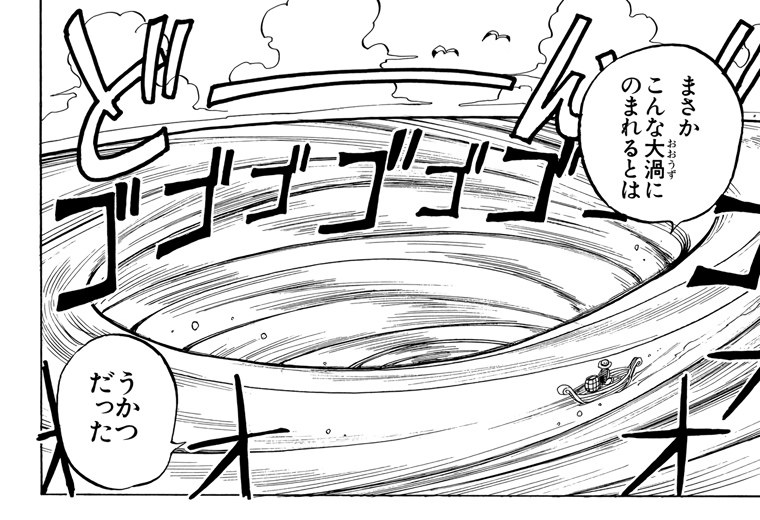
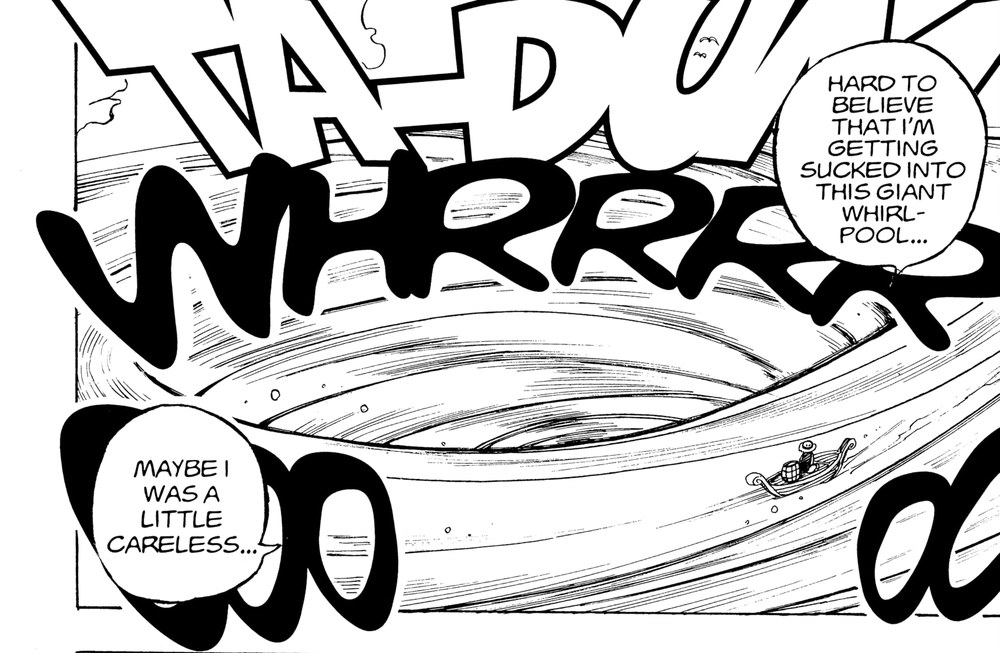
Luffy's life at sea is one chapter old when the ocean makes its first attempt on it. He rows out of Foosha Village alone in a dinghy; the next time we see him, that dinghy is circling the rim of a giant whirlpool. He does not scream. He sits cross-legged, chin in hand, and reviews the facts: masaka konna ōuzu ni nomareru to wa (まさかこんな大渦にのまれるとは, "to think I'd get swallowed by a whirlpool this big"; VIZ: "Hard to believe that I'm getting sucked into this giant whirlpool..."). He allows that he was maybe a little careless. He remembers that his devil-fruit body cannot swim, then brightens: in a vortex this size, swimming ability is irrelevant anyway. He goes under.
Japanese keeps a ready-made word on the shelf for the life that begins on that page: haran banjō (波瀾万丈, "stormy seas, swells ten thousand jō high"), the standard epithet for a life of violent ups and downs. This article is about what sits inside those four characters, where the word actually touches Oda's pages, and what happens to a worn-out sea metaphor when you hand it to a person who lives on the sea.
Four kanji, seven morae
Say it first: は・ら・ん・ば・ん・じょ・う, seven morae with a drumbeat of two syllabic n sounds in the middle. Then take it apart.
The front half, 波瀾 (haran), stacks two wave characters. 波 is the everyday word for "wave" (nami on its own), the one you meet in weather reports. 瀾 is its literary big sibling: a large swelling billow. Doubled up, the pair long ago extended past water: in ordinary usage haran means commotion, upheaval, dramatic turns, the "waves" in a negotiation or a marriage.
The back half, 万丈 (banjō), is a measurement. 万 is "ten thousand," and 丈 (jō) is a traditional unit of length: ten shaku, a little over three metres. A ten-thousand-jō wave would stand roughly thirty kilometres tall. The number is not information, it is volume control: the same hyperbole English performs in "a thousand thanks," and the same measuring word that closes kien banjō (気炎万丈, "spirits blazing ten thousand jō high"). Put back together: seas so rough the swells pass beyond measuring. Said of a voyage, a career, a life.
The spelling fork: 瀾 or 乱
Modern Japanese writes the idiom two ways. 瀾 sits outside the jōyō list of common-use kanji, so everyday print often substitutes the homophone 乱, "disorder," giving 波乱万丈. The swap quietly rewrites the picture: 波瀾万丈 is towering water; 波乱万丈 is "wave-turmoil," the chaos abstracted out of the sea. Dictionaries treat them as one word, but the older spelling keeps the ocean in view, which, for our purposes, matters.
Oda's own pages know the stem well. When the Davy Back Fight against the Foxy Pirates reaches its final round, the ring announcer calls it 波瀾のデービーバックファイト (haran no Debī Bakku Faito), with the literary 瀾, and with the furigana はらん printed alongside, exactly because the character is hard. VIZ renders the line: "The final battle holds the fateful key to this stormy Davy Back Fight!" That "stormy" is our idiom's front half doing its ordinary job in an announcer's mouth.
The compound never appears on the page
Honesty first: the full four-character compound 波瀾万丈 never turns up in the manga's dialogue: searching the text of the series' first hundred-plus volumes surfaces the two-character stem 波乱/波瀾 again and again, in the mouths of announcers and narrators, but never the whole idiom. That is not a defect in the anchor; it tells you what register the word lives in. Haran banjō belongs to biography: life-story television segments, memoir blurbs, the retrospective voice. 波乱万丈の人生, "a stormy life," is what you call somebody's story once you are far enough away to tell it whole. Nobody inside a whirlpool says the word, for the same reason nobody inside a war says "epic."
One Piece is that retrospective told at a library's length: the biography of one man, narrated from the first squall onward. Which is why the whirlpool page is the idiom's true anchor. It is the story's thesis statement about what kind of life this will be — catastrophe as weather — delivered before Luffy has met a single crewmate.
One scene later, hauled out of a barrel, Luffy mentions the whirlpool to a cabin boy named Koby, who sputters the obvious: futsū shinun desu kedo ne (ふつう死ぬんですけどね, "normally, you know, people die"). VIZ gives him "You're lucky to be alive!" — relief where the Japanese has deadpan actuarial fact. Not wrong; warmer. But the Japanese line is the funnier half of the thesis: whirlpools kill people as a matter of routine, and this particular person files them under scenery.
A dead metaphor, wet again
In everyday Japanese haran banjō is a dead metaphor. Nobody pictures water when a talk show calls a singer's career 波乱万丈; the swells flattened into abstraction generations ago. Drop the word onto a pirate and every character gets wet again. Luffy's ups and downs are not "like" stormy seas — they are storms, on seas, and the grand-line institutionalizes the arrangement: an ocean where the weather itself refuses to behave. The series re-literalizes the idiom the way a good pun re-literalizes a cliché, and Japanese readers get that flicker (dead figure, live water) on top of the plain meaning.
English readers are not shortchanged here, just served differently. The stock English phrasings split the field: "a stormy life" keeps the weather, "ups and downs" keeps the wave-shape and drops the water, "a rollercoaster" trades the sea for a fairground machine. VIZ's instinct in the Davy Back line, "stormy," lands on the one that stays native to the pirate premise. What English uniquely adds is its own comic register: "rollercoaster" carries a joke Japanese 波乱 does not, the absurdity of strapping in for the drops on purpose. And that, as it happens, is the most Luffy reading available.
The Luffy inflection
Because here is what he does to the idiom. A 波瀾万丈 life is conventionally narrated with a sigh: the subject endured the waves, and the word carries a nod of sympathy. Luffy inverts the polarity. He chose the ten-thousand-jō swells, on purpose, on page one, because the one-piece-treasure waits on the far side of them; his mission statement is not "I will endure" but the declaration unpacked in our note on 海賊王におれはなる and his first on-page vow. The whirlpool scene shows the temperament that makes the choice livable: he audits the disaster — careless, can't swim, doesn't matter — and grins through the intake.
His sibling idioms divide the same territory. futo-fukutsu names what the waves cannot do to him; jiyu-jizai names what he does to everything else; haran banjō names the water both of them assume. Ten thousand jō is hyperbole everywhere else in Japanese. On this particular sea, for this particular biography, it reads more like a forecast.