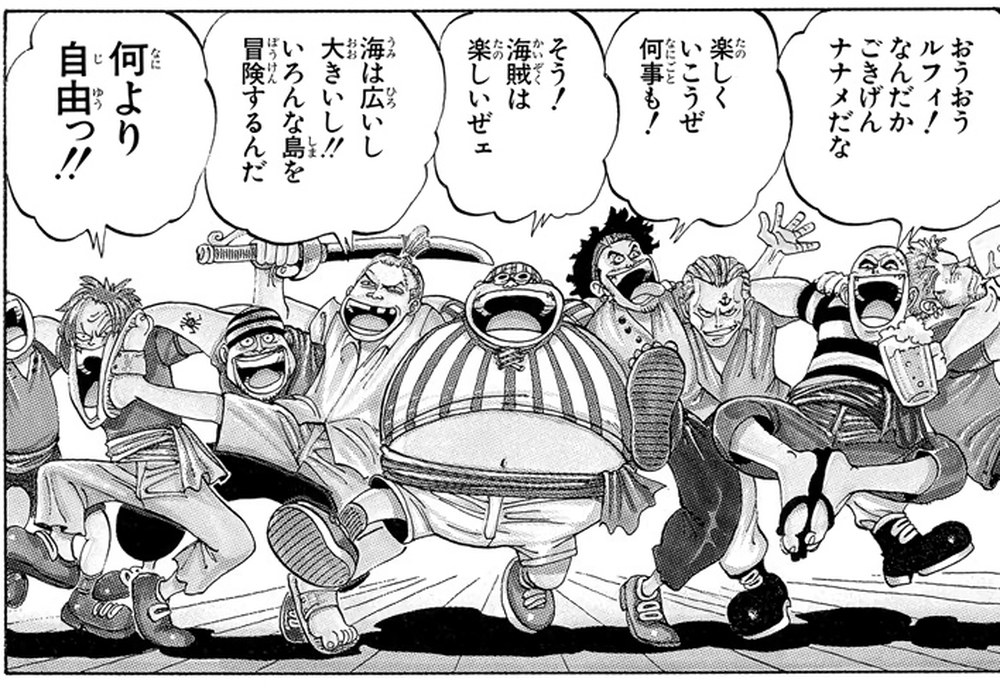
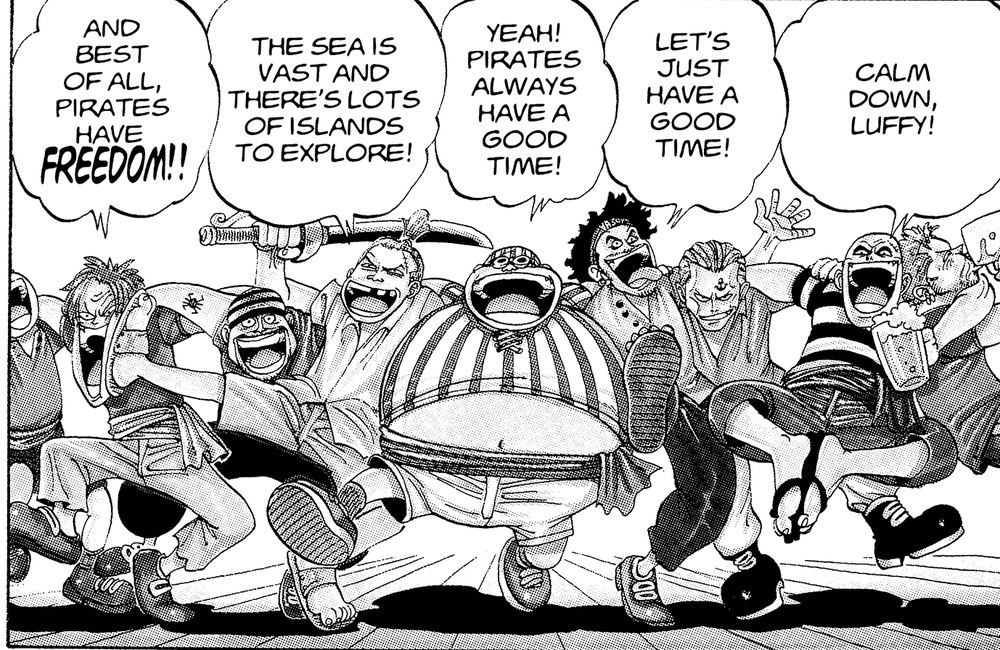
The freest scene in the first volume is a bar full of drunk pirates. Shanks's crew is mid-carouse when one of them turns the recruiting pitch on a wide-eyed kid: the sea is vast, there are islands everywhere to explore, and — nani yori jiyū (何より自由っ!!, "and best of all, freedom!!"). VIZ: "AND BEST OF ALL, PIRATES HAVE FREEDOM!!" Someone else immediately tells them to stop filling the boy's head with crazy ideas. Too late. That single word, jiyū, is already lodged, and it is the front half of the four-character compound Japanese reaches for when it wants to name how this particular pirate moves through the world.
Two selves, bolted together
Jiyū jizai (自由自在) is six morae — じ・ゆ・う・じ・ざ・い — and two separate two-character words that happen to open with the same character, 自 (ji, mizukara, "self, oneself"). The idiom is a doubling: two near-synonyms fastened side by side for total emphasis, the way English might say "free and unfettered." Take the halves apart and the literal reading is almost a creed.
The front half, 自由 (jiyū), is 自 ("self") over 由 ("cause, source, from"). Read straight, it says "from oneself": acting out of your own cause, with nothing outside you as the mover. The word has a long Buddhist life meaning "one's own master," but its loudest modern sense was assigned in the Meiji period, when scholars drafted 自由 to translate the Western "liberty." That political charge — freedom as a right, a thing people fight and die for — is what most Japanese readers hear first today.
The back half, 自在 (jizai), is 自 ("self") over 在 ("to exist, to be present"). "Existing of oneself" — unhindered, unobstructed, at will. It carries an even deeper temple pedigree: 観自在菩薩 (Kanjizai Bosatsu), the bodhisattva of the Heart Sutra, is "the one who perceives freely," 自在 as perfect unobstructed command. In everyday Japanese 自在 is the little "-at-will" you weld onto a verb — 自在に操る (jizai ni ayatsuru, "to control at will").
Put them back together and 自由自在 reads, character by character, as self-caused and self-existing: nothing external governs how you act. Freedom (the state) stacked on unhindered command (the ability). It is the difference between being allowed to move and being able to move exactly as you please, said twice for weight.
The word that never lands on the page
Honesty first, because the idiom demands it: 自由自在 never appears in the manga's dialogue. Comb the series from the first volume well past the hundredth and the whole compound is simply not there — it is the phrase Japanese reviewers, blurb-writers, and fans reach for to describe Luffy, not a line anyone in the story speaks. What is on the page is the compound split into its two halves, each doing load-bearing work in a different corner of the series. Follow them separately and you can watch Oda assemble the idiom without ever writing it.
自由: the half he actually wants
Of the two, 自由 is load-bearing. It is not a description of Luffy's power; it is the name of his want. The bar creed in Volume 1 — nani yori jiyū, freedom above everything — is the thing he absorbs from Shanks's crew before he can even swim, and the series keeps handing the word back to him at scale. When the flashback to Gold Roger's execution opens the story's second act, the narration frames the entire age of piracy around it: hito ga "jiyū" no kotae o motomeru kagiri (人が『自由』の答えを求める限り, "as long as people keep seeking the answer of 'freedom'"), these things — dreams, inherited will, the churn of the era — will never stop. VIZ: "AS LONG AS PEOPLE HUNGER FOR FREEDOM... THESE THINGS WILL EXIST." Freedom is the engine of the whole world, and Luffy is its purest instance: he does not chase the treasure at the end of the sea for wealth or fame or power. In the series' own logic the Pirate King is not the richest man on the water but the freest, and that is the crown he intends to wear.
自在: the half his body does
The other half, 自在, is where his power lives — and the manga does spend the word, just not on him. It gives 自在 to his enemies. Miss Valentine "controls her body weight at will," jūryō o jizai ni ayatsuru; Mr. 3 "manipulates the wax his body produces at will," rō o jizai ni ayatsuru. For those two, 自在 is command over a substance — a power aimed outward at wax, at gravity, at some material they push around.
Luffy is the odd case in which the substance and the commander are the same object. The Gomu Gomu no Mi turned his own body into rubber, and what the gomu-gomu-no-mi grants is precisely 自在 command of himself: he stretches, folds, snaps, and reshapes his own form at will, with no external limb or tool in the loop. Where a villain's 自在 points at the thing they control, Luffy's points back at the person controlling it. His body is not a weapon he wields; it is a freedom he inhabits. That is 自由 and 自在 collapsing into one person — the want and the ability wearing the same skin — which is exactly why the doubled idiom fits him even though no one ever says it.
Free at will, in two languages
English has one superb word for the front half, "freedom," and VIZ leans on it correctly every time 自由 does the heavy lifting; rendering the bar creed as plain "FREEDOM!!" is the right call, not a thin one, because the plain noun is the load-bearing thing. What English lacks is a compact match for the doubled 自由自在. It reaches the same place by stacking adverbs — "freely, at will, however he likes, without restriction" — where Japanese gets the emphasis for free by simply saying two synonyms in a row. Neither method is weaker; they are different machines for the same stress. Japanese builds intensity by repetition inside a fixed four-character frame; English builds it by accumulation across a clause. A translator who writes "he moves with total freedom" has kept the load-bearing half and paid for the lost doubling with an adverb, which is the honest exchange rate.
Where it sits among his idioms
His four-character compounds divide his life cleanly among them. haran-banjo names the stormy sea he chose to sail. futo-fukutsu names what those storms cannot do to him. Jiyū jizai names what he does back to everything else: moves through it exactly as he pleases, a self-caused, self-existing body chasing a self-defined freedom. It is the one idiom of the set that is less about what happens to Luffy and more about the verb he is.