Glossary · Naruto Uzumaki
火影
Hokage
"Fire Shadow" — the strongest shinobi and leader of the Hidden Leaf Village; VIZ renders the title as "Lord Hokage." Inheriting the name is Naruto's declared dream from chapter 1.
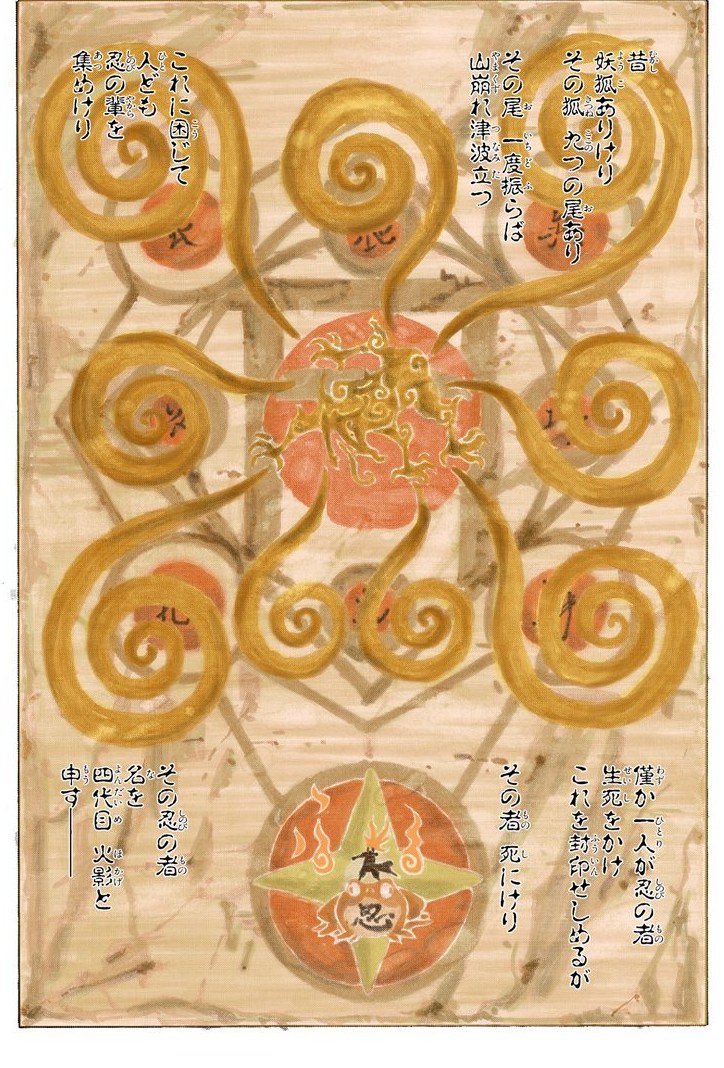 NARUTO―ナルト― 第1巻 p.5 ©岸本斉史 スコット/集英社
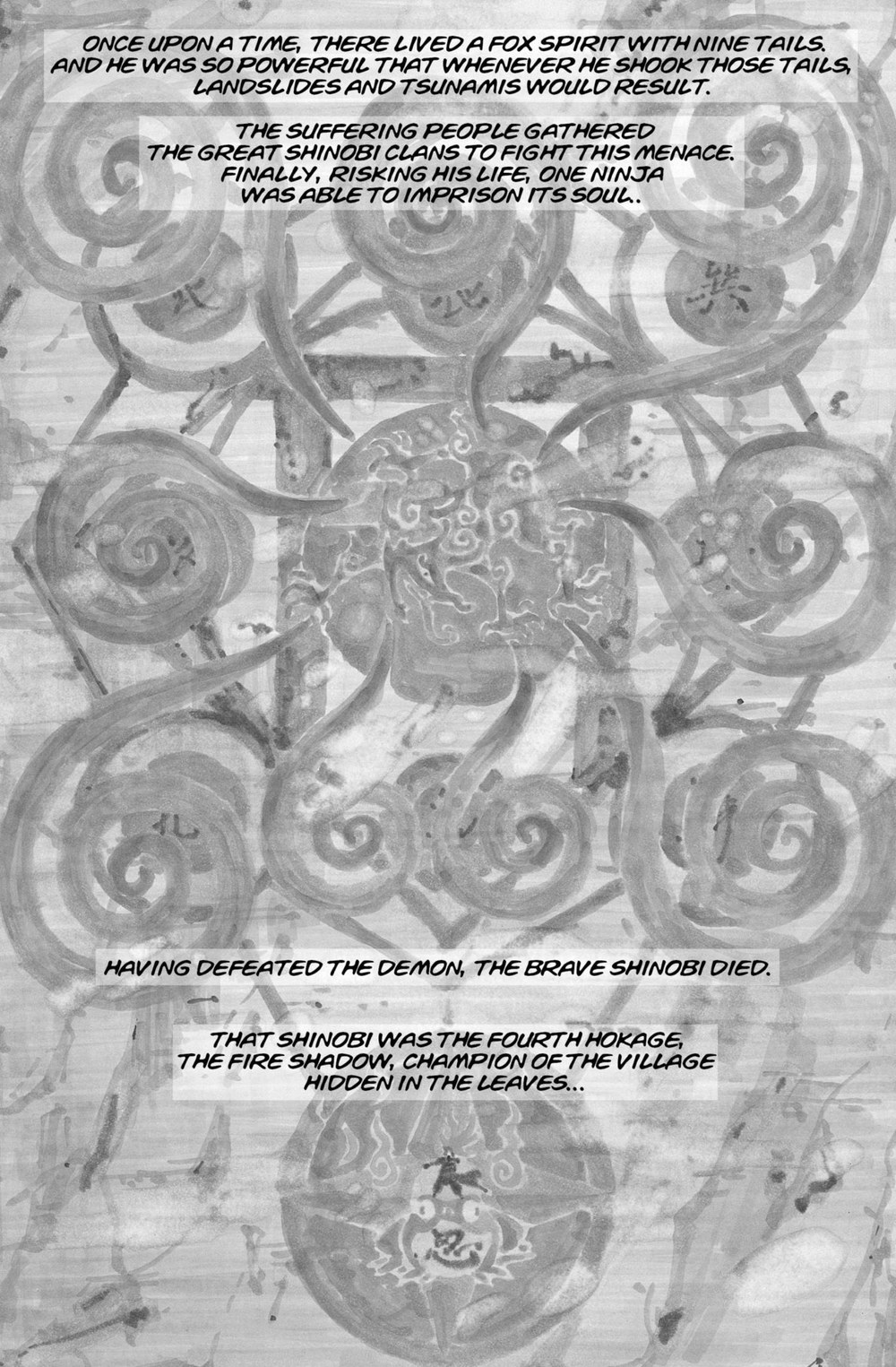 Naruto Vol. 1 (VIZ Media), p.5 ©Masashi Kishimoto / Shueisha · VIZ Media
Page one of the series is a painted scroll: nine golden tails coiling around a sealing seal, narrated in the archaic Japanese of a folktale. The final line of that prologue hands you the story's most important word. 「その忍の者 名を四代目火影と申す――」 (sono shinobi no mono, na o yondaime Hokage to mōsu, "that shinobi bore the name Fourth Hokage"). VIZ's version of the same page reads: "THAT SHINOBI WAS THE FOURTH HOKAGE, THE FIRE SHADOW, CHAMPION OF THE VILLAGE HIDDEN IN THE LEAVES..."
Notice what VIZ did there. It kept the Japanese word, then translated it anyway. That double move — loanword plus gloss — tells you the translators knew this was not an ordinary title.
A shadow made of fire
火影 stacks 火 ("fire") on 影 (kage, "shadow"). The furigana on the prologue page spell the reading out: ほかげ, Hokage — the ho- is an older combining form of 火, the same one you hear in hoteru (火照る, "to flush with heat").
Kishimoto did not invent the word. Long before the manga, 火影 (hokage) sat quietly in Japanese dictionaries meaning firelight — the glow of a flame, or a figure glimpsed by it. A Japanese reader meeting the title gets that flicker of lamp-lit poetry for free: the strongest ninja in the village named after the way a fire throws shapes on a wall.
An English reader can't hear any of that through the romaji. But VIZ's gloss hands over something Japanese pages never spell out: "THE FIRE SHADOW," stated in so many words, right at first contact. Translation lost the poetic residue and paid it back in explicitness.
Five countries, five shadows
The title is one cell of a system, and the manga documents the system itself. Kakashi's trivia page in volume 2 lays out the five great shinobi nations and adds: 「里の長が“影”の名を語れるのもこの五か国だけで...」 (sato no osa ga "kage" no na o katareru no mo kono go-ka-koku dake de) — in VIZ's wording, "THEY ARE ALSO THE ONLY PLACES WHERE THE SHINOBI LEADER CALLS HIMSELF A KAGE, OR SHADOW."
Each leader takes the element of the country, not a personal emblem: 火影・水影・雷影・風影・土影 — Hokage, Mizukage, Raikage, Kazekage, Tsuchikage — collectively 五影 (Gokage), which VIZ renders "THE FIVE SHADOWS." So 火影 parses as "Shadow of [the Land of] Fire": the fire belongs to the country, the shadow to the office.
Why "shadow" for a head of state? The manga never stops to explain, and you don't need it to. These are hidden villages — 木ノ葉隠れの里 (Konohagakure no Sato, "the Village Hidden in the Leaves") — and a hidden village's leader is an unseen presence rather than a king on a throne. Read another way, a shadow is what shade does: it covers what stands beneath it. Both readings fit, and the word refuses to choose.
Counting leaders: 三代目, 四代目
The prologue's Fourth Hokage is 四代目 (yondaime). That 〜代目 (-daime) is a counter for holders of an inherited name: 初代 (shodai) for the first, then 二代目, 三代目, 四代目 for each successor. It is the same machinery Japanese uses for kabuki stage names, rakugo storytellers, and the third-generation master of a sushi counter. Grammatically, the Hokage is not an office you win. It is a name you receive.
The manga leans on exactly that framing. When Iruka demands to know why Naruto defaced the monument, Naruto's answer runs: 「火影の名前を受けついだ人ってのは 里一番の忍者だったってことだろ」 (Hokage no namae o uketsuida hito tte no wa, sato ichiban no ninja datta tte koto daro) — VIZ: "TO INHERIT THE HOKAGE NAME... HE'D HAVE TO HAVE BEEN THE BEST SHINOBI IN THE VILLAGE." And in the same breath he vows to outdo every holder of it — the line that became his signature declaration.
Japanese can even address the man by ordinal alone. Iruka, catching up to the Third: 「三代目 捜しましたよ!」 (Sandaime, sagashimashita yo!, "Third! I've been looking for you!"). English cannot call a person "Third" in the street, so VIZ writes "LORD HOKAGE! I'VE BEEN LOOKING ALL OVER FOR YOU." Correct rank, right register — but the address that carries a whole genealogy inside it is gone. The reverse gain: because English must expand these ordinals, VIZ readers hear the title itself far more often, and "Hokage" hardens into a name much faster than the scattered 三代目 and 四代目 of the original.
One more compression English lacks: 歴代火影 (rekidai Hokage), "the successive Hokage as a set" — the word for the faces carved into the mountainside. VIZ unpacks it as "THE MOUNTAINSIDE IMAGES OF ALL THE HEROES OF OUR VILLAGE — YOUR HONORED FOREBEARS!"
火影様 — and the boy who won't say it
Attach 様 (-sama) and you get the form nearly everyone in Konoha uses to the man's face: 火影様 (Hokage-sama), which VIZ renders "LORD HOKAGE." The village messengers shout it on page 10 of volume 1; it is the sound of the office.
Then listen to Naruto. Asking Konohamaru why he keeps ambushing his own grandfather: 「何でお前ってばそんなに火影のじいちゃんに食ってかかんだ?」 (nande omae tteba sonna ni Hokage no jī-chan ni kuttekakan da?) — "the Hokage gramps." VIZ: "WHAT'S YOUR BEEF WITH THE OLD MAN?" No 様. Not even the neutral title on its own. Naruto bolts an affectionate family word onto the highest office in the village, and nobody in the scene blinks.
That dropped honorific is Naruto's entire stance toward power in one syllable-sized hole: he refuses the distance the title demands, because his goal is not to serve the seat but to sit in it — and to be met person-to-person on the way there. VIZ's "the old man" is a real translation, not a shrug; it lands the familiarity even though English has no register floor to fall through. How Japanese honorifics build that floor, and what else VIZ does with 様, 殿, and ばあちゃん, has a full article of its own — the short version is that Naruto talks up to no one, and the manga prices that in.
The name as finish line
Why does a twelve-year-old's dream fixate on a job title? Because in this village the title is recognition made official. Iruka spells out the stakes: 「里の誰もが認める最高の忍者 火影って名前を奪うってんだからよ」 — VIZ: "YOU'RE TALKING ABOUT TAKING THE NAME HOKAGE! THAT'S THE GREATEST SHINOBI IN TOWN..." The verb everyone circles is 認める (mitomeru, "to acknowledge, accept"): the Hokage is, by definition, the shinobi the whole village has acknowledged. For a boy the village pretends not to see, no other prize exists. That is the logic under his ramen-stand promise, under Iruka's change of heart, and under the self-introduction he never varies: the shinobi who will become Hokage.
So the word you met on page one is doing three jobs at once: a poetic old noun for firelight, a constitutional term in a five-nation system, and a generational name waiting for its next holder. The next time you meet a 三代目 outside the manga — on a sushi shop's sign, in a rakugo program — you'll hear what Konoha built into its highest office: the assumption that a name outlives every person who carries it.
First appearance
Vol. 1, p.5 of the Japanese colored digital edition (NARUTO―ナルト― 第1巻), in the prologue line 「その忍の者 名を四代目火影と申す――」; the same splash page falls on p.5 of VIZ's Naruto Vol. 1.
Related terms
Sources
- NARUTO―ナルト― 第1巻 p.5, p.10, p.17, p.69, p.72, p.80(集英社・デジタルカラー版)
- Naruto Vol. 1 (VIZ Media, English edition), p.5, p.10, p.17, p.69, p.72, p.80
- NARUTO―ナルト― 第2巻 p.41(集英社・デジタルカラー版)
- Naruto Vol. 2 (VIZ Media, English edition), p.41