Glossary · Naruto Uzumaki
忍
Shinobi
The in-world word for ninja. The kanji 忍 stacks 刃 (blade) over 心 (heart) and means "to endure" — VIZ keeps the Japanese term, rendering 忍者 as "shinobi" on nearly every page.
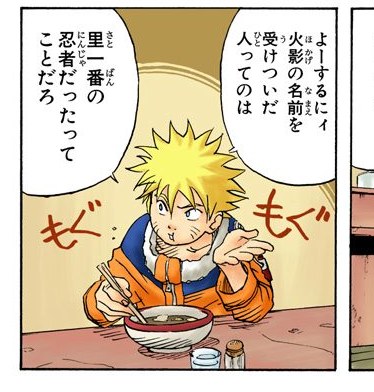 NARUTO―ナルト― 第1巻 p.17 ©岸本斉史 スコット/集英社
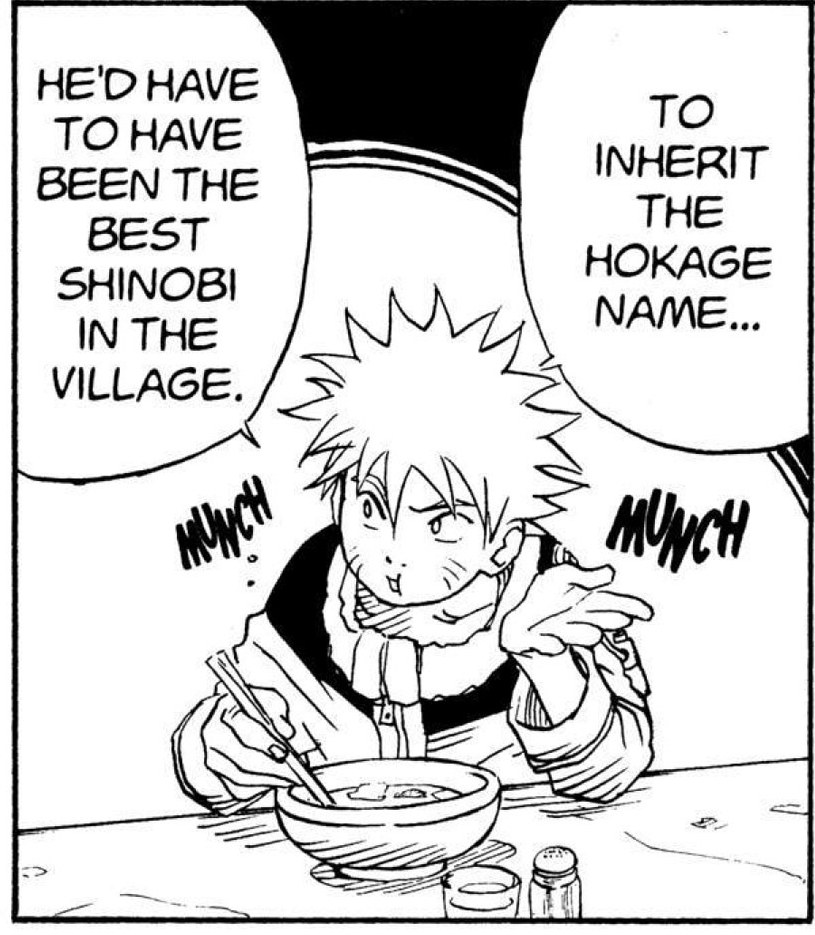 Naruto Vol. 1 (VIZ Media), p.17 ©Masashi Kishimoto / Shueisha · VIZ Media
Mouth full of ramen, Naruto works out loud what the word carved into the mountain must mean. 「火影の名前を受けついだ人ってのは 里一番の忍者だったってことだろ」 (Hokage no namae o uketsuida hito tte no wa, sato ichiban no ninja datta tte koto daro, "to inherit the hokage name, you'd have to have been the village's number-one ninja"). The word in his mouth is 忍者 (ninja). VIZ's balloon reads: "HE'D HAVE TO HAVE BEEN THE BEST SHINOBI IN THE VILLAGE." VIZ heard ninja and wrote shinobi. That quiet swap happens on nearly every page of the series, and it is the single most consistent decision the English edition makes.
One job, three spellings
Japanese writes this profession three different ways, and the manga uses all three.
- 忍者 (ninja) — the everyday word: 忍 plus 者 (-sha / mono, "person"), literally "a person who does 忍." This is what characters usually say out loud.
- 忍 (shinobi) — the bare single kanji, read not with its Sino-Japanese sound nin but with the native reading shinobi. It sounds older, more literary. The series' folktale prologue uses exactly this form: 忍の者 (shinobi no mono, "the shinobi").
- シノビ — the same shinobi, in katakana. Katakana lends a word a clipped, coined, faintly technical look, the way a company might style its own product name.
They all point at one profession. What changes is register — plain, literary, stylized. English has no comfortable way to mark that difference on the page, so VIZ picks one English word, shinobi, and lets it stand in for the lot.
The kanji is a blade over a heart
Here is the fact the romaji hides. 忍 stacks 刃 (yaiba, "blade") on top of 心 (kokoro, "heart"). Its core dictionary meaning is not "to sneak." It is 忍ぶ (shinobu) and 忍耐 (nintai, "endurance"): to bear, to withstand, to hold under pressure. The picture schoolchildren are taught is blunt — a blade held against the heart, carried without flinching.
A note on honesty: linguists classify 忍 as a 形声 (keisei, phono-semantic) character, in which the top element 刃 mainly supplies the sound nin and 心 supplies the meaning. So "blade over heart" is a mnemonic reading rather than the strict etymology. But it is the reading every Japanese speaker is handed, and it is not decorative here — the profession this manga is about is named, at the level of the character itself, after the capacity to endure.
There is a second sense folded into the same verb. 忍ぶ also means to do a thing unseen, to conceal oneself: 忍び足 (shinobiashi, "stealth-step, creeping"), 忍び込む (shinobikomu, "to sneak in"). So one root holds both halves of the job at once: to endure, and to go unseen. English "ninja" imported only the second half — the shadow, the stealth, the black hood — and left the endurance sitting in the kanji back home.
Why VIZ standardized on shinobi
By the time Naruto reached English readers, "ninja" was a thoroughly domesticated word: Halloween costumes, cartoon turtles, a punchline. Read a serious line of dialogue with "ninja" in it and half the weight leaks out. Rendering 忍者 as shinobi resets the dial — it feels like an in-world term rather than a toy-aisle label, and it signals that the reader is meant to take the profession as a profession.
Not that VIZ purges "ninja" entirely. The same prologue that gives us "SHINOBI" also says "one NINJA was able to imprison its soul," and casual lines keep the familiar word. That mix is a feature, not a slip: English gets two words for the one Japanese role and can split the labor between them — "ninja" when a line is offhand and pop-cultural, "shinobi" when it wants the term of art. Japanese does the same work with the 忍者 / 忍 / シノビ spread; VIZ just relocates the register shift from the writing system into word choice. Not wrong. A clean trade.
What each side keeps is worth naming. The Japanese reader gets 忍 already carrying 忍耐 (endurance) inside it for free — the job's very name whispers "perseverance," which quietly underwrites the whole ethic of getting knocked down and standing back up (shichiten-hakki) and of finishing late but finishing anyway (taiki-bansei). The English reader loses that buried echo, but gains a word scrubbed clean of cartoon associations, a word that sounds like it belongs to this world and not to a costume shop.
The morpheme the whole vocabulary hangs on
Once you can see 忍, the rest of the series' vocabulary decodes itself, because 忍 is the block almost everything is built from:
- 忍術 (ninjutsu, "shinobi arts / techniques") and 忍法 (ninpō, "shinobi methods")
- 忍具 (ningu, "shinobi tools")
- the rank ladder: 下忍 (genin, "lower shinobi"), 中忍 (chūnin, "middle shinobi"), 上忍 (jōnin, "upper shinobi") — here 忍 is doing duty almost as a counter for rank
- 忍道 (nindō), 忍 plus 道 (michi, "way, path"): a shinobi's personal creed. That word is Naruto's private code of conduct, VIZ handles it several different ways, and it has a full article of its own — so it is only pointed at here, not unpacked.
Even Naruto's untranslatable verbal tic, the ってばよ he bolts onto his sentences, rides on top of this vocabulary and gets its own entry. But 忍 is the root under all of it.
So the next time you meet 忍者 on a tourist poster, read the top of the character before the bottom. It is not promising stealth first. It is promising a heart that can hold a blade against itself and not move — and only after that, the shadow.
First appearance
Vol. 1, p.5 of the Japanese colored digital edition (NARUTO―ナルト― 第1巻), in the folktale prologue 忍の者 (shinobi no mono); the same splash falls on p.5 of VIZ's Naruto Vol. 1, where it is rendered "shinobi." The 忍者 → "shinobi" swap becomes routine from the ramen-counter scene on p.17.
Related terms
Sources
- NARUTO―ナルト― 第1巻 p.5, p.17(集英社・デジタルカラー版)
- Naruto Vol. 1 (VIZ Media, English edition), p.5, p.17