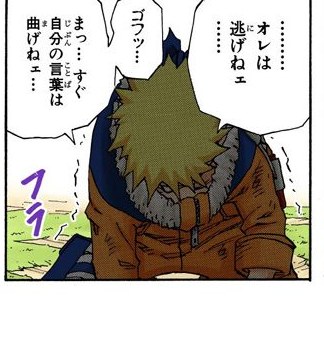
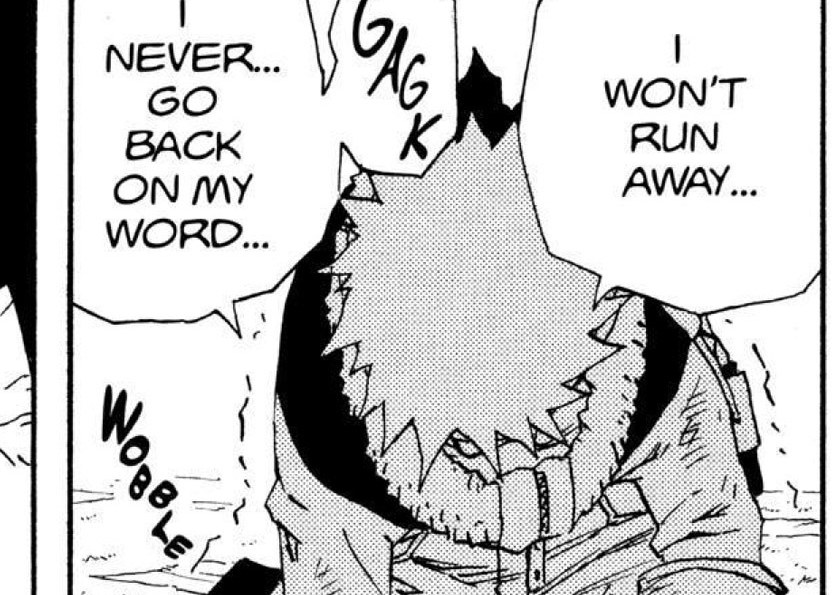
Neji has already sealed off Naruto's chakra, knocked him flat, and pronounced sentence: 「お前はオレに負ける運命だ」 (omae wa ore ni makeru unmei da, "your fate is to lose to me"). The chapter is titled, in the corner of the page, 落ちこぼれ ("The Failure"). Face in the dirt, spitting blood, Naruto answers anyway: 「オレは逃げねェ」 (ore wa nigenē, "I won't run away") — 「まっ..すぐ自分の言葉は曲げねェ」 (massugu jibun no kotoba wa magenē, "I don't bend my own words"). VIZ: "I WON'T RUN AWAY..." / "I NEVER... GO BACK ON MY WORD..." Then he gets up. Again.
Japanese has a compound for exactly this reflex: shichiten hakki (七転八起).
Four kanji — and two ways to read them
- 七転 (shichiten) — 七 (shichi, "seven") plus 転 (ten, native reading korobu, "to fall, tumble, roll over"). Seven falls.
- 八起 (hakki) — 八 (hachi/ha, "eight") plus 起 (ki, native reading okiru, "to rise, get up"). Eight risings.
Fall seven times, rise eight. But this idiom has a second life, and it is the more famous one. Spelled out in native Japanese as a proverb it becomes 七転び八起き (nanakorobi yaoki) — the same seven-fall, eight-rise image, read with kun-readings instead of the Sino-Japanese shichiten hakki. The relationship is worth stating precisely: they are the same idea in two registers, not two different sayings. 七転八起 (shichiten hakki) is the four-character compound (yojijukugo), read with on-readings, the form you meet in writing and speeches. 七転び八起き (nanakorobi yaoki) is the everyday proverb (kotowaza), read with native readings, the form you say to a friend. Same seven and eight, same meaning, different dress. (One caution: the four-character 七転八起 is conventionally read shichiten hakki, not nanakorobi yaoki — the proverb reading belongs to the spelled-out form.)
Why seven falls but eight rises?
The arithmetic looks off — surely you rise once per fall, so the numbers should match. The usual folk explanation is gently Buddhist in flavor: you begin life unable to stand, and someone lifts you to your feet for the very first time. That first rise, before any fall, is counted, so the risings always run one ahead of the tumbles. Read that way, the mismatched numbers are the whole point: the idiom guarantees you end up, not down. (In plainer terms, seven and eight here just mean "many" and "one more than many" — Japanese, like a lot of languages, uses small numbers to mean "a lot.")
Not to be confused with its evil twin
There is a compound that looks almost identical and means nearly the opposite: 七転八倒 (shichiten battō), 七転 plus 八倒 (八 "eight" + 倒 tō, "to topple, keel over"). That one is writhing on the ground in agony — the seven-falls image with no rising at all, only more falling. Swapping 起 (rise) for 倒 (topple) flips a story of resilience into a story of collapse. Keep the 起 and you keep the hope.
The compound never appears in Naruto — and the manga is built out of it
To be exact: neither 七転八起 nor 七転び八起き appears in the Japanese text of the manga; a search across the colored digital edition returns nothing. It is not a phrase the series quotes. It is the phrase that describes the series' basic motor — Naruto's answer to defeat is not a new plan but the same plan tried again from the floor.
The Neji fight is its clearest single case. Neji is the branch-house prodigy who has built an entire philosophy out of the idea that 運命 (unmei, "fate, destiny") is fixed and a 落ちこぼれ stays a 落ちこぼれ. He beats Naruto down the way the plot needs him beaten down — thoroughly, and with a theory attached. And Naruto's counter-argument is not rhetorical; it is physical. He keeps standing up until the theory runs out of road, then wins from underground. When it is over he hands Neji the moral in the plainest words the manga owns: 運命がどーとか変われないとか そんなつまんねーことめそめそ言ってんじゃねーよ ("quit whining about 'destiny' and 'you can't change'") — お前はオレと違って落ちこぼれなんかじゃねーんだから ("because unlike me, you're not a failure").
Notice the line he chose to fall on: 「まっすぐ自分の言葉は曲げねェ」, "I don't bend my own words." That is his promise-keeping ethic — the never-go-back-on-my-word rule that is the backbone of his nindō — and here it is doing double duty as a reason to get back up. For Naruto, rising after a fall is not optimism; it is a debt he owes to something he already said out loud.
What each language gets
A Japanese reader watches this fight with 七転八起 already sitting in the back of the mind, a ready-made frame from schoolroom posters and pep talks and the little round Daruma dolls that are weighted to pop upright every time you knock them over. The whole cultural furniture of "get back up" is prewired; the fight just plugs into it.
English has no single equivalent that is quite so compact, but it is not empty-handed — "if at first you don't succeed," "get back on the horse," "down but not out," and above all "never give up" all carry the freight, and VIZ leans on the last of these across the series. Something is traded either way. English loses the tidy four-character stamp and the Daruma-doll image behind it; but VIZ's plainspoken "I WON'T RUN AWAY," delivered through a mouth full of blood with no idiom to cushion it, arguably hits harder for having no proverb to hide behind. A local loss, a local gain.
Using it yourself
Both forms are common and entirely positive. Use the proverb 七転び八起き (nanakorobi yaoki) in speech and warm contexts — consoling someone after a setback, describing a comeback. Use the compound 七転八起 (shichiten hakki) in writing, in a motto, on a New Year's card. Just keep your 起 (rise) away from that look-alike 倒 (topple), or you will accidentally wish someone a lifetime of writhing on the floor. And if you want the flip side of the same coin — the reckless forward charge that causes half of Naruto's falls in the first place — that is chototsu-moshin, the boar-rush; this compound is just what happens after the boar hits the wall.