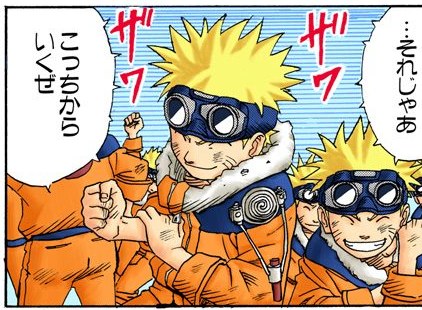
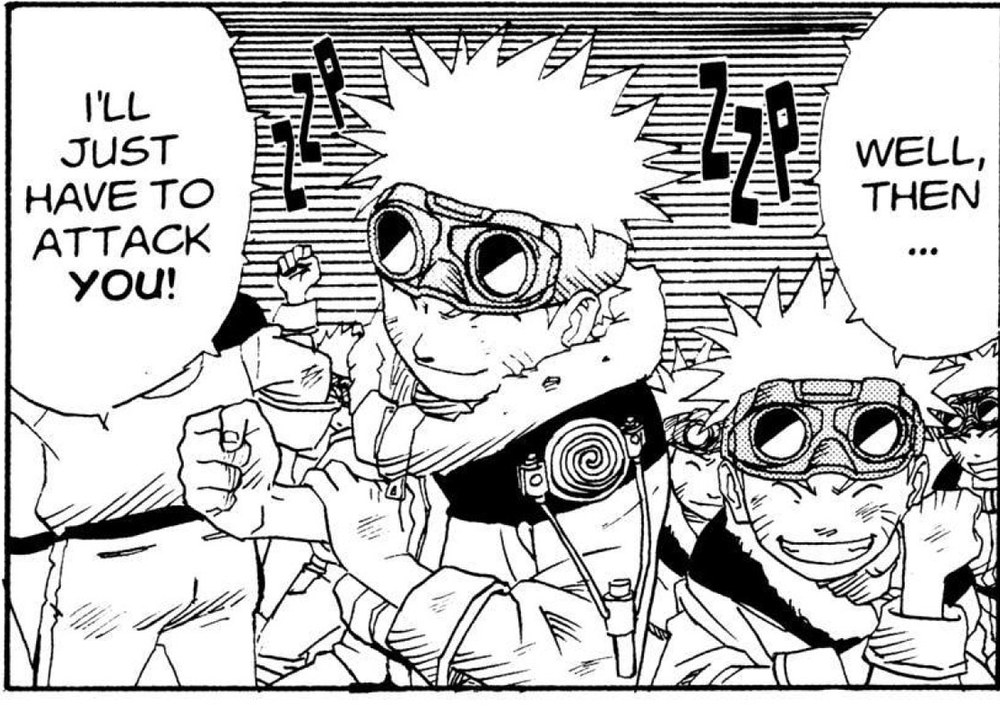
A thousand of him, and exactly one plan: straight ahead. The night Naruto steals the scroll and learns the technique VIZ calls the Art of the Doppelganger, he does not use his new army to lay a trap for the traitor Mizuki. The clones fill the clearing and the trees, jeering: 「どうしたよ 来いってばよ」 (dō shita yo, koi tte ba yo, "what's wrong? come on already") — VIZ: "WHAT'S THE MATTER, TOUGH GUY? COME AND GET ME!" And when Mizuki can't move, the whole grinning crowd rolls its sleeves up: 「…それじゃあ こっちからいくぜ」 (sore jā, kotchi kara iku ze, "fine, then we'll come at you"), VIZ's "WELL, THEN... I'LL JUST HAVE TO ATTACK YOU!" The beating itself is rendered entirely in sound effects.
Japanese has a four-character compound (yojijukugo) for exactly this approach to problem-solving: chototsu mōshin (猪突猛進).
Four kanji, one animal
The compound is two stacked two-kanji verbs:
- 猪突 (chototsu) — 猪 is the wild boar (on-reading cho; the native reading is inoshishi). 突 (totsu) is "thrust, crash into," the same kanji as in 突撃 (totsugeki, "charge, assault"). Together: "to rush like a boar."
- 猛進 (mōshin) — 猛 (mō) is "fierce," the kanji learners meet in 猛スピード (mō-supīdo, "breakneck speed"); 進 (shin) is "advance," as in 前進 (zenshin, "forward movement"). Together: "to press forward furiously."
Read aloud it is ちょとつもうしん — seven mora (cho·to·tsu·mo·u·shi·n). It takes する directly, so 猪突猛進する is "to bull ahead," and 猪突猛進型 (-gata, "-type") labels a person who fights, works, or lives that way.
One bonus fact hiding in the first kanji: in modern Chinese, 猪 means the domestic pig. Japanese kept it for the wild animal and coined 豚 for the farm one, which is why the boar of the Japanese zodiac is a bristling tusked charger and not a pink barnyard resident. The compound only works because of that: nobody was ever flattened by a pig.
The criticism built into it
Dictionaries gloss chototsu mōshin with the phrase 向こう見ず (mukōmizu, "without looking where you're going"). The folk image behind it is that a boar runs at full speed in a straight line and cannot turn. An older cousin word makes the judgment explicit: 猪武者 (inoshishi musha, "boar warrior"), a fighter who knows only the frontal charge — brave, and a liability. The same nuance survives in thoroughly modern settings: a manager can use 猪突猛進 to scold someone who launched a project without checking anything, job-hunting students who describe themselves with it in interviews are taught to attach a self-aware caveat, and people born in a boar year get it as the stock zodiac joke.
So when a Japanese speaker calls someone chototsu mōshin, it is usually not praise. At best it is a double-edged compliment: your engine is admirable, your steering is missing. That is worth knowing before you deploy it on a friend. (It can be worn proudly, too — Demon Slayer's Inosuke turned the word into a battle cry, and the joke lands precisely because the word is not a compliment.)
The word never appears in Naruto — and it fits him anyway
Full disclosure: 猪突猛進 never appears verbatim anywhere in the Japanese text of the manga; a search across all 72 volumes of the colored digital edition turns up nothing. It is not a word the series uses. It is the word Japanese readers and reviewers reach for about the series' hero, because his default answer to nearly any obstacle looks like the dictionary illustration: more force, straighter line.
The Mizuki scene above is the pattern's debut. Naruto has just learned the most tactically flexible technique imaginable, one that later shinobi strategists use for scouting, decoys, and information relay. His first instinct is to multiply himself a thousandfold and charge from the front. Iruka, watching, is astonished on exactly that point: 「へっ!本当に千人に分身しやがるとは……」 (hontō ni sennin ni bunshin shiyagaru to wa, "he really split into a thousand"), and in the next breath wonders whether the boy might one day surpass any Hokage who came before — VIZ: "I WOULDN'T BE SURPRISED IF SOME DAY HE REALLY DOES TURN OUT TO BE BETTER THAN ANY HOKAGE WHO'S COME BEFORE!" The series states its thesis in its first chapter: the boar-charge is not going to be framed as a flaw to fix.
The charge that hides a trick
Here is where Naruto quietly breaks the idiom. In the bell test two chapters later, Kakashi files him under exactly the stereotype the compound carries — 「御託ならべて大見得切ったってしょせんナルト…」, which VIZ renders with an English animal idiom of its own: "YOU'RE STILL ONLY NARUTO! YOU'RE A ONE-TRICK PONY." Then the trick lands. One clone had slipped away downstream and circled behind: 「影分身の術で一人だけ川下からこっそり上がって裏手に回り込んどいたんだってばよ!」 ("I isolated one of my doppelgangers... sent it out of the water posing as me, while I circled around behind you!"). Watching from hiding, Sasuke names it: 陽動作戦 (yōdō sakusen, "diversionary operation") — VIZ: "THE ART OF MISDIRECTION."
A textbook 猪突猛進 fighter cannot feint, because a feint requires the one thing the boar lacks: a second idea. Naruto's frontal wave turns out to be the screen for the second idea. The criticism embedded in the compound never quite sticks to him, and that gap — looks like a boar, thinks like a fox, at least sometimes — is a running engine of the early series. What looks like recklessness keeps getting reframed as sincerity: the shortest possible line between word and deed, the quality celebrated in yugen-jikko and in his promise-keeping (I never go back on my word, my shinobi way). And on the days the charge simply fails, its sibling compound shichiten-hakki takes over: he gets knocked flat, and gets up.
What each language gets
A Japanese reader gets the whole boar in one word: the zodiac animal, the folk zoology, the interview cliché, the faint smell of scolding. No English phrase carries that exact luggage, and VIZ sensibly does not try to import it; the taunts come out as fast, punchy schoolyard English ("COME AND GET ME!"), and where the register needs an animal, English supplies its own barnyard — that "one-trick pony." Not a loss so much as a swap: English idiom happens to keep a stable of charging-animal images (bull-headed, like a bull at a gate) that map onto Naruto just as naturally, and VIZ's snappier taunt rhythm arguably lands the clone scene's comedy harder than the Japanese does. What the English reader uniquely misses is only the dictionary echo: the little jolt a Japanese reader gets from watching a boy embody a word that is normally an insult and slowly argue it into a virtue.
Using it yourself
Describing someone else: expect it to read as criticism or affectionate teasing, roughly "he's a bulldozer." Describing yourself: fine, and common, but pair it with awareness (猪突猛進なところがあるので、確認を心がけています — "I have a headlong streak, so I make a point of double-checking"). And if you quote the clone army's taunt, note the 〜ってばよ tail on 来いってばよ: it is Naruto's personal speech tic, untranslatable enough to have an entry of its own.