The Moment
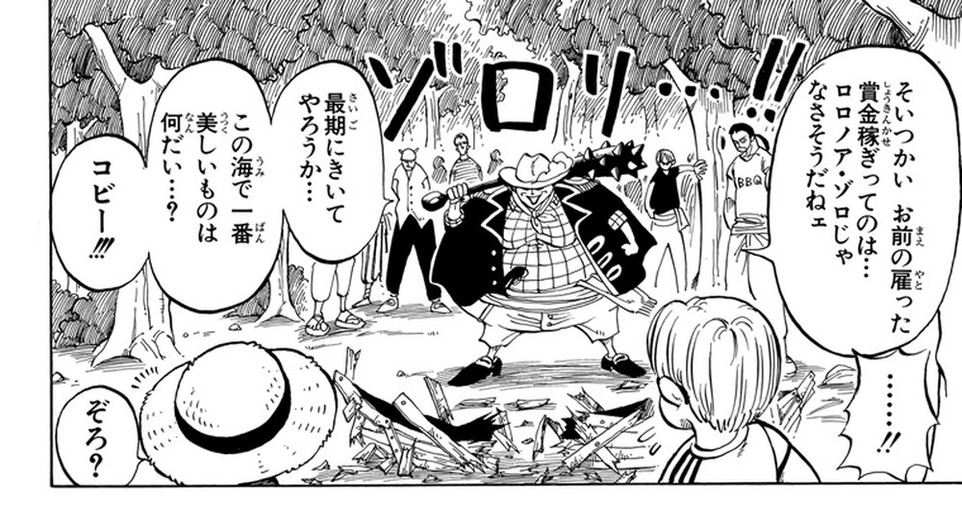
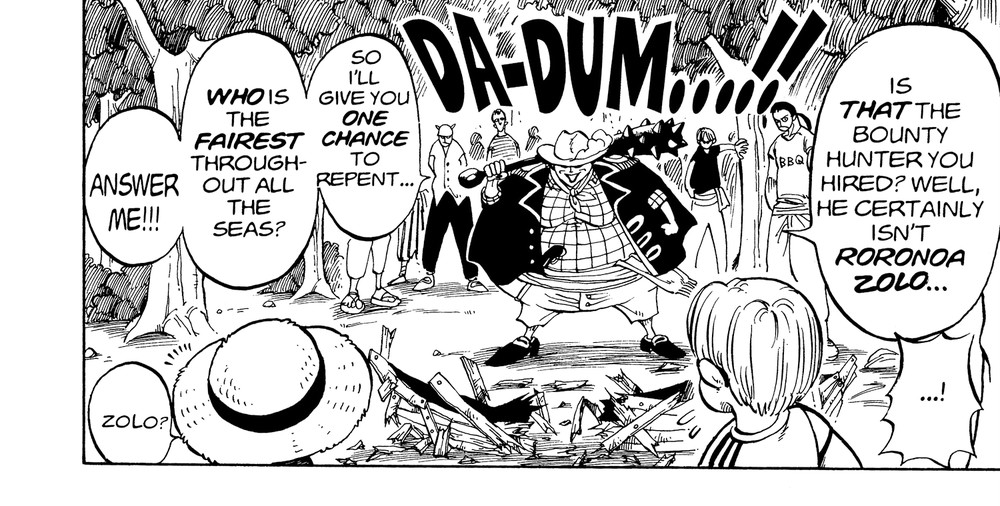
Shells Town, still several pages before Roronoa Zoro gets to be Roronoa Zoro on the page. Coby — the pink-haired cabin boy currently being hunted through the woods by his own captain — has just told Luffy, in a burst of nerve, that he's leaving Alvida's crew to join the Navy and personally arrest her one day. Alvida catches up to them anyway, spiked club in hand, and opens with her signature interrogation: 「この海で一番美しいものは何だい…?」 — "WHO IS THE FAIREST THROUGHOUT ALL THE SEAS?" (the correct, terrified answer is always "you, Captain Alvida"). While she corners Coby, one of her crewmen — a bald pirate in a "BBQ" tank top, sizing up the straw-hatted stranger Coby's brought along — mutters to a crewmate:
「そいつかいお前の雇った賞金稼ぎってのは…ロロノア・ゾロじゃなさそうだねェ」
Soitsu kai, omae no yatotta shōkinkasegi tte no wa… Roronoa Zoro ja nasasōda nē.
VIZ's English edition prints: "IS THAT THE BOUNTY HUNTER YOU HIRED? WELL, HE CERTAINLY ISN'T RORONOA ZOLO..." (Vol. 1, p.76).
It's a throwaway line, and the mook is wrong on every count — Coby hasn't hired anyone; the "bounty hunter" jab is just pirates being cruel to a scared kid. But as far as our corpus can confirm, this is the first time the words "Roronoa Zolo/Zoro" appear anywhere in VIZ's English One Piece — seven pages before Zoro himself gets a face, a jail cell, or a chapter title of his own. And Luffy, who will recruit that exact bounty hunter within the next ten pages and sail with him for the rest of the series, hears the name cold, for the first time, and mutters it back to himself under his hat, bottom-left of the same panel:
「ぞろ?」 — "ZOLO?"
Grant the choice its due before dismantling it: "Zolo" reads perfectly naturally in isolation. It scans, it sounds tough, nothing about the printed word signals "error." That's exactly what makes it durable — and exactly the problem. Whatever else this article argues, start here: the disputed spelling isn't a late-series slip that crept in over decades of freelance translators. It's present at the character's first breath in English, on page 76 of volume 1, and it is spelled with total, unwavering confidence.
The Original
ロロノア・ゾロ (Roronoa Zoro) carries no kanji at all. It's written wall-to-wall in katakana — the syllabary Japanese reserves for loanwords, foreign names, and sound effects — an immediate visual flag, to any Japanese reader, that this name comes from outside the Japanese naming tradition entirely. Split it at the interpunct (・) and the two halves have very different paper trails.
ロロノア (Roronoa) is a loanword once removed. It's Eiichiro Oda's katakana respelling of the surname of François l'Olonnais, a real 17th-century French privateer notorious enough in his own lifetime to earn the nickname "the Flail of the Spaniards" for his campaigns against Spanish colonial shipping in the Caribbean. The French surname L'Olonnais gets rebuilt through Japanese phonology into four moras — ロ・ロ・ノ・ア (Ro-ro-no-a) — about as close a fit as the katakana inventory can manage for a name that ends in a nasalized French vowel Japanese doesn't have a slot for. Zoro is, notably, the only member of the original Straw Hat crew whose name traces to an actual historical person.
ゾロ (Zoro), the given name, has no comparable paper trail. Oda has never published a source for it in an interview or an SBS Q&A column, and roughly two decades of fan speculation — a nod to ぞろぞろ (zorozoro), the onomatopoeia for a line of people or animals filing past "one after another"? some other truncation entirely? — has turned up nothing confirmed. Treat any confident etymology you read online for the given name with real skepticism; this article isn't going to invent one either.
What is certain, and what the entire dispute rests on, is phonology rather than etymology. ゾロ is two moras: ゾ (zo) and ロ (ro). That second mora belongs to what's called the ら-row (ra-gyō) in the Japanese syllabary — ラ・リ・ル・レ・ロ — and Japanese has exactly one consonant sound covering that whole row, a light alveolar flap that sits phonetically between an English L and an English R without matching either one precisely. Japanese speakers don't choose between L and R when they say ロ; the distinction simply isn't part of how the language organizes its consonants. English forces the choice the instant you write the sound down in the Roman alphabet, because English does distinguish law from raw. Every katakana word built on that row — from ライス (raisu, "rice") to ロボット (robotto, "robot") — carries this same latent fork, resolved case by case, name by name, translator by translator, entirely by convention and precedent rather than by anything the Japanese text itself specifies. ゾロ picked up its precedent from a business decision instead.
VIZ's Choice
We pulled every occurrence of ゾロ / ロロノア・ゾロ we could locate across Volumes 1 through 33 of VIZ's English One Piece and checked the printed English page — not just the automated transcript — for each one below. The character's name, as VIZ Media prints it, across roughly a decade of publication:
| Vol. / p. | Context | Japanese | VIZ English |
|---|---|---|---|
| 1 / 76 | An Alvida crewman doubts Luffy is "Roronoa Zoro" | そいつかいお前の雇った賞金稼ぎってのは…ロロノア・ゾロじゃなさそうだねェ | IS THAT THE BOUNTY HUNTER YOU HIRED? WELL, HE CERTAINLY ISN'T RORONOA ZOLO... |
| 1 / 76 | Luffy, hearing the name for the first time | ぞろ? | ZOLO? |
| 1 / 83 | Chapter 3's title card | 〝海賊狩りのゾロ、登場 | ENTER ZOLO-PIRATE HUNTER |
| 1 / 83 | Sanji explains the epithet to Luffy | ロロノア・ゾロは”海賊狩りのゾロ”という異名をもつ恐ろしい奴です | BUT THEY CALL HIM "ZOLO THE PIRATE HUNTER." |
| 10 / 53 | Zoro, mid-duel with the fishman Hachi | おれはな!!ロロノア・ゾロ!!“剣士”にとても強いんだ | SEE, RORONOA ZOLO!? I'M MORE THAN A MATCH FOR ANY SWORDSMAN. |
| 33 / 78 | A crowd cheering at the Davy Back Fight | ゾロ!! | ZOLO! |
| 32 / 193* | An announcer reads Zoro's post-Enies Lobby bounty | 6千万B〝ロロノア・ゾロッ!! | RORONOA ZOLO, WORTH 60 MILLION BERRIES!* |
* Vol. 32, p.193 (VIZ p.206): our bilingual corpus's automated transcript records the English line as "60 Million B 'Roronoa Zoro!!'" — misreading VIZ's own "Zolo" as the more familiar "Zoro," which is itself a small, almost funny demonstration of how strong the pull toward the "correct" spelling is. We checked the actual printed VIZ page by hand: the real bubble, restructured into a single line, reads "RORONOA ZOLO, WORTH 60 MILLION BERRIES!" — unmistakably "Zolo," consistent with every other row in this table. The rendering shown above is the hand-verified real print; rawCaptureEn in this article's references field preserves the corpus's byte-exact (if inaccurate) transcript per our sourcing rules, with this correction on record.
Seven citations, five separate volumes, roughly a decade of Japanese and English publication between the first and the last — and the spelling never once wavers to "Zoro" in the actual printed page. That consistency is the real story here, more than any individual line: this isn't a translator improvising differently scene to scene, the way most of the pitfalls on this hub document. It's a single decision, made once, upstream of any individual translator, propagating unchanged through more than three thousand pages of English One Piece.
The Gap
The romanization imports a distinction the Japanese source is structurally silent on. Japanese doesn't ask whether ゾロ "is" an L-sound or an R-sound — that question doesn't exist until the word gets romanized. VIZ isn't clarifying an ambiguity present in Oda's original; it's resolving Japanese's genuine phonological neutrality into one specific, non-standard, debatable English answer, and then printing that answer with the total unearned confidence of official typeset dialogue. Almost no English-only reader ever learns a choice was made at all — they simply meet "Zolo" as a fact, the way they meet "Luffy" or "Nami" as facts, with no signal that this particular name carries an asterisk none of the others do.
It severs a chain of custody the Japanese text keeps intact. ロロノア is a real French pirate's surname carried into katakana largely as-is; "Roronoa Zoro" would extend that same L/R-neutral transliteration logic evenly across both halves of the name, the way the Japanese original does. "Roronoa Zolo" welds one honestly-transliterated half to one half resolved by a completely different logic — a licensor's risk calculus, not phonology or etymology — so the printed English name looks etymologically unified in a way it structurally isn't. A reader who goes looking for l'Olonnais will find the surname lines up; the given name is doing something else entirely, for reasons the page never discloses.
It produces a canon-split no Japanese reader has ever had to navigate. The JP text is always, unfailingly ゾロ — one spelling, one character, across the manga, the anime, the games, the toy line, everything Shueisha licenses. English readers, depending entirely on which shelf they bought from, meet two different official spellings for the same person with no editorial note bridging them: Funimation's dub (2007 onward), every mainline video game, and the merchandise all say "Zoro"; VIZ's manga, alone among major licensed products, still says "Zolo." That's not a nuance quietly falling out of a sentence the way it does in most of the pitfalls on this hub — it's a referential fork, one character splitting into two printed identities because two licensing departments made two different calls two decades apart and neither has revisited the other's.
The reported original justification has also mostly evaporated. "Zolo" is widely attributed to a defensive move against Zorro Productions Inc., the trademark holder behind the swordsman Zorro, inherited from 4Kids Entertainment's 2001 anime dub and carried into VIZ's contemporaneous manga translation for consistency with the TV series airing at the time (treat the exact legal reasoning as reported, not confirmed — none of 4Kids, VIZ, or Shueisha has ever gone on record with the specifics). Some retellings tie the caution specifically to Zorro Productions' history of aggressive trademark and copyright assertions in French- and Italian-market comics and parodies over the following decades — the company's most visible European fights have landed there — which is the likeliest source of the "France" detail that circulates in fan versions of this story; it's plausible lore, not a documented cause. What's better documented: in May 2018, a U.S. federal court ruled that Zorro had fallen into the public domain, undercutting the legal caution the spelling was reportedly built around for any new work. "Zolo" has persisted in VIZ's manga anyway, less as an active legal strategy at this point than as an unexamined holdover nobody has had the budget or the mandate to correct — which is presumably why two separate Change.org petitions, years apart, have independently asked VIZ to just fix it.
What If
For a name rather than a line of dialogue, the "alternatives" are really policy choices, each with a real cost:
- Retire "Zolo" outright, match "Zoro" across the catalog — the way the anime license did in 2007. Merit: ends the split, matches fan expectation, matches the actual transliteration and its French-pirate etymology. Cost: re-lettering the SFX-dense pages of dozens of back-catalog volumes is an expensive continuity project no publisher volunteers for on a legacy title that already sells briskly exactly as it is.
- Keep "Zolo" in the original single-volume printings as a historical artifact, standardize new formats going forward (omnibus 3-in-1s, digital, future reprints) on "Zoro." Merit: treats the discrepancy the way film preservation treats a studio-mandated title change — honestly, instead of erasing print history. Cost: guarantees the exact patchwork this article documents, permanently, just redistributed across formats instead of volumes.
- Add a one-time translator's note at the character's first appearance (Vol. 1, p.83) explaining the spelling and its reported origin. Merit: converts twenty years of silent reader confusion into one paragraph of transparency. Cost: One Piece's English edition has never once broken its fourth wall with an editorial footnote inside the main text, and Shueisha's licensing terms are notoriously resistant to any visible added apparatus.
- Do nothing — let context (the art, the katakana on Japanese-language tie-in goods, two decades of wiki and fandom culture) carry the disambiguation, the way VIZ effectively has since 2003. Merit: zero cost, zero new decisions. Cost: is the status quo that produced two Change.org petitions and this article.
Take-away
"Zolo" isn't a mistranslation in the usual sense this hub tracks — nobody misread a kanji or picked the wrong sense of a polysemous word. It's a romanization choice, made once, for reasons outside the text, that has outlived the reasons and kept propagating anyway.
Three rules of thumb to carry off this page:
- Katakana loanword names are always a resolved ambiguity, not a fact. Every ら-row name you meet in Japanese media — this one included — passed through a moment where a real human being had to decide L or R with no help from the Japanese text itself. Ask what that decision was based on before trusting it as neutral.
- Consistency isn't the same as correctness. VIZ's "Zolo" is remarkably, admirably consistent — seven citations, five volumes, a decade, and it never wavers. That consistency made it easy to document in this article. It has nothing to do with whether the spelling is right.
- A name can fork without anyone "translating" anything wrong in the moment. Two licensors made two independent, locally reasonable calls in the early 2000s. Neither call was corrected against the other later. The result, twenty years on, is a single manga character with two official English names and zero editorial acknowledgment of the gap — worth remembering any time "the official translation" is treated as a single, unified, authoritative thing.
For more on how VIZ's One Piece translation treats Zoro specifically, see 外道 (gedō), the Buddhist heretic-word English scatters into "stinking," "brute," and "fiend" every time Zoro's own dialogue uses it — a case where the inconsistency runs the opposite direction from this one: too many English words for one Japanese concept, instead of two English spellings for one Japanese name. For a word where VIZ's scatter is driven by genuine untranslatability rather than a legal dodge, see 因縁 (innen), the karmic tie English splits five different ways. Browse the full One Piece translation notes index for more.
Every Japanese and English line quoted above is a byte-exact capture from the cited editions — ONE PIECE Vol. 1–33 (Japanese) and One Piece (VIZ Media) at the corresponding panels — via our bilingual page database, with one noted exception (Vol. 32, p.193), where the automated transcript itself misread VIZ's "Zolo" as "Zoro" and the rendering discussed in the body was confirmed by hand against the printed page image; see Sources below.