The Moment
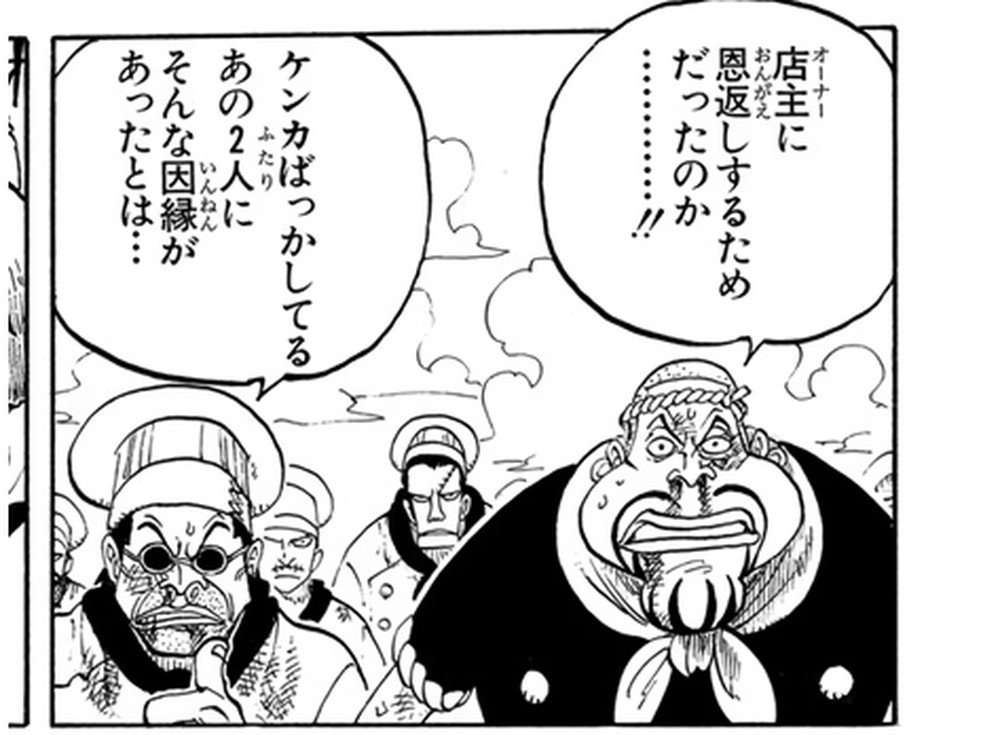
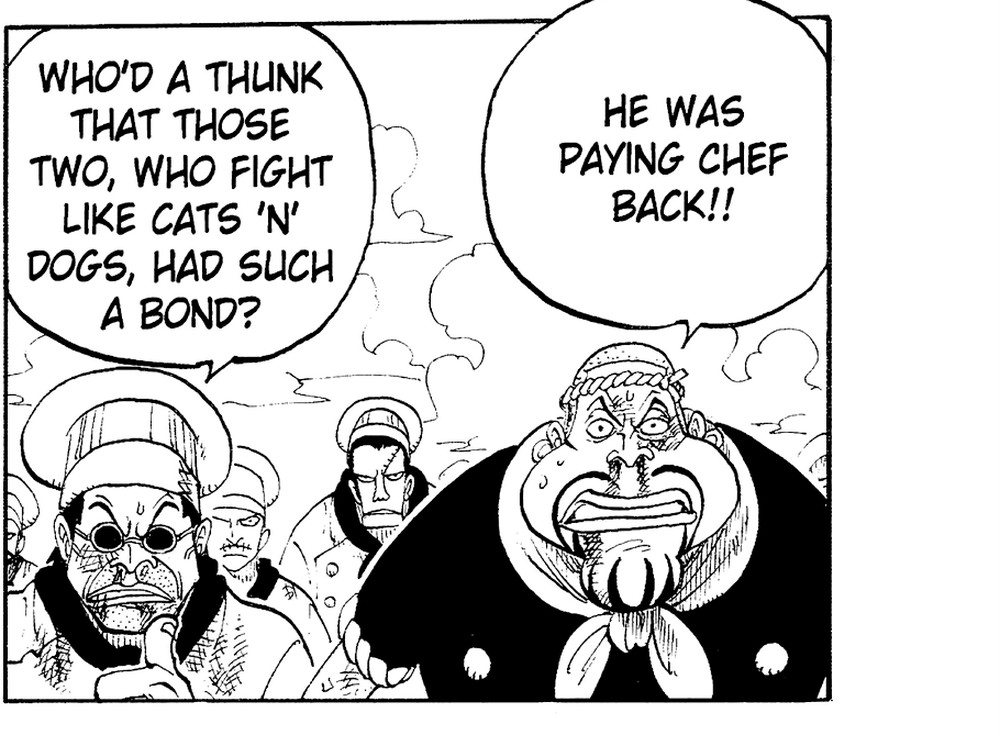
The Baratie — the floating restaurant where the East Blue's rowdiest cooks serve lunch between brawls. Everyone aboard knows one fixed law of the place: the young sous-chef Sanji and the peg-legged old owner Zeff do nothing but fight. Then the story behind the fighting surfaces, and it turns out the fighting was never the story: the kid has been repaying the old man all along. A bubble beside our line reads 「店主に恩返しするためだったのか」 — "HE WAS PAYING CHEF BACK!!" — and one of the onlookers, watching the whole relationship re-arrange itself in front of him, murmurs:
「ケンカばっかしてるあの2人にそんな因縁があったとは…」
Kenka bakka shiteru ano futari ni sonna innen ga atta to wa…
VIZ's English edition prints: "WHO'D A THUNK THAT THOSE TWO, WHO FIGHT LIKE CATS 'N' DOGS, HAD SUCH A BOND?" (Vol. 7, p.111).
Grant the rendering its due first: it is lively, it fits the Baratie's tone, and "bond" is not wrong. But listen to the two lines side by side. The Japanese trails off into silence — that sentence-final とは… is the "to think that…" of quiet awe, of someone re-seeing everything he thought he knew. The English does vaudeville: "WHO'D A THUNK," "CATS 'N' DOGS." And the word carrying all the weight — 因縁 (innen) — comes out as "bond," which is perhaps a third of what it says.
The Original
Take 因縁 apart, because both halves are worth owning.
因 (in) is "direct cause." You know it from 原因 (gen'in, "cause") — the thing that makes something happen.
縁 (en) is "indirect condition; connection" — and it is the same 縁 as ご縁 (go-en), the everyday Japanese word for a fateful human connection, the one in またご縁がありましたら ("if fate brings us together again"). Where 因 is the push, 縁 is the field the push happens in.
Together, 因縁 is the Japanese rendering of the Buddhist doctrine of hetu-pratyaya: nothing arises from a cause alone; it needs conditions too. The seed is the 因; the soil, the rain, the season are the 縁. Only together do they make a tree. That is real theology — and then, as Buddhist vocabulary tends to do in Japanese, the word walked out of the temple and got a street life. In everyday speech 因縁 covers a whole family of entanglements:
- a karmic tie between people — "we were fated to meet";
- a long-standing score — "I have old business with that man";
- the origin-story behind a thing or a feud — the history that explains the present.
And one famous set phrase runs the meaning all the way downhill: 因縁をつける (innen o tsukeru), "to pick a fight on a pretext" — literally to attach an innen to someone, to invent a karmic grievance where none exists. It is what a movie delinquent does to a stranger in a bar. Sports pages, meanwhile, love 因縁の対決 — the "grudge match" whose backstory is half the spectacle.
So the one word covers "we were fated to meet" AND "I have an old score with him." Hold that double life in mind — it is exactly what English is about to fail at. Grammar-wise there is nothing exotic here: the headline line is just [PERSON に 因縁がある], "there was such innen between those two." As vocabulary, 因縁 is JLPT N1 and the bare 縁 roughly N2 — but chase the concept, not the level.
VIZ's Choice
Here is every appearance of 因縁 in the volumes we have on file, side by side with the official English. Read down the right-hand column:
| Vol. / p. | Japanese | VIZ English |
|---|---|---|
| 3 / 78 | ちょっとじゃねェ因縁の仲さ!! | NOW, THAT'S NOT NICE. OUR FATES ARE INTERTWINED. |
| 7 / 111 | ケンカばっかしてるあの2人にそんな因縁があったとは… | WHO'D A THUNK THAT THOSE TWO, WHO FIGHT LIKE CATS 'N' DOGS, HAD SUCH A BOND? |
| 10 / 36 | お前がおれをどんな因縁で殺したがってようが関係ねェ…もう状況は変わってんだよ | WHAT YOU THINK DOESN'T MATTER. THE TABLES HAVE TURNED. |
| 34 / 71 | 別に恨みはねェよ…因縁があるとすりゃあ… | I HAVE NOTHING AGAINST HER.. IF I HAVE ANY CONNECTION WITH HER AT ALL... |
| 35 / 139 | 何か今までにアイスバーグ氏が命を狙われる様な因縁などありませんでしたか!? | IS THERE ANYTHING IN MAYOR ICEBERG'S PAST THAT COULD EXPLAIN THIS ASSASSINATION ATTEMPT? |
Five appearances. "Fates… intertwined," "bond," nothing at all, "connection," "past." Five scenes, five different solutions, zero shared vocabulary — the classic signature of a word with no fixed seat in English.
And each solution is locally defensible. In Vol. 3, a pirate looming over someone caught with his crew's boat purrs 因縁の仲 with heavy sarcasm — "OUR FATES ARE INTERTWINED" is actually the most faithful of the five, keeping both the fate-word and the menace. In Vol. 35, a reporter shouting questions about the attempt on Mayor Iceberg's life uses 因縁 for "whatever in his history could make someone want him dead" — "ANYTHING IN MAYOR ICEBERG'S PAST" is a clean journalistic fit. The translator is not napping; the translator is improvising, every single time, because English never built the word.
The Gap
One concept, five English words — and the thread snaps. A Japanese reader meets 因縁 in a pirate's sarcasm, a cook's awed murmur, a killer's dismissal, an admiral-scene confession, a reporter's shout — and each time the same word lights up: karmic entanglement, the past binding the present. The English reader meets "fates," "bond," "connection," "past," and a blank, and has no way to know these scenes rhyme. The scatter isn't just lexical loss; it deletes a recurring idea from the book.
In Vol. 10, the karma vanishes entirely. The Japanese is お前がおれをどんな因縁で殺したがってようが関係ねェ — "whatever karmic grudge drives you to want me dead, it doesn't matter… the situation has changed." The speaker concedes that a real history exists — his enemy has just screamed 「てめェはおれの同胞をいっぱい斬りやがったんだ!!!」 ("AND YOU WIPED OUT MY COMRADES!!!") — and dismisses it anyway. That concession-plus-dismissal is the cruelty of the line. VIZ compresses the whole clause to "WHAT YOU THINK DOESN'T MATTER." — as if the grievance were an opinion. The tables turn either way, but in English nobody ever had a karmic claim to begin with.
恨み vs 因縁 — a distinction English can't hold. In Vol. 34, asked what he has against Robin, a Navy admiral answers: 別に恨みはねェよ…因縁があるとすりゃあ… He is drawing a line between two different words: 恨み (urami), the hot personal resentment, which he denies — and 因縁, the impersonal fated entanglement, which he half-admits. No grudge; but karma, maybe. VIZ gives "I HAVE NOTHING AGAINST HER.. IF I HAVE ANY CONNECTION WITH HER AT ALL..." — accurate in outline, but "nothing against her" versus "connection" turns a metaphysical distinction into small talk. The Japanese line says their histories are tangled whether he feels anything or not. The English line says they're acquainted.
What If
For the Baratie line, the menu and its prices:
- "To think those two, always at each other's throats, shared a fate like that…" — keeps the awe of とは… and the fateful weight. Cost: "fate" sounds grander than a cook's casual murmur.
- "Who knew those two had that kind of history?" — "history" is English's best all-purpose seat for the entangled-past side of 因縁, and the register stays natural. Cost: the karmic overtone is gone without a trace.
- "So all this time, those two were bound to each other…" — "bound" gestures at the tie. Cost: wordy, and it leans on the artwork to say what the word no longer does.
- Keep "bond," cut the vaudeville: "TO THINK THOSE TWO, ALWAYS FIGHTING, HAD SUCH A BOND…" — Cost: still under-translates 因縁, but the quiet awe survives, and quiet awe was half the line.
Notice what every option shares: each one picks a side of 因縁 — fate, history, or bond — and hides the rest. That is not the translator failing; that is English lacking a word whose whole point is refusing to pick.
Take-away
因縁 is hard not because it is rare but because it straddles a line English insists on drawing: the warm fated tie and the hostile old score are, in Japanese, one karmic thread. When a translation gives you "bond" here and "grudge" there, the thread is real — it's just been cut to fit the sentence.
Three rules of thumb to carry off this page:
- When you meet 因縁, ask which face is up — fated tie or old score — and then remember the word itself refuses to choose. That refusal is the meaning.
- Collect 縁 (en) wherever it appears — ご縁, 縁がある, 縁を切る ("to sever ties") — it is the warm, human face of the same karmic vocabulary.
- Keep 因縁 apart from 因果 (inga): 因果 is the machinery of cause and effect (因果応報, "what goes around comes around"); 因縁 is the tangled relationship the machinery leaves behind.
For another line where a Buddhist word slipped out of the English, see the Buddhist death buried in 往生際が悪い — or browse the One Piece translation notes index.
Every Japanese and English line quoted above is a byte-exact capture from the cited editions — ONE PIECE Vol. 3–35 (Japanese) and One Piece (VIZ Media) at the corresponding panels — via our bilingual page database; see Sources below.