The Moment
Shells Town, East Blue. Roronoa Zoro has spent a month lashed to a wooden post in the Marine base courtyard — the price for humiliating the corrupt Captain Morgan's son — and he is telling Monkey D. Luffy, who wants him for a crew, exactly why the answer is no.
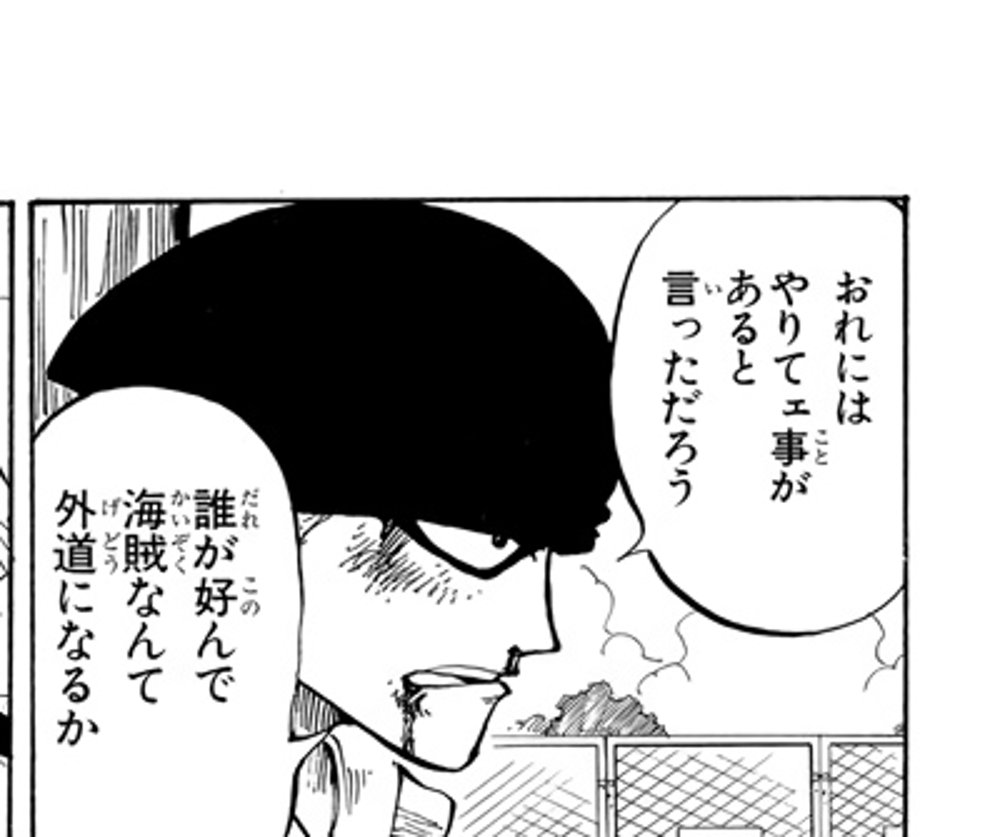
「おれにはやりてェ事があると言っただろう…誰が好んで海賊なんて外道になるか」
Ore ni wa yaritē koto ga aru to itta darō… dare ga kononde kaizoku nante gedō ni naru ka.
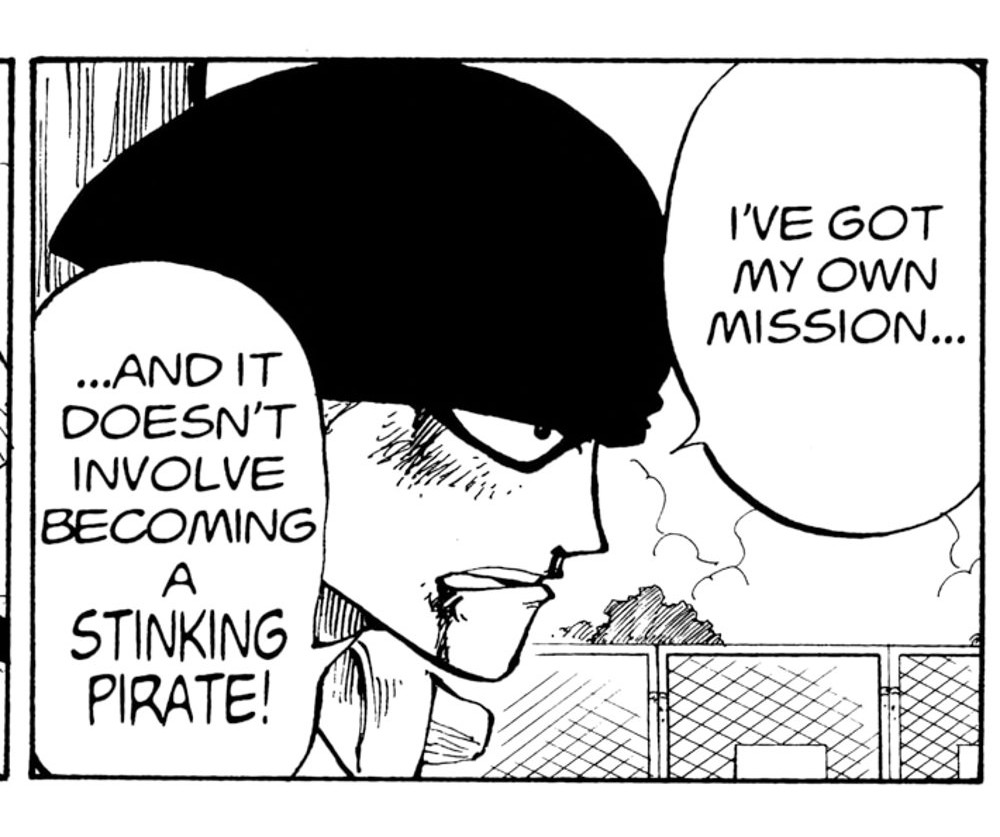
VIZ's English edition prints: "I'VE GOT MY OWN MISSION... AND IT DOESN'T INVOLVE BECOMING A STINKING PIRATE!" (Vol. 1, p.110).
Give the line its due first: it's punchy, it fits a proud teenage swordsman spitting words through a chain-link fence, and "stinking" does real work — it's exactly the register of a kid too proud to explain himself further. But listen to what Zoro is actually saying. He isn't just calling pirates smelly. Grammatically, 海賊 ("pirate") and 外道 sit in apposition — 海賊なんて外道になる isn't "become a pirate, who also happens to be gross"; it's "become a pirate, WHICH IS TO SAY, a gedō," one noun standing in for the other, pirate defined AS heretic. Zoro's real claim is that piracy is, categorically, a life lived off the one true Path. VIZ keeps every ounce of his contempt and quietly drops the equation underneath it.
The Original
外道 (gedō) is two kanji you already own separately. 外 (soto/gai) is "outside" — the same 外 in 外国 (gaikoku, "foreign country") and 外れる (hazureru, "to come off, to miss"). 道 (dō) is "road, path, Way" — the same 道 that ends 剣道 (kendō, "the way of the sword"), 茶道 (sadō, "the way of tea"), and, most relevantly, 仏道 (butsudō, "the Buddha's Path," Buddhism's own name for its own teaching). Put them together and 外道 means, with total literalism, the path outside the Path.
That capital-P Path is doctrinal. In classical Japanese Buddhism, 外道 is the Sino-Japanese rendering of the Sanskrit tīrthika — literally "ford-maker," the term Buddhist writers used for rival ascetic and Brahmanical schools in ancient India: real teachers, real disciplines, just not the teaching. A 外道 wasn't automatically evil. He was, technically, correctly, on the wrong road. Buddhism organized its entire non-Buddhist religious world this way — every teaching that wasn't the Dharma got filed under one label, defined purely by its position relative to the one Way. That is the same move Zoro's line still makes, eight centuries and one ocean later: pirate equals gedō, because a road exists — society, law, whatever code Zoro himself lives by — and piracy departs from it.
Centuries of ordinary speech wore the doctrine down and kept the sting. By the time it lands in a Shōnen Jump speech bubble, 外道 is street slang: "fiend," "degenerate," "inhuman wretch" — the word a Japanese speaker reaches for when "bad guy" isn't strong enough. 外道の所業 ("a gedō's deed") is what you call a crime so low it offends even other criminals. The theology has left the speaker's conscious mind. It's still baked into the grammar: nothing can stand OUTSIDE a path that was never there. Every time a character spits 外道 at someone, the sentence quietly assumes a correct road is out there somewhere — even if nobody on the page could tell you where it goes.
VIZ's Choice
Every appearance of 外道 (the noun, not the homophone-adjacent 以外道, "no other way," which we screened out and discuss below) across the volumes on file:
| Vol. / p. | Japanese | VIZ English |
|---|---|---|
| 1 / 110 | 誰が好んで海賊なんて外道になるか | ...AND IT DOESN'T INVOLVE BECOMING A STINKING PIRATE! |
| 6 / 43 | そんな外道は見殺しにするのが | THAT TWO-FACED SCOUNDREL SHOULD STARVE!! |
| 9 / 90 | コイツは根っから性の腐った外道だったんすよ!! | SHE WAS ROTTEN FROM THE START !!! |
| 9 / 189 | 外道......!! | YOU CHEAT !!! |
| 16 / 99 | くそ...ハァ...ハァ...あんな外道どもの手を借りるとは...!!! | BLAST... WEEZ WEEZ... YOU'D ASK THOSE VILLAINS FOR HELP!? |
| 19 / 122 | ...外道って言葉はコイツにピッタリだな | THIS GUY GIVES SCOUNDRELS A BAD NAME. |
| 22 / 11 | 外道が... | THAT FIEND ... |
| 33 / 60* | すでに外道!! | SHE'S A BRUTE!! * |
| 33 / 109 | 審判に攻撃するなんて彼もまた外道なのか~っ!? | HE ATTACKED THE REF! HE'S A BRUTE TOO! |
| 33 / 148 | その名も!!”外道”!!!航海士ナミ | SHE'S NAM! "THE BRUTE" NAVIGATOR!! |
* Vol. 33, p.60: our bilingual database's automatic jp↔en alignment drops this pairing (recorded as unmatched, no English text attached). We confirmed the true VIZ rendering by hand against the printed English page: in the same panel, the Japanese runs 「”信じる心”って…何ですか?」「知るか!!!」「すでに外道!!」 stacked as three short caption bubbles, and the English page runs the matching three bubbles「...DO YOU KNOW WHAT IT MEANS...」「WHADDA I CARE ?!!」「SHE'S A BRUTE!!」 in the same order, in the same panel. The aligner shifted by one bubble; the real translation of すでに外道!! is SHE'S A BRUTE!!, not the blank the database shows.
Seven different scenes, seven different English solutions, and not one repeats a word: "stinking," "two-faced scoundrel," "rotten … from the start" (which drops the noun and its verdict entirely, keeping only the moral judgment), "cheat," "villains," "gives scoundrels a bad name," "fiend." That's the expected shape of a word with no fixed English seat — the translator improvises fresh, every time, and every choice is locally defensible.
Then something more interesting happens. In the space of about ninety pages — the Davy Back Fight's donut race, Volume 33 — 外道 lands on Nami three separate times, always from the same wisecracking narrator/announcer voice that comments on the race like ringside commentary. VIZ answers all three with "brute." "SHE'S A BRUTE!!" (p.60). "HE ATTACKED THE REF! HE'S A BRUTE TOO!" (p.109, about Sanji, briefly borrowing Nami's word). "SHE'S NAM! 'THE BRUTE' NAVIGATOR!!" (p.148, delivered as an actual ring nickname). Read only in English, this looks like a deliberate running joke, a nickname the localizer built for Nami on purpose. Read against the Japanese, it's something subtler: the manga's narrator keeps reaching for the same word, 外道, because the bit only lands if it's the identical accusation each time — a girl fans call sweet turns out, three times running, to be fighting dirty. English reconstructs that repetition almost by accident, because "brute" happened to fit the commentary-track register three times in a row, not because the translator was tracking one Japanese word across ninety pages.
The Gap
The apposition collapses. 海賊なんて外道になる isn't "become a pirate, who is also gross" — it's "become a pirate, WHICH IS TO SAY, a gedō," one noun defining another. "...BECOMING A STINKING PIRATE" turns that two-noun equation into an adjective plus a noun, and the equation itself — piracy equals stepping off the Path — disappears along with the missing noun.
The Path never enters English at all. Across all ten occurrences, not one English rendering gestures at a road, a teaching, or an "outside." "Brute," "fiend," "scoundrel," "cheat" all judge behavior; none of them judge position. A reader working only from the English editions could read every volume on this list and never suspect that One Piece characters keep accusing each other of practicing the wrong religion.
Severity is a coin flip, not a scale. 外道 aimed at Crocodile — a warlord orchestrating a country's destruction — and 外道 aimed at Nami — throwing peanuts to sabotage a fairground donut race — are the identical word, carrying the identical weight; the manga trusts scene and tone to supply the difference, the way English trusts "jerk" to mean something different at a funeral than at a football game. VIZ's scatter ("GIVES SCOUNDRELS A BAD NAME" for Crocodile, "BRUTE" for Nami) happens to land at roughly the right relative severity for each scene — but only because a fresh, careful guess was made ten separate times, not because one English word tracked the constant underneath.
Nami's nickname is a coincidence wearing a costume. See VIZ's Choice above: three renderings of "brute" in ninety pages reads, in English alone, like an invented running gag. It IS a running gag — just one the Japanese text built with the same word on purpose, and English rebuilt with a different word by luck.
What If
For the headline line, the menu and its prices:
- "...AND IT DOESN'T INVOLVE WALKING A HERETIC'S ROAD." — keeps the literal path-and-heresy image explicit. Cost: "heretic's road" is an odd collocation in English and stalls the reader mid-panel to parse it.
- "...AND IT DOESN'T INVOLVE TURNING MY BACK ON DECENCY TO DO IT." — keeps the "stepping off something" vector of 外道 without importing foreign religious vocabulary. Cost: "decency" is a much softer, secular standard than a Buddhist Path.
- "...NOT BY BECOMING SOME GODLESS OUTLAW." — "godless" at least signals Zoro's objection is spiritual, not hygienic. Cost: swaps the Buddhist frame for a vaguely Judeo-Christian one — the wrong religion, the same trick VIZ pulled turning 往生しろ into "rest in pieces."
- Keep VIZ's punch, restore the noun: "...AND IT DOESN'T INVOLVE BECOMING SOME PIRATE DEGENERATE." — "degenerate" at least names a category of person, the way 外道 does, instead of just describing an odor. Cost: still no Path, no heresy — English still can't say what piracy is a departure FROM.
Take-away
外道 always assumes a 道 — a road, a teaching, a correct way of living — even when the manga never bothers to name what that road is. English's insult shelf judges what someone DID; 外道 judges where someone IS STANDING, relative to a Path the sentence takes for granted.
Three rules of thumb to carry off this page:
- When you meet 外道, ask "outside of what?" — even if the story never answers, the question is the whole meaning. The word is a position, not a personality trait.
- Collect the X-道 family. 外道, 内道, 邪道, 極道, 仏道, 剣道 — Japanese routinely builds moral and vocational identity as "which road you're on," a metaphor English uses far more sparingly (we "go astray" or "walk the straight and narrow," but rarely build a whole vocabulary of insults on it).
- A repeated insult isn't always a translator's invention. When one English word clusters suspiciously on one character (see Nami's three "brutes"), check whether the Japanese repeated ITS word first — the joke may already exist in the original, and the English is reconstructing it by coincidence.
外道 has good company on this hub. 畜生 (chikusho), the Buddhist curse-word for being born into the animal realm, and 自業自得 (jigou-jitoku), the karmic verdict VIZ turns into battle advice, are both Buddhist cosmology doing insult-and-idiom duty exactly the way 外道 does. For the karmic tie that 外道's missing partner 内道 quietly implies exists, see our piece on 因縁. (For the record: a search of our Demon Slayer corpus for this article turned up exactly one string containing these two characters — 以外道はない, "there is no OTHER WAY [than to keep struggling]," from 以外 "except" plus 道 "way" — a different word entirely, correctly discarded; no genuine noun-form 外道 has yet surfaced in the Kimetsu no Yaiba volumes we have indexed.) Browse the full One Piece translation notes index for more.
Every Japanese and English line quoted above is a byte-exact capture from the cited editions — ONE PIECE Vol. 1–33 (Japanese) and One Piece (VIZ Media) at the corresponding panels — via our bilingual page database, with one noted exception (Vol. 33, p.60), where the automated alignment dropped the English pairing and the rendering shown was confirmed by hand against the printed page image; see Sources below.