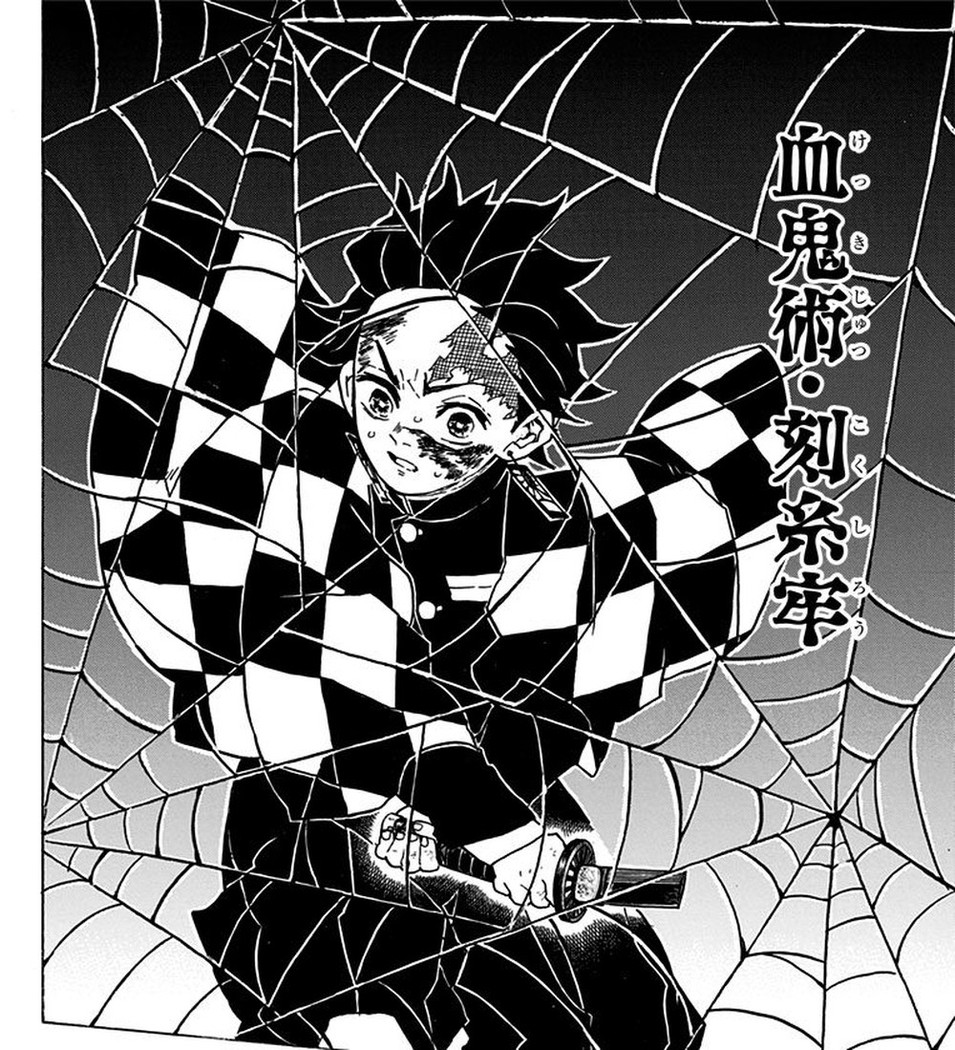
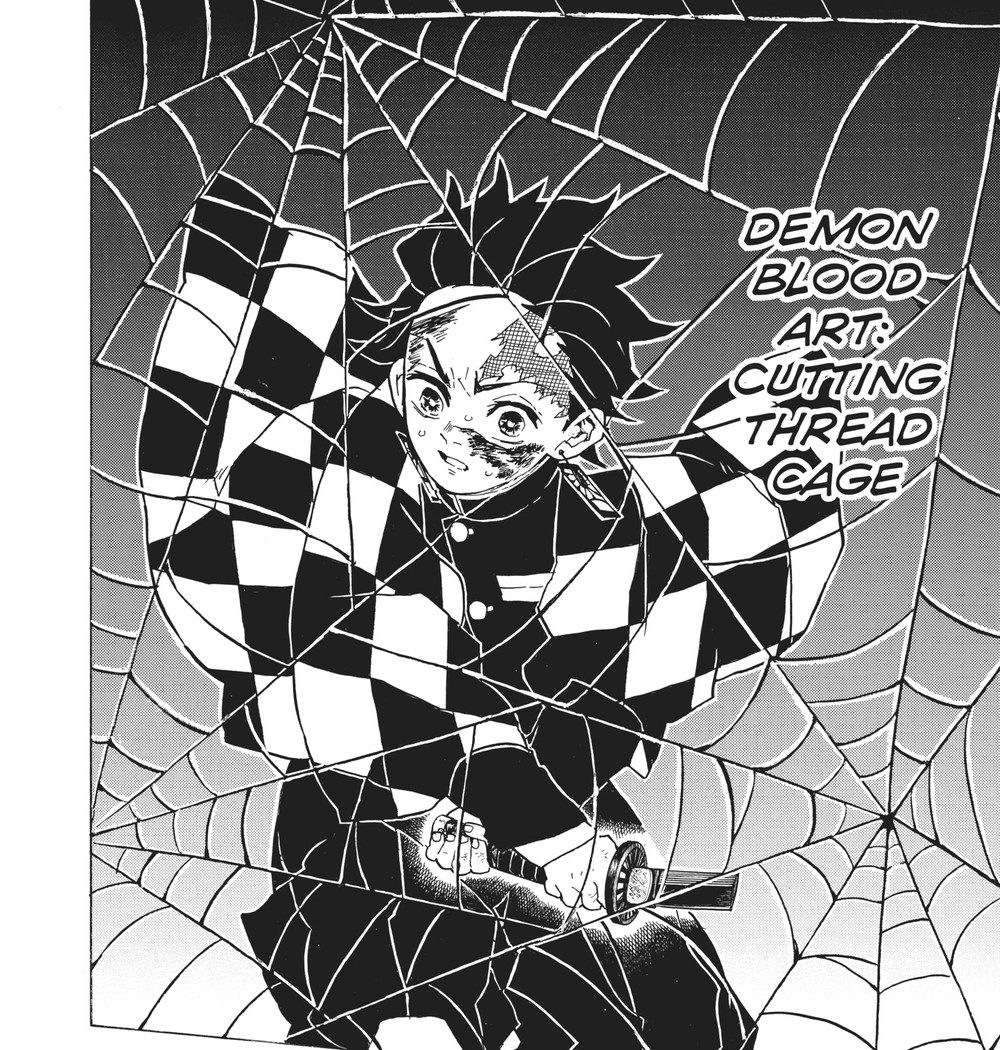
VIZ's "CUTTING THREAD CAGE" is a rare case of the English landing almost word-for-word on the Japanese structure — thread, cutting, cage, in that order of information if not exact word order — while still losing the compactness of the four-kanji original. 刻糸牢 fits in the same visual footprint as "Water Surface Slash"; "Cutting Thread Cage" needs three English words to cover ground two kanji (糸牢, thread-cage) plus one verb kanji (刻, carve) covered in Japanese. The corpus's own OCR-derived English for this exact line, "BLOOD POWER: CUTTING THREAD CAGE," actually shows the pipeline's transcription slipping on the style-level callout — the real printed VIZ text above Tanjiro's caged silhouette reads "DEMON BLOOD ART: CUTTING THREAD CAGE," not "BLOOD POWER." It's a useful reminder that 血鬼術 itself was still being calibrated across the early volumes; VIZ's now-standard "Blood Demon Art" wording was already in place by Volume 5, even if this particular OCR pass mis-transcribed it.
Rui is the first Twelve Kizuki member the reader meets, and 刻糸牢 sets the template every later demon technique in this dictionary works against or riffs on: a plain descriptive compound (material + action + container) with none of the classical flourish of Akaza's later vocabulary or the sword styles' nature-poetry. That flatness is deliberate — Rui is a demon obsessed with recreating a nuclear family by force, and his threads are functional tools of domination before they're anything else. There's no ornamentation in his naming because there's none in his worldview.
The panel this technique is drawn on is the full-page reveal immediately before Rui's "Goodbye. I've had enough of you" — the closest thing the early volumes have to a villain monologuing over a captured hero, except Gotouge draws it in total silence apart from the technique callout itself. The web isn't just a weapon in this panel; it's compositional, with Tanjiro's face caught dead-center in a spiral of his own visible fear. It's one of the few technique-naming panels in the corpus that reads as a portrait rather than an action shot.