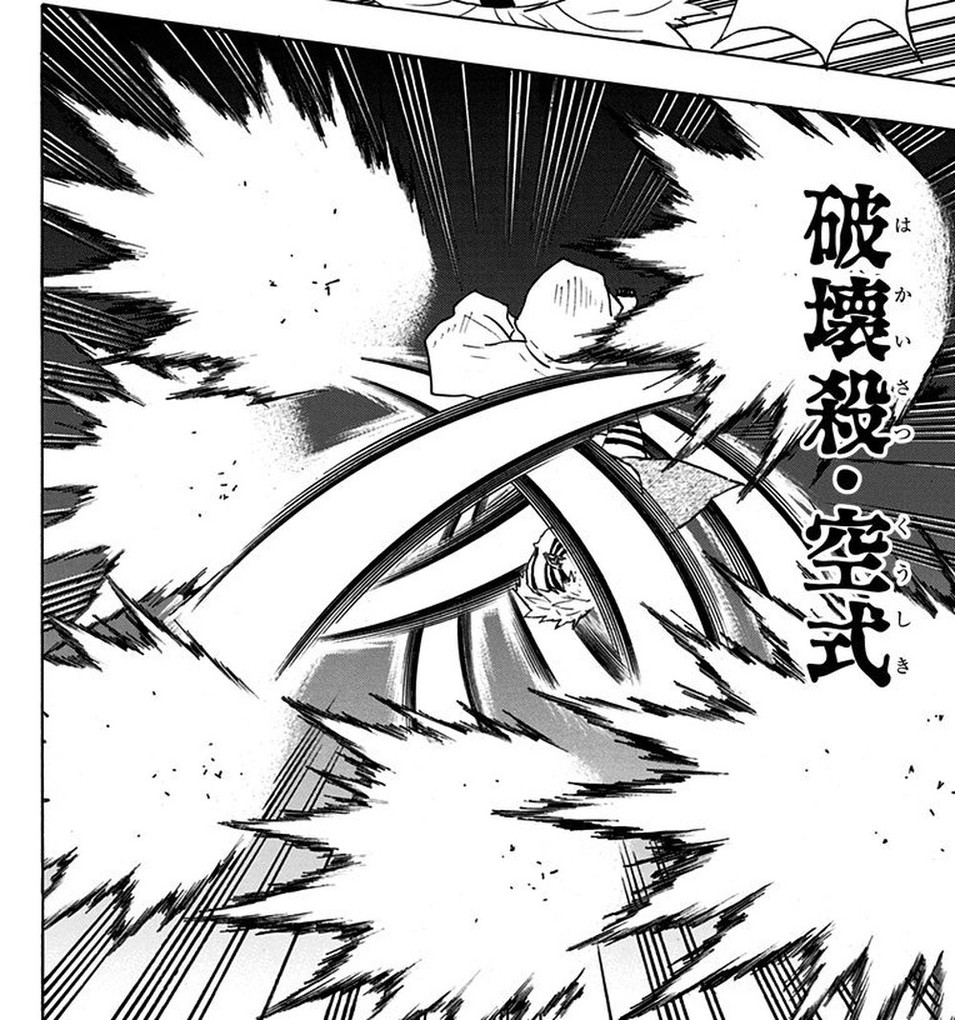
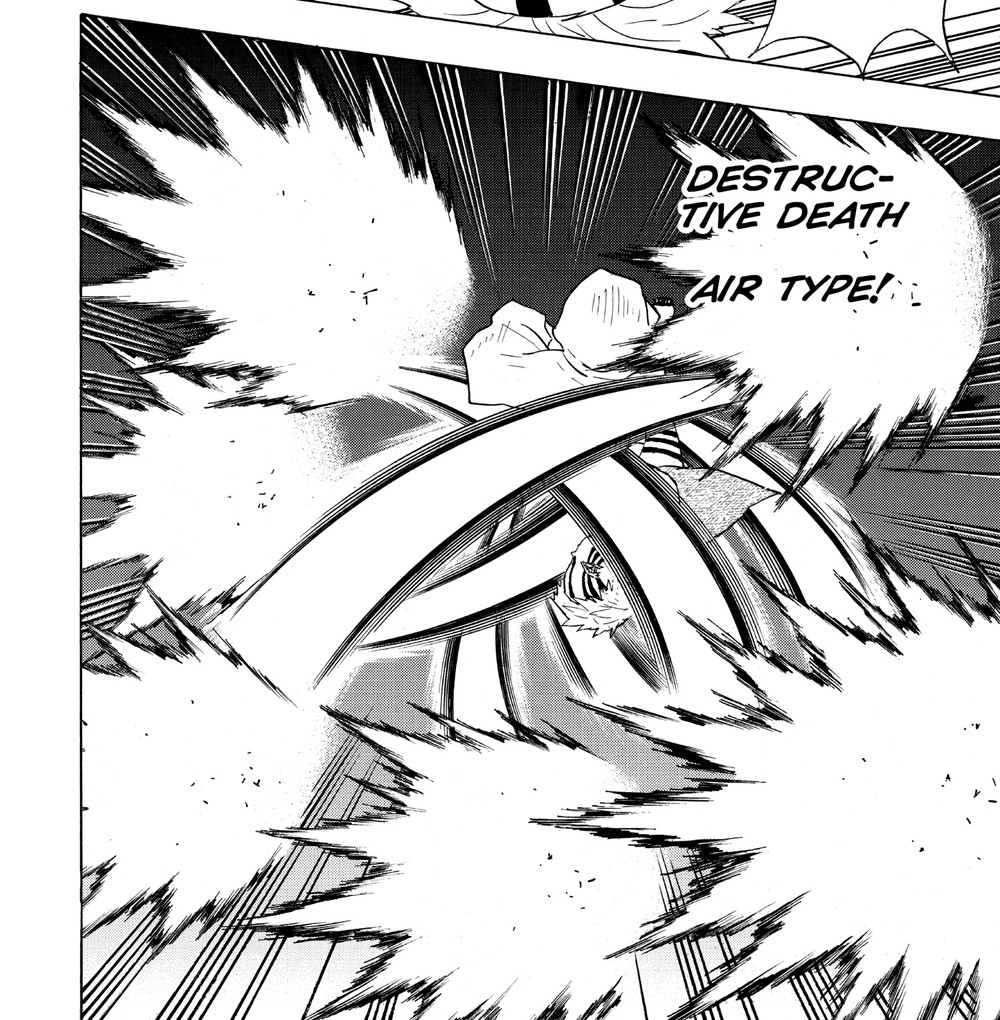
空式's 空 does triple duty that no single English word captures cleanly: it's the medium the attack travels through (air), the visual absence at the point of impact (emptiness, a compressed vacuum), and a distant echo of martial-arts vocabulary where "empty" already means something in Japanese (空手, "empty hand" — no weapon needed). VIZ's "AIR TYPE" takes the first meaning and lets the other two go, which is the right call for a splash-panel callout that needs to read instantly, but it does flatten a name that a Japanese reader versed in even casual martial-arts terms would recognize as gesturing at unarmed-strike tradition generally, not just at moving air.
The choice of 式 over 型 across all four of Akaza's named techniques in the corpus (羅針, 空式, 乱式, 滅式) is worth dwelling on, because every sword-based breathing style in this dictionary uses 型 without exception — 壱ノ型, 弐ノ型, and so on. 式 carries more of a sense of "formula" or "method" than "form" or "pattern"; it's the character in 方式 (houshiki, "method, system") and 儀式 (gishiki, "ritual, ceremony"). Akaza fights unarmed, with a body he's spent over a century reshaping according to his own private discipline, and his vocabulary reflects that: not a style passed down and numbered by a teacher, but a personal system he alone developed and named.
This is also the technique whose corpus context is the most narratively loaded in this dictionary. The two pages before the attack (Vol. 8, p.42) show Akaza in genuine, if warped, distress — "I can't stand it. Die for me, Kyojuro, while you're young and strong!" — offering Rengoku demonhood as what Akaza sincerely believes is a gift, framed by his own tragic backstory of losing everything as a human. Rengoku's refusal, delivered moments earlier, is the emotional core of the Mugen Train arc; 空式 is simply the mechanism by which that refusal gets answered. Reading the technique name in isolation gives none of that weight — it's the surrounding dialogue captured in this entry's sources that turns four syllables into one of the series' most quoted death scenes.