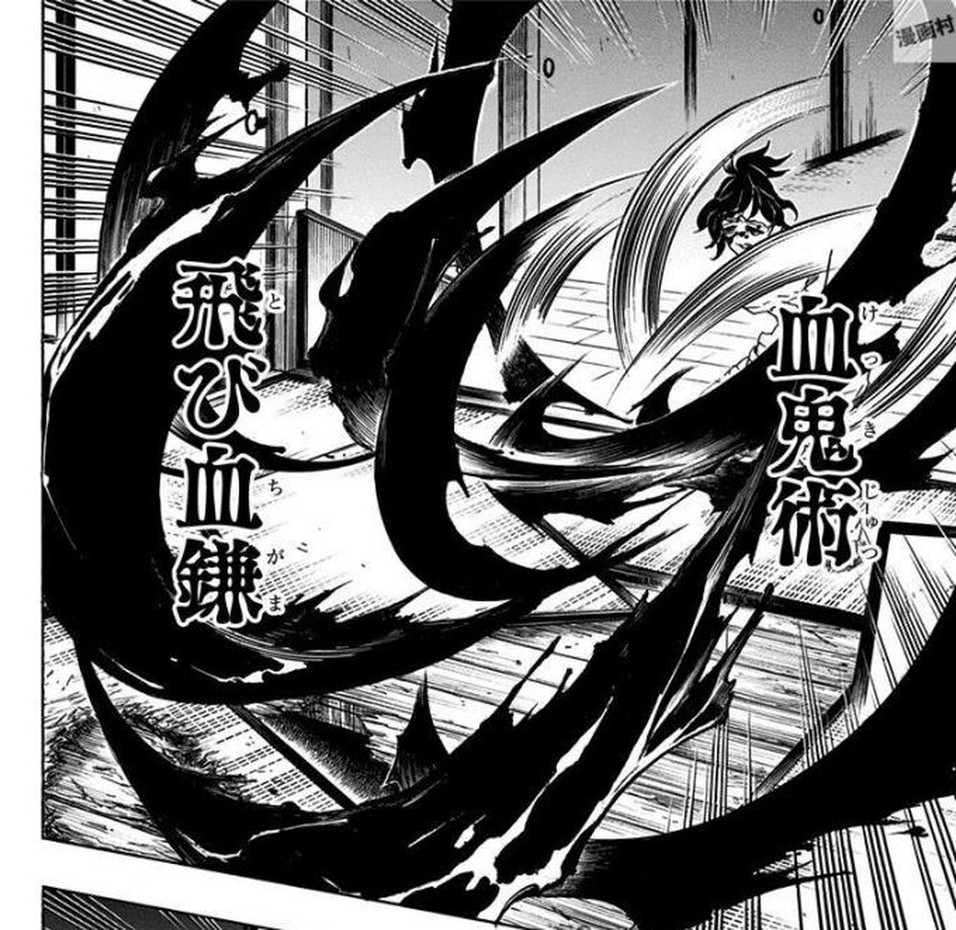
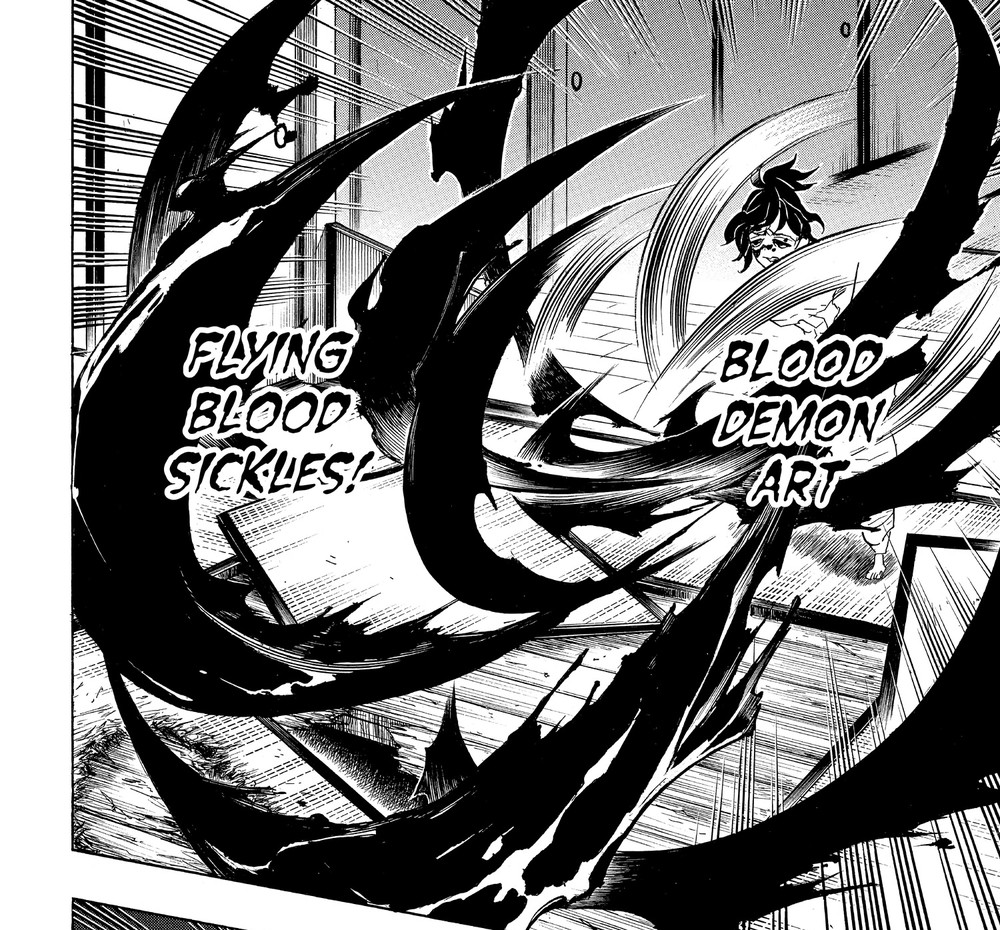
"Flying Blood Sickles" is one of the cleanest one-to-one translations in this entire dictionary — four English words for four Japanese morphemes, no compression, no added or dropped imagery. That's partly because the phrase is built from ordinary vocabulary rather than classical or invented compounds: 飛ぶ, 血, and 鎌 are all words a Japanese elementary-schooler knows, unlike Akaza's 破壊殺 or Doma's more baroque ice-technique names elsewhere in the corpus. Gyutaro's naming register throughout the Yoshiwara arc stays blunt and physical — poison, blood, sickles — which matches a character whose entire life before becoming a demon was defined by violence he didn't choose and could only survive by inflicting more of it.
The corpus captures a second, more garbled invocation of the same technique two pages later (品10巻140), rendered by VIZ as "FLYING BLOOD SICKLES... TURN!" — Gyutaro redirecting the blades mid-flight rather than casting them fresh. That a demon can verbally steer a weapon already airborne, simply by naming it again, is a small but telling detail about how Blood Demon Arts function as spoken commands as much as physical attacks throughout the series: saying the technique's name isn't just narration for the reader, it's often the activation mechanism itself.
Gyutaro's sickles carry a lethal poison independent of the cutting damage, which the corpus notes explicitly a few pages earlier ("MY BLOOD SICKLES ARE POISONOUS") — meaning the technique's threat isn't the blade geometry alone but a compounding effect VIZ's four-word title can't carry on its own. It's a reminder that this dictionary's answer-first translations of technique names are necessarily partial: 飛び血鎌 tells you what the weapon looks like, not what it does to you after it connects, which the surrounding dialogue has to supply.