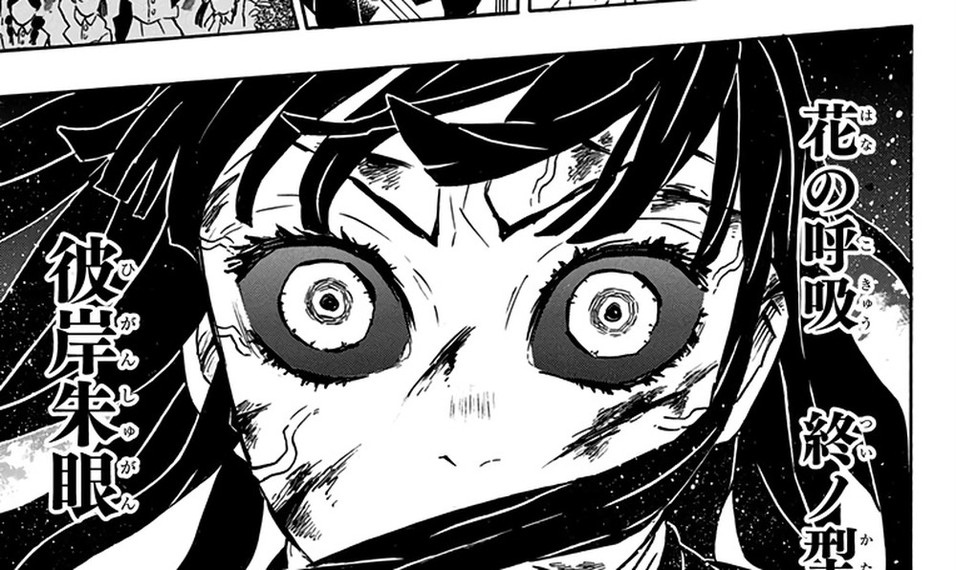
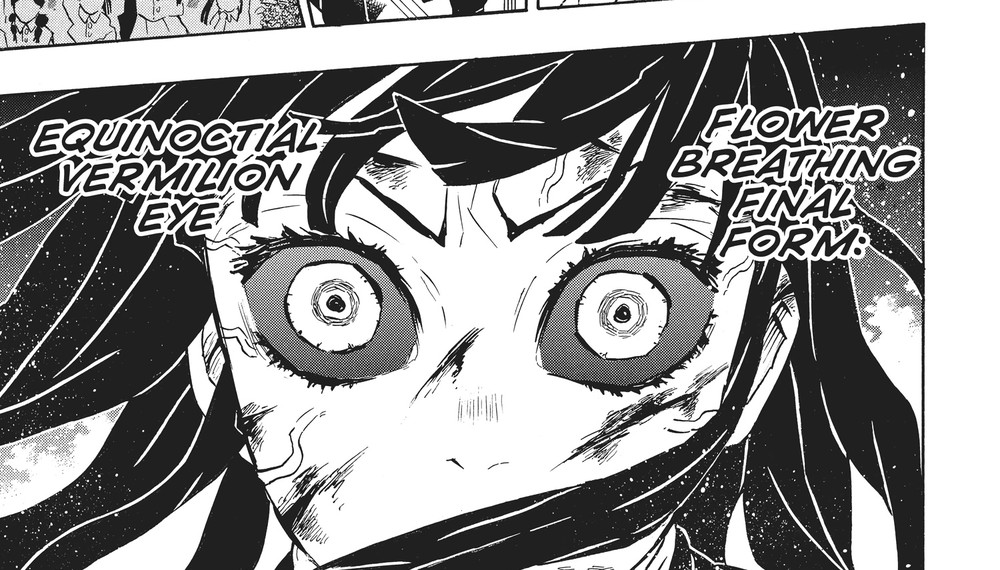
彼岸 is doing at least three jobs at once in this name, and VIZ's "Equinoctial" only surfaces one of them. Its plainest meaning is calendrical — the equinox, higan, a real annual Buddhist observance in Japan when families visit graves because the sun's due-east/due-west path is believed to align this world with the next. Its religious meaning is cosmological — the "far shore" of enlightenment across the river of death from 此岸, this suffering shore, a term embedded throughout Japanese Buddhist vocabulary. And its botanical meaning, unstated but almost certainly present given the flower this entire style is named for, points at 彼岸花 — the red spider lily (higanbana) that blooms specifically during the autumn equinox, is traditionally planted along graves and paddy borders because its bulb is toxic to pests and rodents, and carries centuries of association with death, final partings, and the road to the underworld. A Flower Breathing technique landing on a word that simultaneously means "equinox," "the shore of the afterlife," and — by direct botanical implication — "the flower of death" is not a coincidence in a series this attentive to naming; it's the single densest pun on this entire hub.
VIZ's "Equinoctial Vermilion Eye" picks the calendar meaning as its English anchor and lets the other two ride along unstated, which is arguably the only workable choice — there's no single English adjective that carries "equinox," "far shore of nirvana," and "spider lily" simultaneously the way 彼岸 does for a Japanese reader. What survives the translation intact is 朱 for "vermilion" rather than the more generic "red": VIZ is careful to keep this technique's color distinct from Fourth Form's crimson (紅) hanagoromo, preserving the fact that Gotouge chose two different red kanji for two different techniques in the same style rather than reusing one.
The technique's cost is the emotional core of both scenes it appears in. Shinobu's dying warning — "if you use that technique, Kanao... you may go blind" — is delivered on the page immediately before this callout in Volume 19, and Kanao invokes it anyway, deliberately overriding the one person whose approval she'd spent the whole series seeking. Its second appearance, four volumes later against Kaigaku, replays the same risk-calculation in miniature: an internal monologue about evading a demon who "just now turned into a demon" — meaning his reflexes haven't caught up to his new body yet, buying her a narrow window to push her eyes past their limit again. Reading Final Form's two occurrences side by side turns this dictionary hub's occurrences list into something more than a citation table: it's the shape of Kanao choosing, twice, to risk her sight for a decisive hit.
Both instances also carry a shared corpus quirk worth flagging for readers using the underlying bilingual database directly. The Volume 19 debut lands in a stretch of that volume with a confirmed +1 English-pagination offset, so the corpus records a completely blank English field for this technique's Japanese callout — the real VIZ text sits one page later. The Volume 23 recurrence has no such offset and pairs cleanly, which is why it's cited here with its English text intact rather than blank.