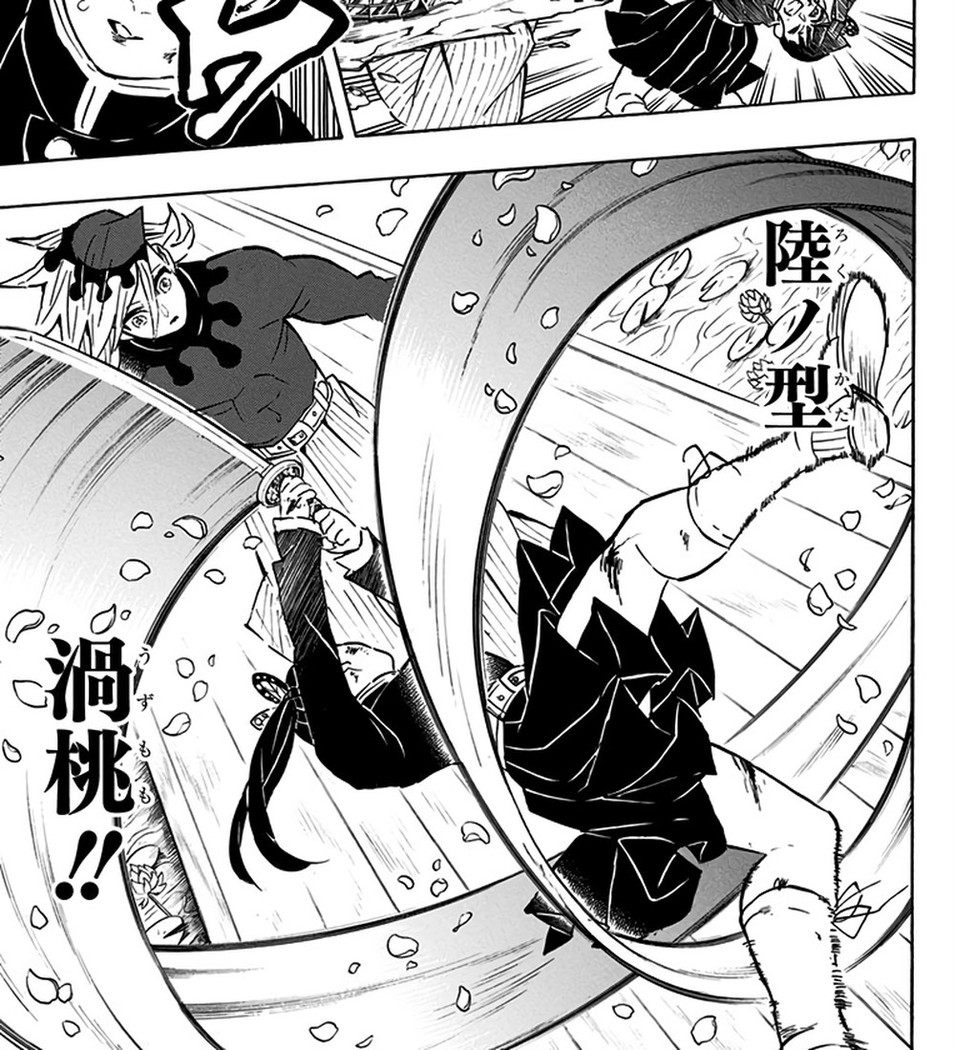
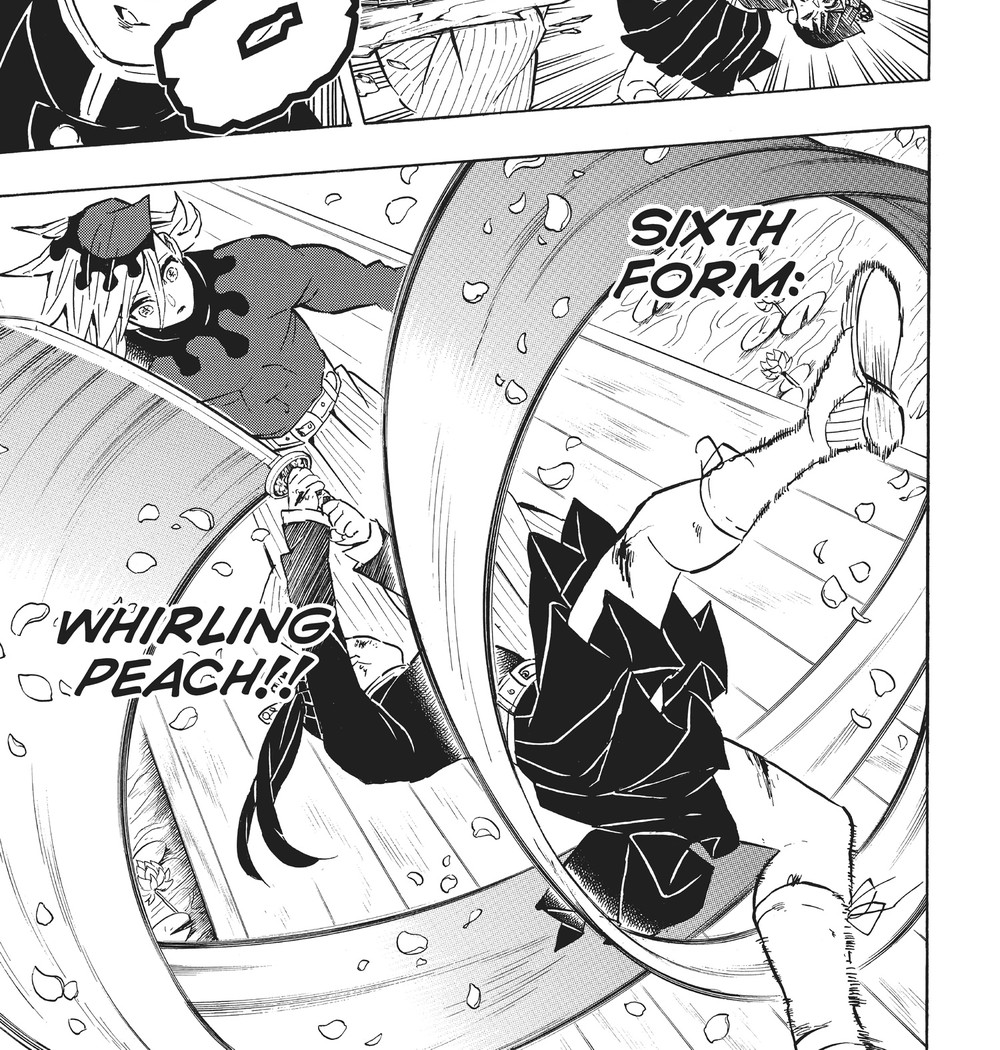
Sixth Form completes a small pattern running through this style's naming that's easy to miss reading the forms in isolation: two of Kanao's numbered techniques on this hub are named for stone-fruit blossoms one season apart — Second Form's 梅 (plum, the first flower of the year, blooming through snow) and Sixth Form's 桃 (peach, blooming weeks later in early spring). Between them sits Fourth Form's crimson hanagoromo and Fifth Form's peony — the four together read less like a numbered martial sequence and more like a seasonal flower-arranging calendar, which is presumably the point: Flower Breathing is explicitly the style Kanao absorbed by watching her adoptive sister Kanae and mentor Shinobu, neither of whom trained her in it formally, so its form names lean toward aesthetic association rather than martial description.
桃 also isn't a neutral fruit to reach for in this franchise. Peaches carry a specific exorcistic charge in Japanese myth going back to the Kojiki, where Izanagi throws peaches at the pursuing thunder-demons of Yomi (the underworld) to drive them off — the origin point for peaches-as-ward-against-evil that later surfaces in folklore like Momotarō, the peach-born boy who grows up to defeat oni. A demon slayer naming a whirling killing strike after the fruit that mythologically repels demons is very likely not a coincidence, even if the manga never states it outright; it sits alongside this hub's Water Breathing and Sun Breathing entries as another case where a technique name quietly recruits centuries of folklore into a single two-kanji label.
As with this style's Second and Fifth Forms, the corpus's automatic OCR pass badly fragments this callout — the source page's dense, radiating-line artwork (the panel is built around a literal spinning vortex of speed lines) leaves the vertical text "陸ノ型" and "渦桃!!" split into unrelated-looking fragments (「陸,」and「桃!!」) with no visible connection between them in the raw extracted pairs. It's the same caution flagged on this hub's Second Form entry: always confirm against the actual page image before trusting an automatically split OCR fragment as a complete technique name.