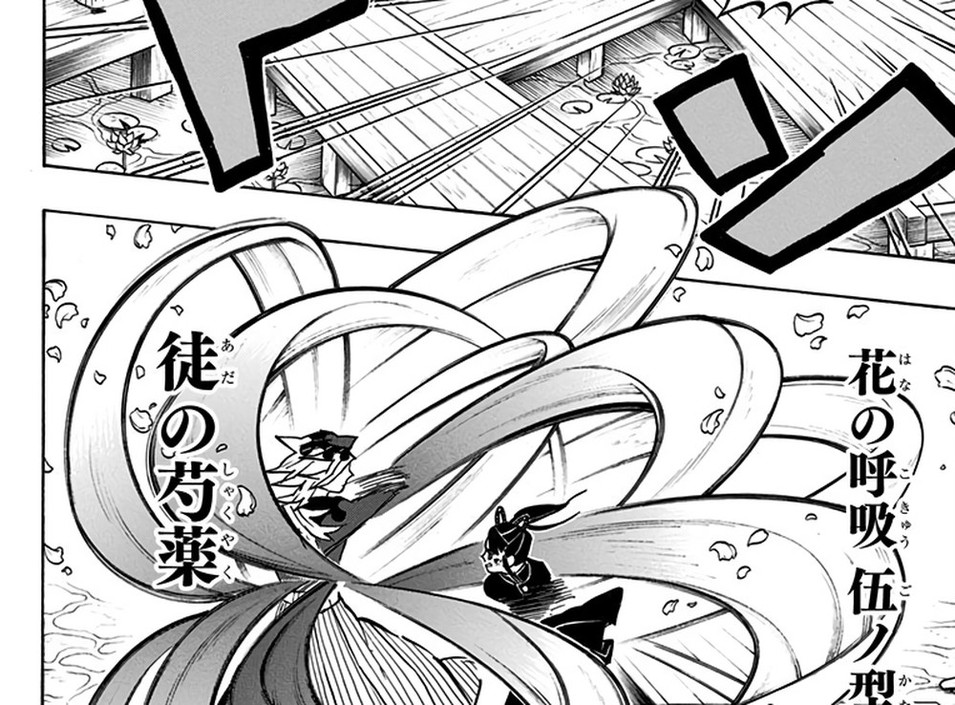
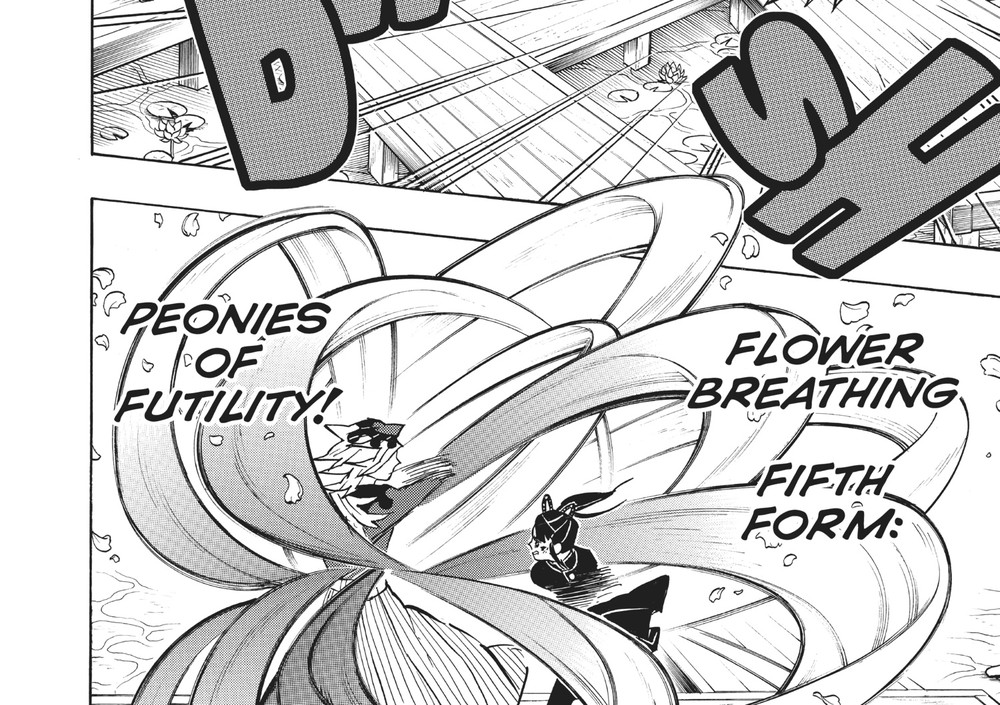
The name only works if you already know 徒花 (adabana) — "a vain flower," one that blooms showily and then bears no fruit, used figuratively for beauty or effort that comes to nothing. 徒の芍薬 recombines that same rare reading of 徒 with 芍薬 specifically, reaching past 徒花's usual generic "flower" to name the one flower most bound up in Japan's oldest beauty proverb. VIZ's "Peonies of Futility" gets the sense right — futile, vain, fruitless — but an English reader gets none of the proverb underneath it; there's no equivalent tradition of ranking women's beauty against three specific standing, sitting, and walking flowers for the phrase to evoke.
Read against the fight itself, the futility is not abstract. This form lands partway through Kanao's technique chain against Doma, a demon who has just diagnosed her fighting style out loud — noting her micro-adjustments, her eye movements, calling her clever but ultimately doomed ("小賢しいうえに並の剣士ができることじゃない" — "not something an ordinary swordsman could pull off, and clever besides" — appears on the very next page). A gorgeous, many-petaled slash named for a flower that blooms without ever bearing fruit, thrown at an opponent who is actively out-thinking her in real time, turns the technique's own name into commentary on the fight: beautiful, and — for now — not enough.
The corpus's automatic pairing garbles this entry more than any other technique on this hub. The OCR pass misreads 薬 (yaku, "medicine/drug" — the second half of 芍薬) as 栗 (kuri, "chestnut"), producing the nonsense string 徒の芍栗; a few pages earlier in the same fight, 御影 gets caught in a similar scramble. Both are minor single-character slips, but they're a reminder that even a clean, in-continuity manga corpus needs its rawCapture bytes checked against the actual page — see this hub's Second Form entry for the fuller version of that same caution.