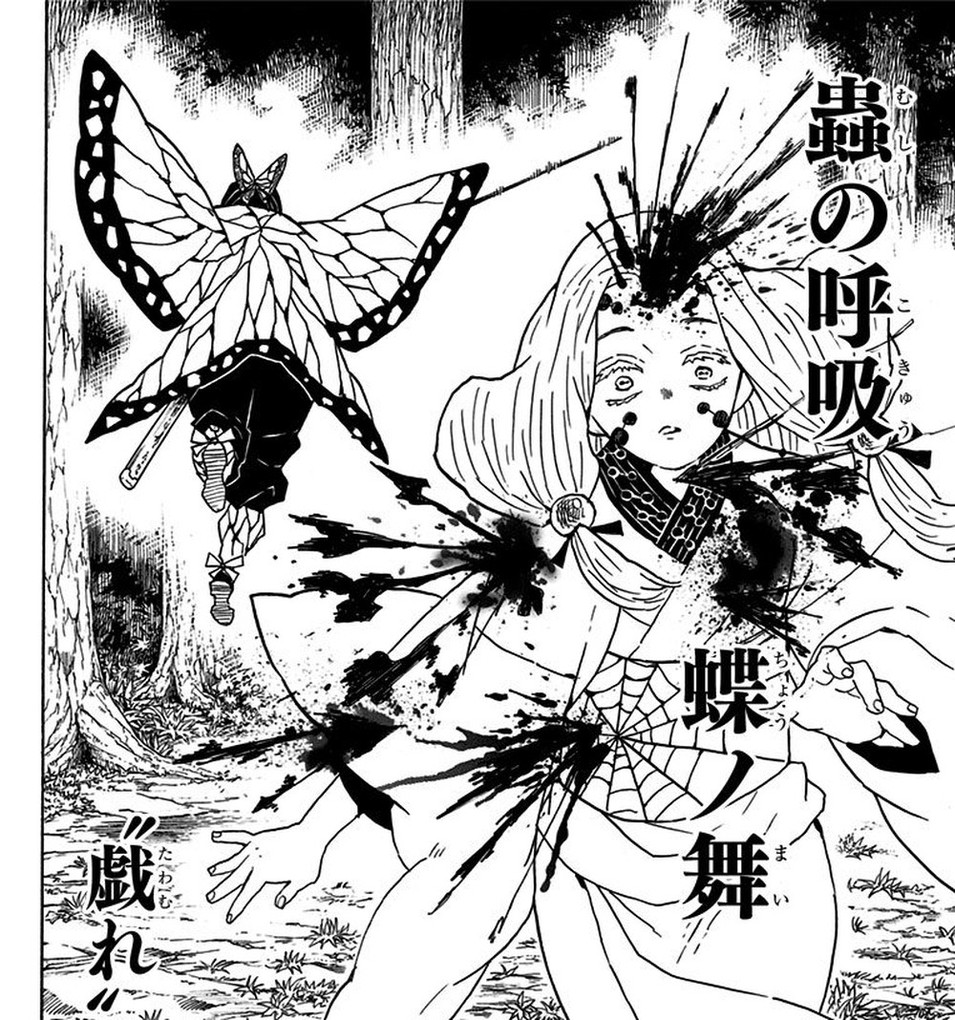
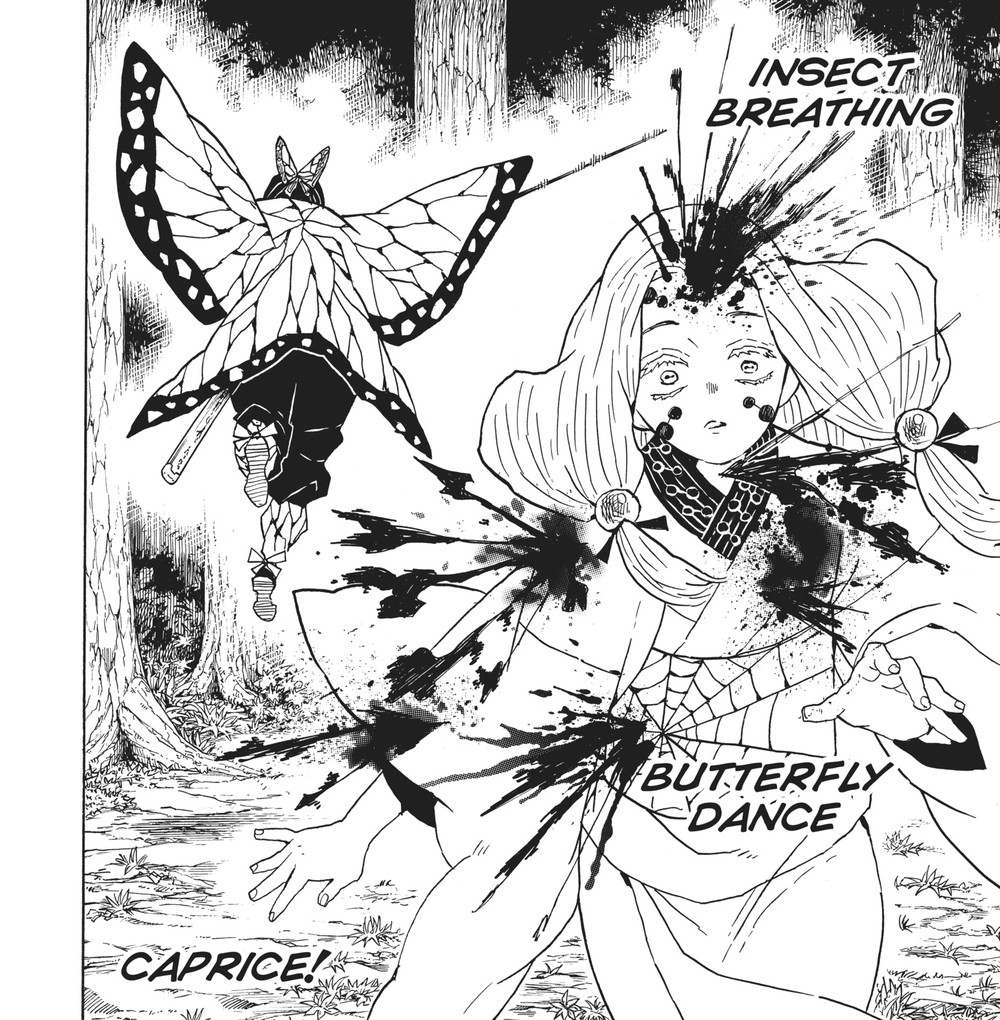
Every other breathing style on this hub counts its techniques with 型 (kata, "form") — a martial-arts word implying a fixed, drilled shape to be repeated. Insect Breathing is the one style that doesn't: its techniques are 舞い, "dances," and its sub-names read like stage directions rather than command shouts. "Caprice" is the clearest possible example. Where Water Breathing opens with the blunt, functional "Water Surface Slash" and Flame Breathing opens with "Unknowing Fire," Shinobu's first cataloged attack is simply named for playing around — an odd label for a killing strike, until you clock that it's true to how she actually fights. Shinobu is the only Hashira built around admitting she can't cut a demon's head off; she's too physically weak to swing a full-weight nichirin blade hard enough. Her whole style compensates by trading force for repetition and precision, needling in wisteria poison through many light, fast cuts rather than one heavy one. "Playing around" isn't false modesty here — it's a mechanically accurate description of a fighting style built on speed and volume instead of power.
The 舞い/型 distinction isn't just flavor text; it's baked into how VIZ renders the callouts, and it's the single most useful thing a reader of this hub can notice across all four Insect Breathing entries. Every other numbered style shouts a form number first ("SECOND FORM:", "FOURTH FORM:"); Insect Breathing shouts a dance name instead ("BUTTERFLY DANCE", "DANCE OF THE BEE STING:") and then, separately, a shorter quoted sub-name for the specific strike ("CAPRICE!", "TRUE FLUTTER!"). That two-layer naming — a dance category, then a named variation within it — has no equivalent among this hub's numbered styles, and it's presumably deliberate: Shinobu is explicitly the weakest Hashira in raw combat terms, and giving her techniques a distinct, unranked naming grammar visually sets her apart from styles built around linear physical progression.
The corpus's automatic OCR pass garbles this technique's sub-name specifically: the raw extracted text reads 「膨れ」(fukure, roughly "swelling" or "puffed up") instead of the actual printed 「戯れ」(tawamure, "playing around") — a single-character misread (膨 for 戯) that happens to produce another real, if nonsensical-in-context, Japanese word rather than gibberish, making it an easy trap for anyone trusting the raw OCR output at face value. The same stretch of Volume 5 also carries a confirmed +1 English-pagination offset, so the corpus records this occurrence's English field as fully blank; the real VIZ callout was confirmed by direct visual comparison of the correctly offset page.