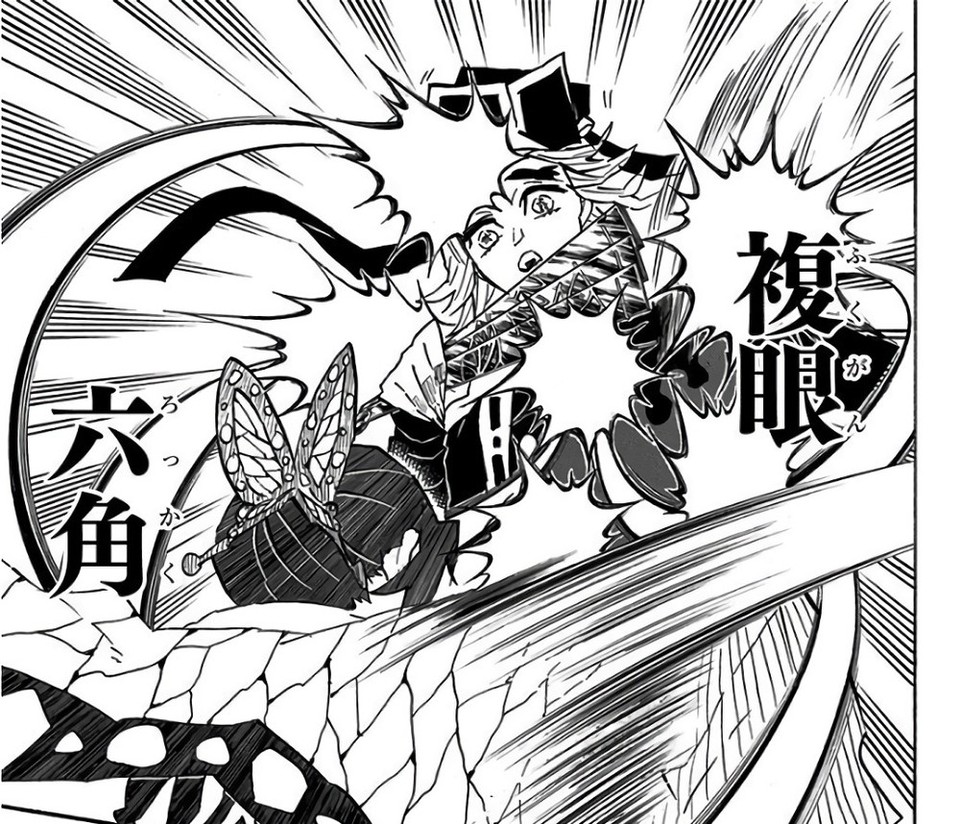
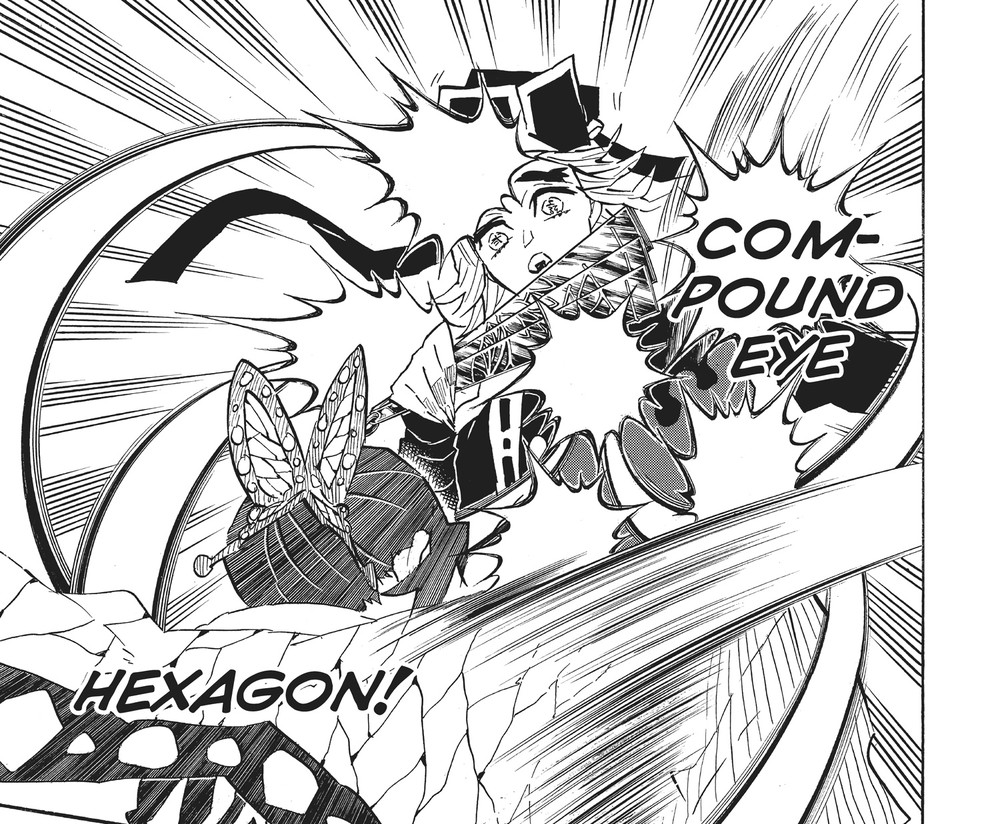
This is the one Insect Breathing sub-name built entirely from biology rather than a mood word. "Caprice" and "True Flutter" describe how a strike feels; "Compound Eye Hexagon" describes how an actual dragonfly sees and hunts, and Shinobu's attack borrows both properties directly. Real dragonflies have compound eyes made of up to 30,000 individual hexagonal lenses (ommatidia) each capturing a slightly different angle, which is why dragonflies can track and intercept fast-moving prey in flight with a hit rate that outperforms most other predators, insect or otherwise. Naming a six-directional evasive thrust combo after that specific anatomical structure isn't decorative color — it's a precise description of what the technique is supposed to do: see every angle an opponent could come from, and answer from all of them.
The placement in the fight underlines the connection: Doma delivers this technique's setup line, "you really are fast — maybe the fastest Hashira I've met so far," as a direct reaction to watching Shinobu execute it. A demon whose entire signature ability is called "Compound Eye" earning a compliment specifically about speed and unpredictability from an opponent who has fought (and eaten) an unknown number of Hashira before her reads as the manga's clearest on-page confirmation that this technique works exactly as its biology-derived name promises.
A reader relying only on the underlying bilingual corpus should know this entry required unusually careful direct visual verification. The corpus's automatic OCR pass captured only half of this sub-name — the 複眼 ("COMPOUND EYE") portion is present as a clean, correctly paired entry, but 六角 ("HEXAGON!"), printed in large stylized lettering on the same splash panel just below it, was never separately extracted into the underlying pairs data at all. This entry's nameJp and vizName fields reflect the full compound name as printed on the actual page — confirmed by direct inspection of both the Japanese and English page images — while this entry's byte-exact sources/references citations are limited to what the corpus actually captured (複眼 / "COMPOUND EYE"), in keeping with this hub's rule that quoted citations must trace to real corpus text.