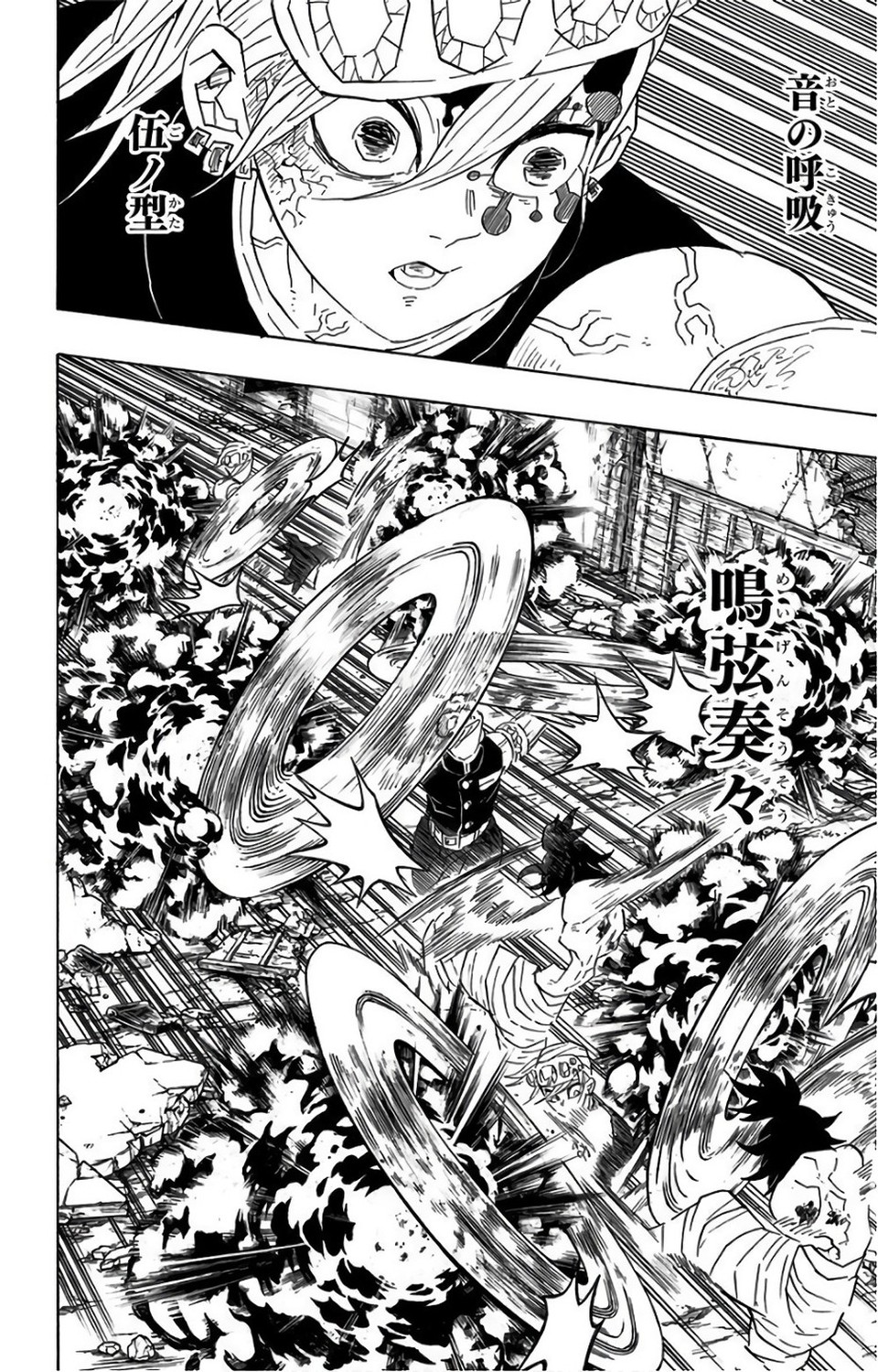
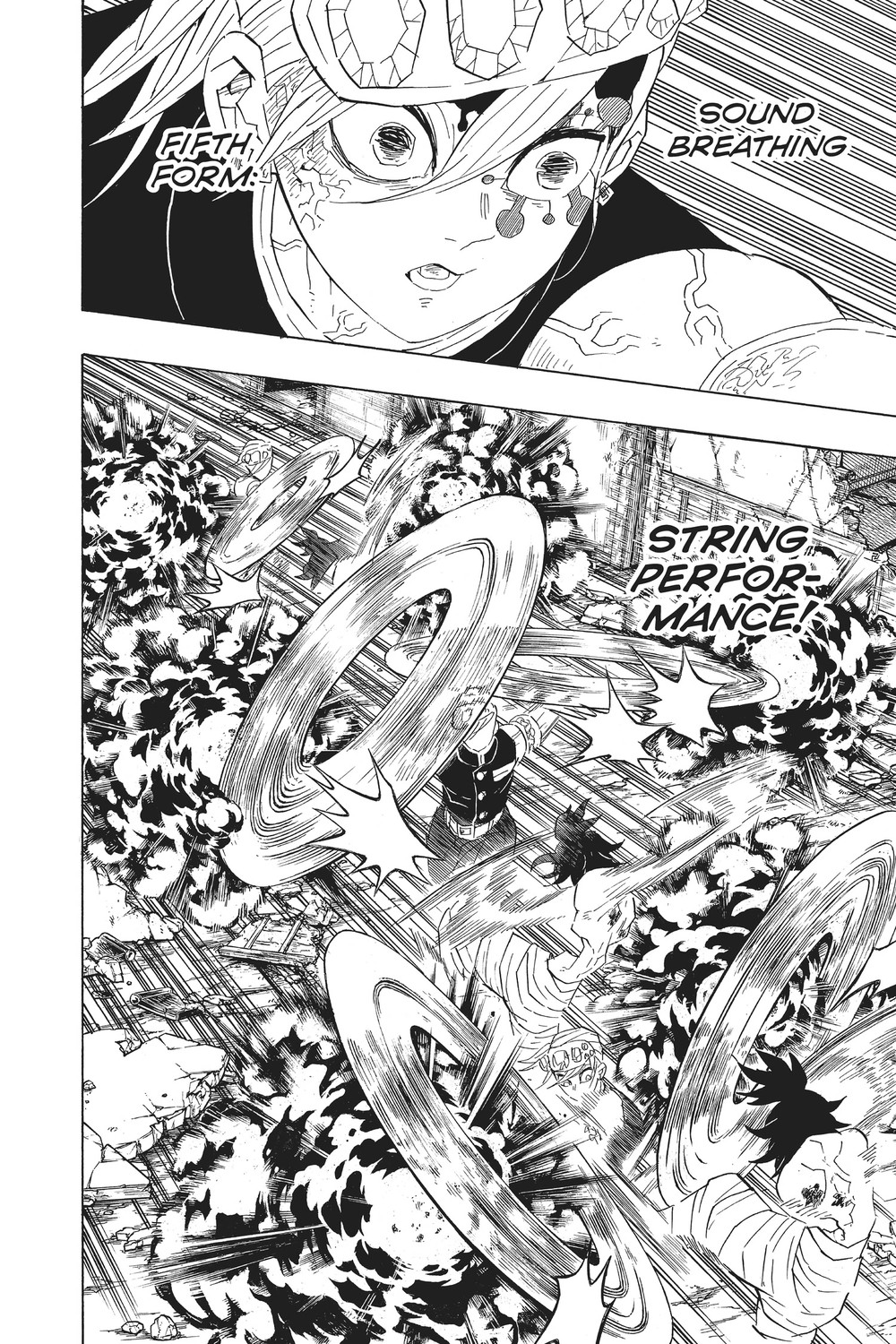
鳴弦 (meigen) names a real historical ritual, not a poetic invention for the manga: 鳴弦の儀 (meigen no gi) is a Heian-period court exorcism in which an archer, without loosing an arrow, simply plucks the bowstring to produce a sharp crack — the sound alone was believed sufficient to frighten off evil spirits and malign influences, and variations of the rite are still performed today at certain shrine ceremonies and imperial events. "STRING PERFORMANCE" is a reasonable, singable English attack name, but it collapses a specific named ritual object (an exorcism bow) into a generic musical instrument. The technique isn't invoking music in the way "performance" suggests to an English ear — it's invoking a very old, very specific practice of using pure sound as a weapon against the supernatural, which maps with unusual precision onto a Demon Slayer literally using sound-based swordplay against demons.
奏々 (sousou) — "playing, playing again" — is built from the ordinary verb for playing an instrument (奏でる, kanaderu) doubled with the repetition mark 々, giving the sense of something performed over and over rather than once. Paired with 鳴弦, the full name describes an exorcism-twang repeated in a continuous sequence — which is exactly the technique's choreography: a spinning, multi-hit flurry rather than a single strike, the visual equivalent of plucking the same bowstring again and again until the demon in front of you stops moving.
This entry required a genuine source-material gap to resolve. The bilingual corpus captures the form-number label (伍ノ型/FIFTH FORM:) and the style name (音の呼吸/SOUND BREATHING) as ordinary paired dialogue, but the large stylized attack-name lettering itself was never extracted as Japanese text at all — it registers in the underlying page data only as an English-side sound-effect string ("STRING PERFORMANCE!"), with no matching Japanese capture. The nameJp given here (鳴弦奏々) is therefore confirmed by direct visual inspection of the printed page rather than by corpus text-extraction — the same standard of visual verification this dictionary applies whenever automated OCR falls short, whether by misreading a kanji (as in 恋猫しぐれ and 揺らめく恋情・乱れ爪, elsewhere in this dictionary) or, as here, by missing it outright.