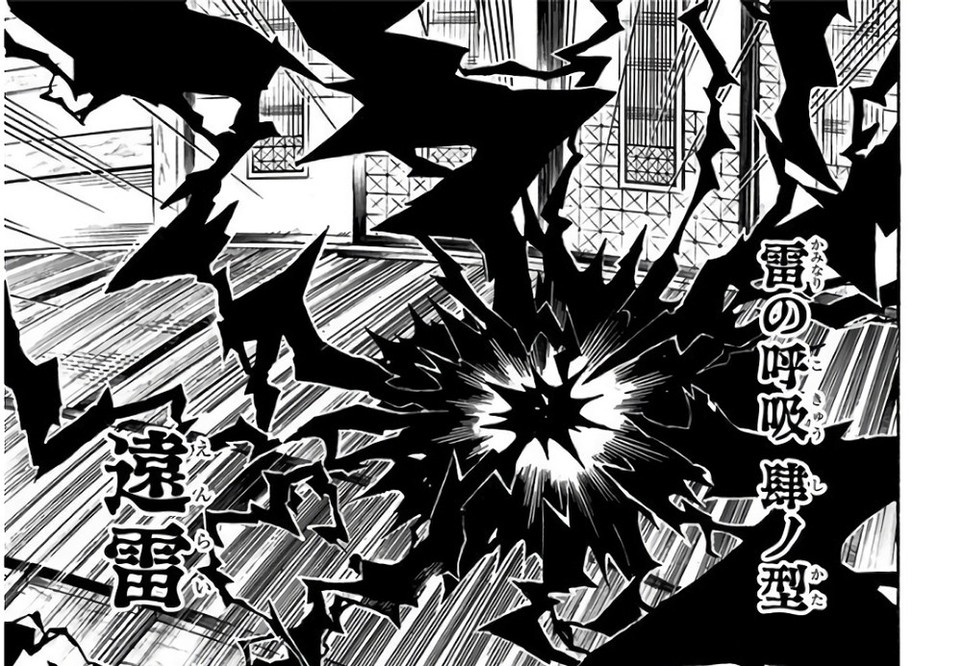
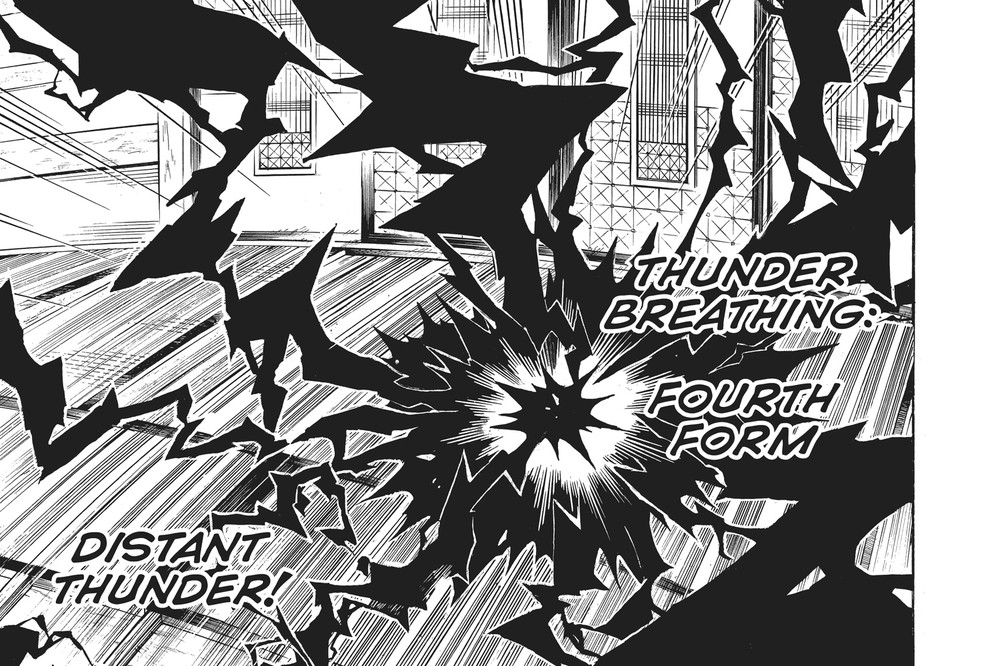
Unlike most of its siblings, 遠雷 is an ordinary, pre-existing Japanese word rather than an invented compound — it's a real season word (季語) in haiku, evoking a summer storm too far off to threaten yet, felt only as a low rumble on the horizon. Borrowing it as a technique name imports that specific gap between cause and perceived effect into swordplay: the cut and its consequence seem to arrive out of sync with the motion that produced them, i.e. deceptive timing dressed up as distant weather.
On the page it's the first of the five superior forms Kaigaku shows off during his final duel with Zenitsu, and the corpus captures the technique's announcement sitting directly beside a panel-filling detonation, with no reaction shot from Zenitsu on this particular page. That framing — a demonstration performed at, rather than with, an opponent — reflects the duel's larger shape: Kaigaku spends most of it narrating his own superiority to an audience of one increasingly outmatched Zenitsu.
As a translation, "Distant Thunder" is about as direct as it gets — two kanji, two English words, no interpretive leap required — which makes it a useful baseline against its numbered neighbors. "Rice Spirit" (Form 2) and "Thunder Swarm" (Form 3) both had to compress or discard an underlying idiom or folk belief in translation; 遠雷 needed neither, showing how much translation difficulty can vary within a single, consistently numbered technique list.