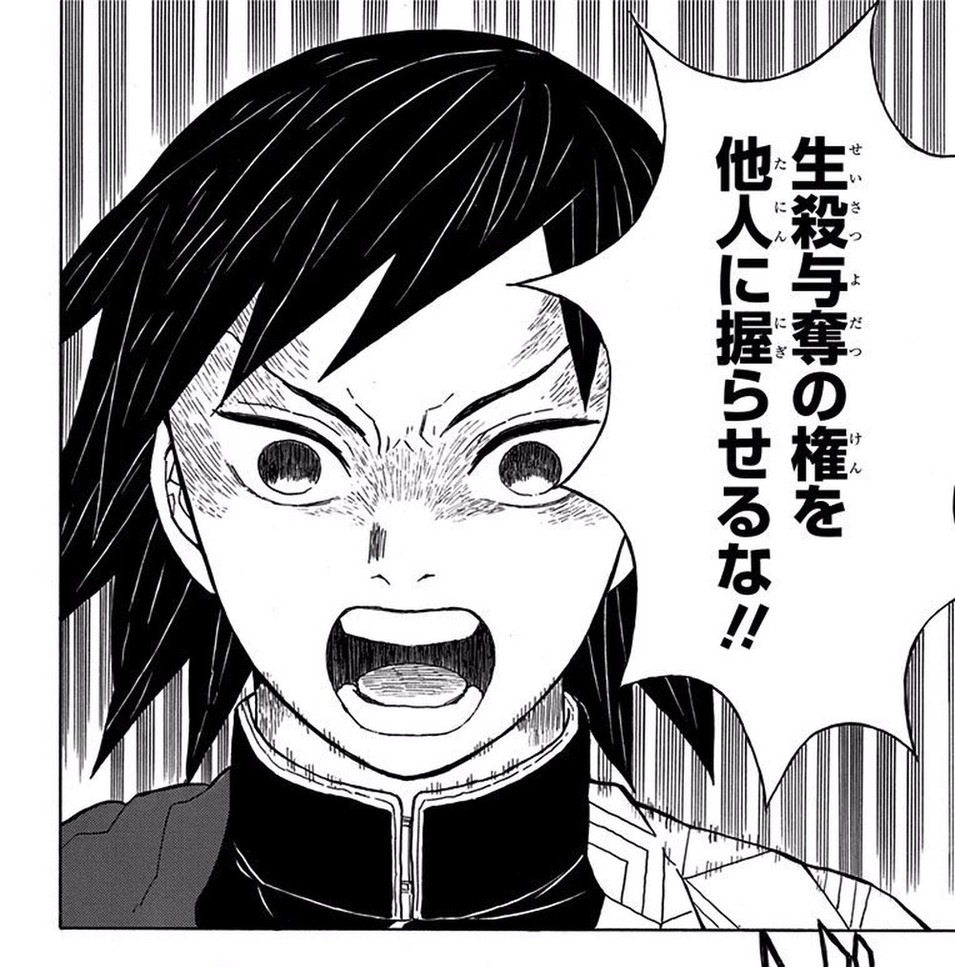
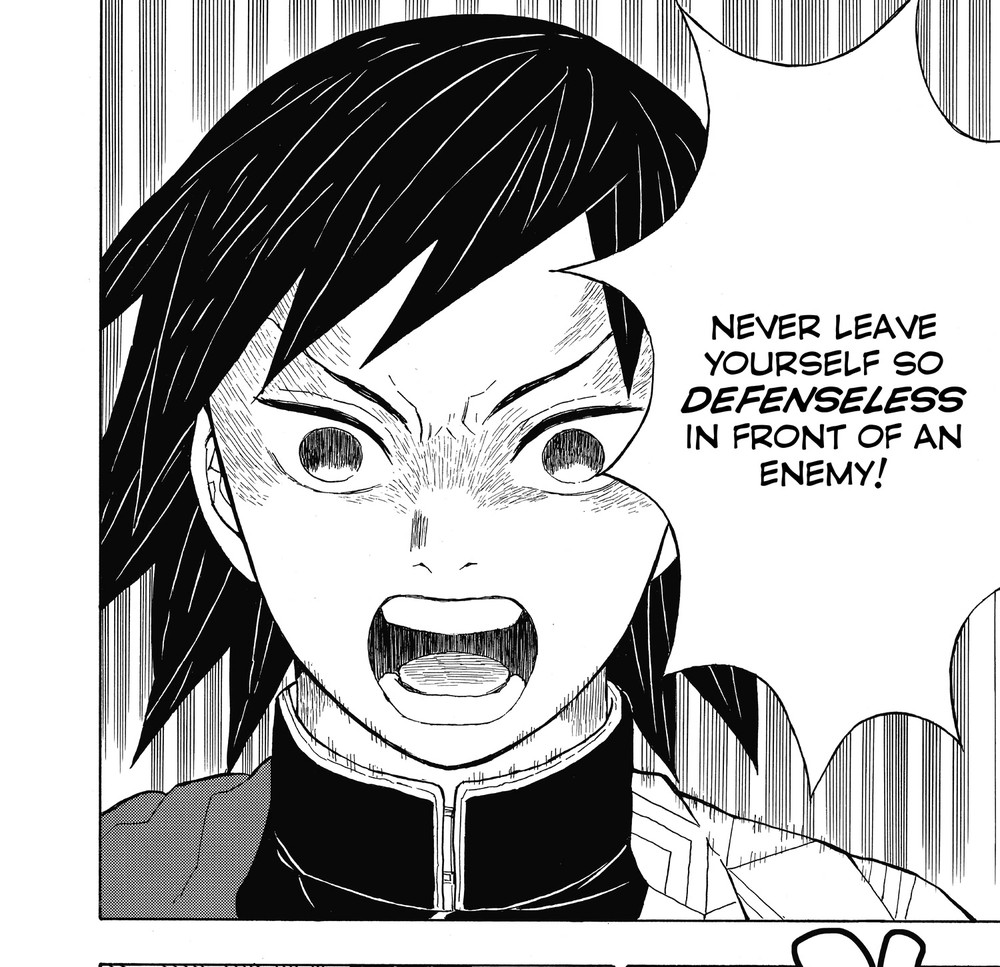
Giyu's Japanese is built almost entirely out of the negative imperative — 〜な attached straight to a verb stem, the bluntest command form the language has, the register a drill instructor uses on recruits, not the register anyone uses on a stranger they've just met. His very first sentence to Tanjiro, 「生殺与奪の権を他人に握らせるな!!」, stacks a classical four-character legal compound (生殺与奪, the sovereign's power to let live or kill) onto that same terse な before Tanjiro has said a word back. VIZ's "NEVER LEAVE YOURSELF SO DEFENSELESS" keeps the shout and drops the legal claim; the next sentence, 「惨めったらしくうずくまるのはやめろ!!」, swaps な for やめろ (a plain "stop it") and turns うずくまる — to crouch, to curl up low, the verb for a wounded animal — into the milder "bowing." Two commands, two different imperative shapes, in the same breath: Giyu doesn't have one voice for orders, he has several, and he always reaches for whichever is shortest.
What's missing from that opening barrage is almost as telling as what's in it: no 俺, no name, no address term at all — just verbs pointed at a stranger. The pronoun only surfaces a few lines later, and when it does it's for a second insult: 「当然俺もお前を尊重しない」, "naturally, I don't respect you either." Even self-reference, when Giyu finally reaches for it, arrives as a weapon rather than an introduction. Then, mid-speech, the classical vocabulary disappears entirely and the sentences shrink to their bare minimum: 「泣くな絶望するな」, two bare -な prohibitions run together with no connective and no subject, and 「怒れ」, one verb, the shortest command he gives anyone in this collection. Taciturn isn't just talking rarely; for Giyu it's compressing what little he says until almost nothing but the verb is left standing.
The one place that compression fully breaks is a single panel in Volume 6. Shinobu Kocho tells him to move — politely, full -てください form, the register she reserves for people she's needling — and the next panel is Giyu's face, visibly stung, delivering the only fully unguarded sentence he has in this whole collection: 「俺は嫌われてない」, "I'm not disliked." It's grammatically the same shape as his opening rebuke — 俺は…ない, a flat negative declarative — but aimed inward for once, defending himself instead of commanding someone else. Shinobu's reply, that she guesses he never realized people hated him, confirms the thing he's denying with a gentleness crueler than an insult. VIZ renders his line as a question, "WHY DID YOU SAY THAT EVERYONE HATES ME?" — wounded curiosity instead of a wounded assertion, which reads naturally in English but loses the one moment in this whole dictionary where Giyu states a fact about his own feelings out loud.
The counter-example to all of this bluntness is a single formal letter. Sending a crow ahead to Sakonji Urokodaki, Giyu writes 「手前勝手な頼みとは承知しておりますが何卒御容赦を」 — full keigo, a doubled self-reference, an apology laid down before the request even lands. It's the same man, addressing someone he actually respects instead of a stranger he's scolding, and the shift in register is the whole point: Giyu has essentially two settings, drill-sergeant terse and formally humble, and almost nothing in between. The mechanics of that second register — how 手前 folds two centuries of humble-pronoun history into a single apology — are unpacked at 手前勝手: the doubled self, from where I stand.
His combat vocabulary follows the same pattern of compression under pressure. Mid-duel against the Upper Rank demon Kokushibou, Giyu's internal monologue shrinks to fragments — 「受けきれるか...!!凪で...!!」, not even a complete clause, just a technique name and a question mark — and moments later, 「凪でも全ては防ぎきれなかった...!!」, an admission of failure in the same clipped shape. Dead Calm (凪), the Eleventh Form he invented himself, is the one technique in Water Breathing with no teacher standing behind it — the full naming logic is at Water Breathing, Eleventh Form: Dead Calm — and even narrating its limits, Giyu doesn't reach for more words. He reaches for fewer.