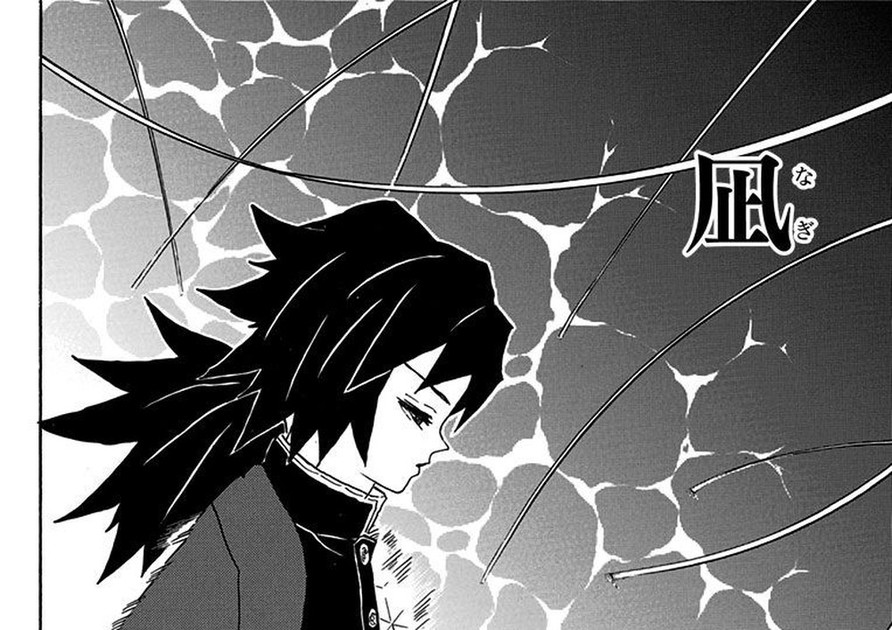
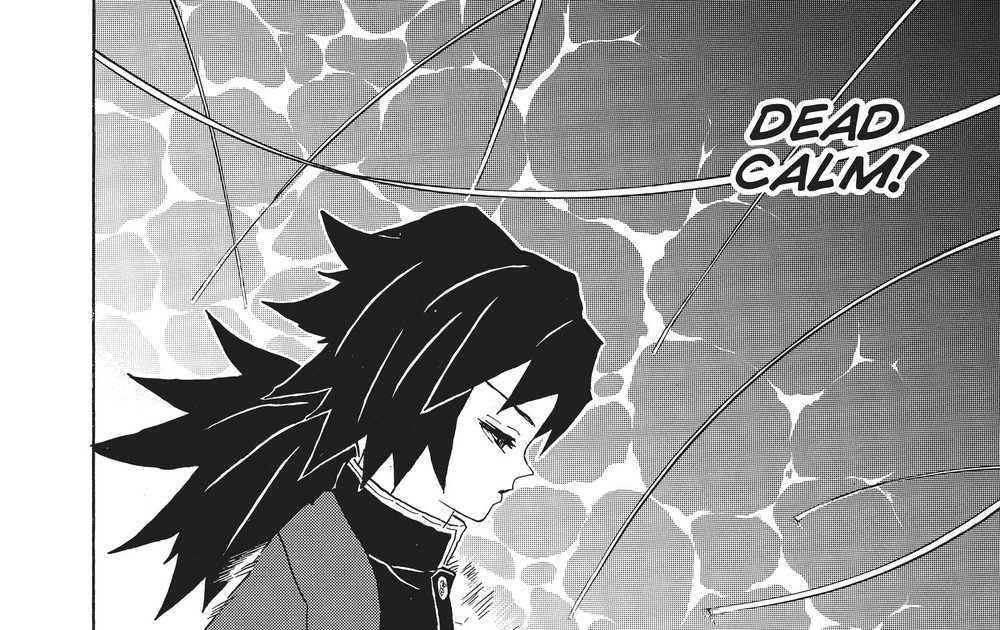
凪 (nagi) is one of the more quietly poetic kanji choices in the entire series, because the character is a kokuji — a native Japanese invention rather than an import from Chinese, built by fusing 風 (wind) and 止 (stop) into a single glyph that visually and etymologically means "the wind has stopped." No other technique name in this dictionary uses a kokuji; every other form (水面斬り, 水車, 生生流転, etc.) is built from ordinary imported kanji compounds. Giving Giyu's signature, self-invented technique the one uniquely Japanese character in the whole style is a small but deliberate piece of craft — the form that breaks from Urokodaki's ten-form curriculum is named with the one character that also breaks from the shared East Asian kanji tradition.
VIZ's "DEAD CALM" is a stronger translation than a plain "Calm" would be, and the manga's own explanatory caption justifies the intensity: "a dead calm... is a sea with no wind and no waves. The water's surface becomes like a mirror." That's not decorative flavor text — it's the technique's actual combat logic spelled out on the page. Where every other Water Breathing form cuts, redirects, or overwhelms an opponent's attack, Dead Calm is described as making the space around Giyu itself perfectly still, so that anything entering his range simply stops moving — "anything that enters Giyu's range is entirely calmed." It is, structurally, the one form in the whole style defined by stillness rather than force.
That's reinforced by its two confirmed appearances: against Rui, a battle Tanjiro could not finish alone, Giyu arrives and ends the fight with a technique that isn't in Tanjiro's ten-form vocabulary at all — a visual and narrative marker of the gap between a talented student and a Hashira. Its second confirmed use, against the Upper Rank demon Kokushibou during the Swordsmith Village arc's climactic multi-front battle (Vol. 18), is framed as genuinely reaching its limit — Giyu's own narration admits "even with Dead Calm, I couldn't block it all," the only place in this dictionary where a technique's failure, not its success, is what the corpus preserves.