The Moment
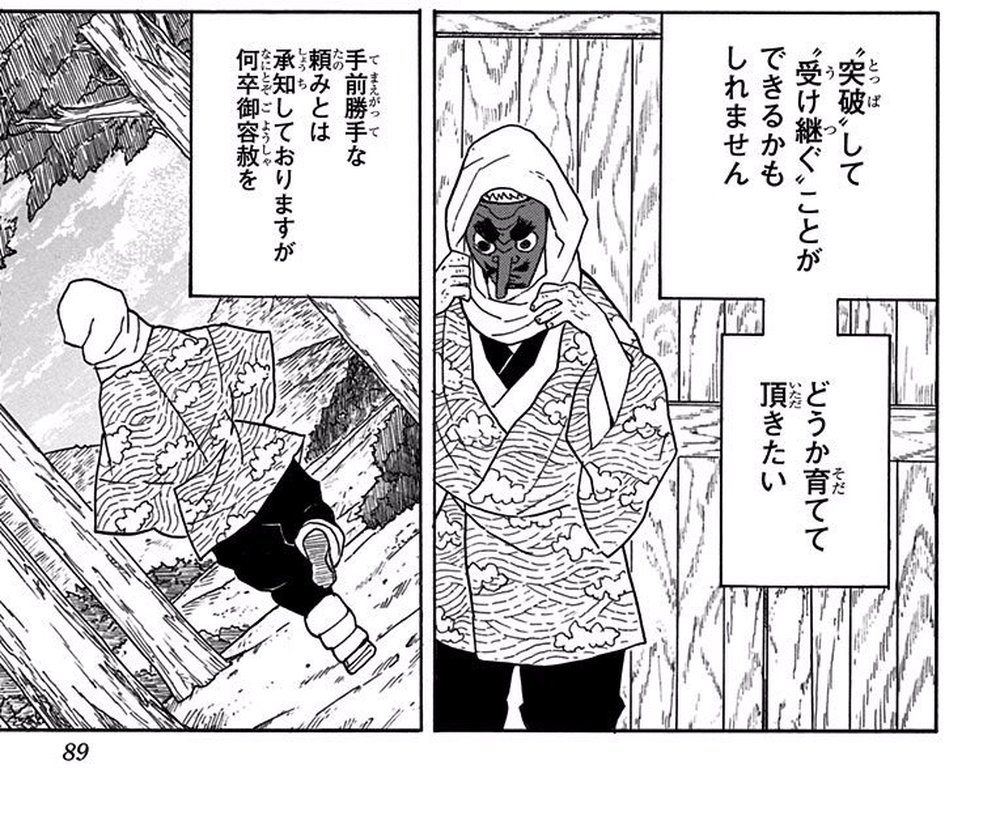
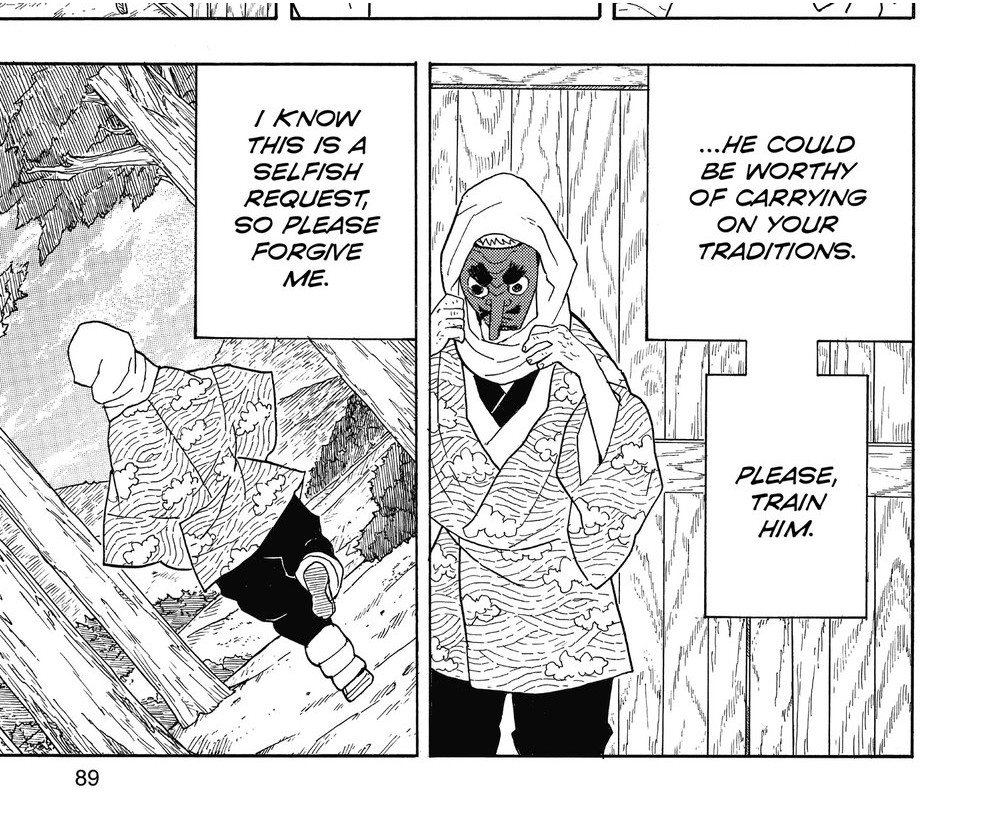
Volume 1, page 89 — Tanjiro's flight down the mountain hasn't led anywhere solid yet. Muzan Kibutsuji has slaughtered his family in the night; his one surviving sister, Nezuko, has been turned into a demon; and a taciturn Demon Slayer named Giyu Tomioka has just done the last thing Tanjiro expected — sparing Nezuko instead of ending her, then sending the two of them up a different mountain to find a man he refuses to fully explain. Before Tanjiro even reaches the door, a trained crow of the Demon Slayer Corps gets there first, carrying Giyu's message ahead of him to the man who lives at the top: Sakonji Urokodaki, a fox-masked, retired Hashira trainer.
The message runs across the page in caption boxes laid over shots of Tanjiro trudging up the mountain path with Nezuko's crate on his back, and of Urokodaki listening at his door: 「この二人には何か他とは違うものを感じます」 ("I sense something in these two that is different from the others"), 「少年の方は貴方と同じく鼻が利くようです」 ("the boy, like you, seems to have a sharp nose"). Then the message turns from observation to request:
「手前勝手な頼みとは承知しておりますが何卒御容赦を」
Temae-gatte na tanomi to wa shōchi shite orimasu ga, nanitozo go-yōsha o.
VIZ's English edition prints: "I KNOW THIS IS A SELFISH REQUEST, SO PLEASE FORGIVE ME." (Vol. 1, p.89).
Give the line its due before anything else: it is a genuinely faithful translation. "I know this is selfish" tracks 手前勝手な…とは承知しております almost clause for clause, and "please forgive me" is a clean, natural rendering of 何卒御容赦を. Nobody reading only this caption box is misled about what's happening — someone is asking a favor and apologizing for the imposition in the same breath. What the English can't quite carry is how that apology is built, because 手前勝手 isn't one word doing the work of "selfish." It's two, and one of them is the speaker naming himself before he's even finished admitting fault.
The Original
Take the compound in two halves.
手前 (temae) literally reads "in front of the hand" — 手 (te), "hand," plus 前 (mae), "front, before." It began as a spatial phrase: the ground directly in front of oneself, close enough to touch. From there Japanese did something it does constantly with spatial vocabulary — it turned "the place right here, before me" into a way of naming the person standing in that place, namely the speaker. By the Edo period, 手前 had become an established humble first-person "I," the pronoun of merchants, craftsmen, and go-betweens presenting themselves modestly to a customer or superior: "this humble one, here before you." Traces of that use survive today in 手前ども (temae-domo), the "we" a shopkeeper still uses for their own establishment, and 手前味噌 (temae-miso, literally "one's own miso"), the idiom for tooting your own horn — praising work that is, pointedly, your own.
勝手 (katte) has a rougher path. 勝 (katsu) is "to win"; 手 (te) is "hand" again — one account ties the compound to the drawing hand in archery, the hand that decides whether the shot lands. However literal that origin, the word settled into "one's own domain, one's own way of doing things": 勝手口 (katte-guchi) is still the everyday word for a house's kitchen door, the household's own entrance rather than a guest's. From "one's own domain" it was a short step to the adjective 勝手な — acting according to one's own convenience, without regard for anyone else's. Selfish.
Put the two together and 手前勝手 doesn't just mean "selfish" — it means selfish from a named vantage point. 手前 supplies the "I" (this humble self, right here); 勝手 supplies the fault (my own convenience, and no one else's). The compound performs the very thing it's confessing: it names the speaker twice — once as the humble party present before you, once again as the self whose convenience is at issue — inside a single four-character word. 手前勝手 sits outside standard JLPT vocabulary lists, but treat it as N1-adjacent: the kind of set phrase a learner meets in formal written Japanese and business correspondence long before casual conversation, almost always inside the ritual apology frame this very sentence uses — [self-deprecating adjective] な + [request noun] とは承知しておりますが、何卒 + [forgiveness verb].
VIZ's Choice
手前勝手 appears exactly once in the Demon Slayer volumes on file — a genuine single occurrence, no scatter table to build here, and no convergence either; VIZ only ever had to make this call once.
Given that, the finding isn't a comparison across renderings. It's a look at what the one available rendering keeps and drops. "I KNOW THIS IS A SELFISH REQUEST" keeps the confession (手前勝手 → "selfish"), keeps the concession structure (…とは承知しております → "I know"), and keeps the plea (何卒御容赦を → "so please forgive me"). Structurally, clause for clause, it's a careful piece of work — three moves in the Japanese, three moves in the English, in the same order. Credit where due: this isn't a case of a translator flattening a complex idea into a single unrelated word. The bones of the ritual survive the crossing.
What doesn't survive is the texture of that ritual — the doubled self-naming that makes 手前勝手 sound like a bow rather than a verdict. "Selfish" is an adjective any speaker could apply to any other person's request; it carries no trace of who is speaking or from where. 手前勝手, by contrast, is unimaginable as something you'd say about someone else's request — the 手前 locks the word to the speaker's own vantage point, the way "yours truly" can only ever describe the person signing the letter. VIZ's line is honest about what the crow is confessing. It can't be honest about the specific grammatical shape of that confession, because English's "selfish" was never built to carry a pronoun inside it.
The Gap
An external verdict replaces a courteous self-positioning. "SELFISH REQUEST" reads as a judgment anyone could pass about anyone else's request; 手前勝手な…とは承知しております is closer to stage direction — the speaker placing himself, visibly, as the party whose convenience this serves, which is exactly what lets the immediately following 何卒御容赦を land as a plea rather than groveling. The Japanese isn't primarily confessing a moral flaw; it's performing the etiquette of asking a favor at all. Flatten the self-positioning to "selfish," and what's left reads more like an admission of guilt than a bow.
The doubled self-reference collapses into a single-reference word. 手前 (myself, from where I stand) plus 勝手 (my own way) stack two self-pointing pieces into one compound — an intensifying repetition that is itself the humility, the way "if I may be so bold as to speak for myself" says more than "boldly" does. "Selfish" has an internal "self" too, but it's a fossilized suffix, not an active pointer; it can't reproduce a repetition that was never built into it.
手前's other two jobs go completely dark. The same two syllables that supply this message's courteous "I" also supply, elsewhere in Japanese, a rough, contemptuous "you" — てめえ (temee) — and a spatial marker meaning "just short of, this side of," as in 四十手前の肉体, "flesh not quite forty years old" (Vol. 14, p.33), said by an entirely different demon sizing up a stranger's age. One written form, doing humble self-reference, hostile other-reference, and spatial almost-there, depending entirely on who's speaking and what surrounds it. A reader who meets 手前 only as part of "selfish" here has no way to guess that the identical word, spoken by an angry man two hundred pages later, could mean something much closer to "you, right there" — spat, not bowed.
What If
- "Forgive me — I know this request serves only my own purposes." — keeps the humble-plea shape and names whose convenience is at stake. Cost: longer, and loses the punch of a single adjective doing the confessing.
- "I'm well aware how self-serving this is of me — please, forgive it." — "of me" recreates a trace of 手前's active self-pointing. Cost: reads closer to a formal memo than a courteous request; the ritual warmth cools.
- "This is a presumptuous request on my part, I know — I beg your forgiveness." — "on my part" borrows 手前's "from where I stand" framing without naming a pronoun outright. Cost: "presumptuous" undersells 勝手's specifically self-interested flavor; boldness and selfishness aren't quite the same fault.
- Keep VIZ's shape, restore the bow: "I KNOW THIS REQUEST IS A SELFISH ONE OF MY OWN MAKING, SO I BEG YOUR FORGIVENESS." — Cost: too long for the panel's actual caption box; VIZ's brevity had its own good reasons, and this option spends space the page doesn't have.
Take-away
手前勝手 isn't hard because "selfish" is wrong — it's a fair, workable gloss for the word's ordinary uses. It's hard because this one sentence isn't using 手前勝手 to describe a personality flaw; it's using it as the opening move of a request-etiquette formula, where naming your own self-interest out loud, twice, is exactly what lets you ask for the favor at all.
Three rules of thumb to carry off this page:
- When 手前 shows up humbling the speaker, look for the ritual it's serving. Formal Japanese request language routinely front-loads self-criticism — 手前勝手な, 僭越ながら, 恐縮ですが — not because the speaker feels genuinely accused, but because naming your own imposition is the price of admission for asking at all.
- 手前 is a single word wearing three faces: humble "I," hostile "you," and spatial "just before." Context — register, who's speaking, what follows — is the only thing that tells you which. English never asks one word to carry all three; expect the connections between them to be invisible in translation.
- A doubled self-reference is a stronger signal than a single adjective. Where Japanese repeats a self-pointing morpheme for emphasis — 手前…勝手 here, or 自分自身 elsewhere — English usually needs an intensifying phrase, "of my own making," "on my own part," rather than a single word, to keep the same weight.
This collection has already spent time in Japanese's first-person wardrobe: Kyogai, Volume 3's drum demon, claims his kills in the bookish, self-effacing 小生 — see This Insignificant Self's Prey — and three train-car boys shout their excitement in the rustic, unpolished おいら — see A Trainful of Country Boys. 手前 belongs to the same closet at a stranger angle: not a fixed pronoun for one kind of character, but a single word that changes which end of the conversation it's pointing at depending on the room. (One work over, Naruto's ninja dog Pakkun growls that wardrobe's martial cousin, 拙者, out of a scowling muzzle — different work, same drawer of archaic "I"s.) Or browse the full Demon Slayer translation notes index.
Every Japanese and English line quoted above is a byte-exact capture from the cited editions — 鬼滅の刃 Vol. 1 & Vol. 14 (Japanese) and Demon Slayer: Kimetsu no Yaiba Vol. 1 & Vol. 14 (VIZ Media) at the corresponding panels — via our bilingual page database; see Sources below.