Most characters on this site have too many good lines to choose from; Nezuko has the opposite problem. Across the entire 23-volume run, the corpus turns up a genuinely small, countable set of moments where she is shown forming words rather than growling, and this page is close to all of them — the silence isn't an editorial gap, it's the character. Kagaya Ubuyashiki's family and the Demon Slayer Corps muzzle her within the first volume specifically so she can't speak or bite, and Gotouge draws that constraint literally: for chapters at a stretch her only lines are onomatopoeia set in the same jagged katakana as sword strikes and explosions, sitting in the dialogue column of the corpus like anyone else's speech, but carrying no lexical content at all. 「グルル」(gururu, "GRAAAH") on the night Giyu Tomioka finds her is pure animal threat-display, aimed at the one adult trying to decide whether to kill her. It shares a script with human dialogue and nothing else.
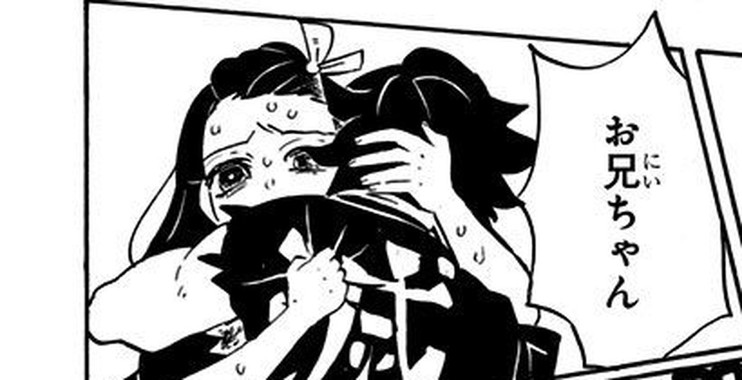
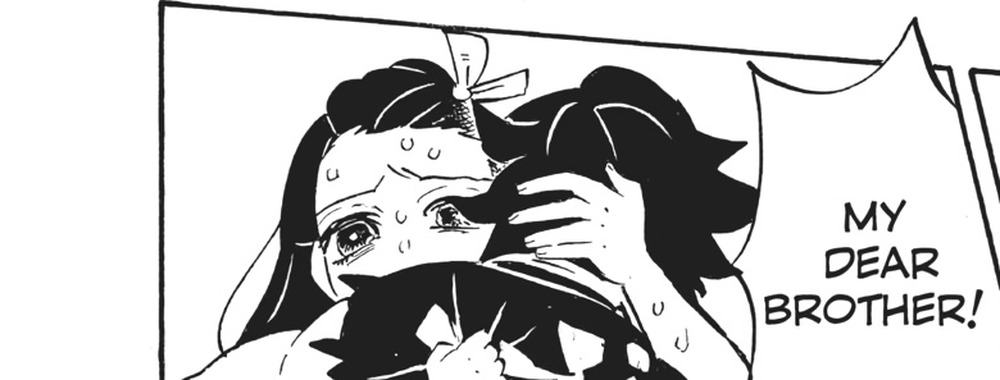
The muzzle produces its own sub-vocabulary. On the Mugen Train, asked to burn through Enmu's dream-binding rope, she manages only 「ムーッ」 — VIZ prints it "MMMF!", real English lip-buzz onomatopoeia rather than a transliterated Japanese sound effect, which is the more labor-intensive choice VIZ reserves for moments where the texture of the muffling matters more than any word underneath it. Compare that to how the same translators handle her one recurring word, お兄ちゃん (onii-chan, "big brother"): in volume 1, spoken by a human girl greeting her brother home from the mountain, it becomes the plain address "TANJIRO!" In volume 23, spoken by someone who has not managed a sentence in over a hundred chapters, the identical two syllables become "MY DEAR BROTHER!" — VIZ raising the register to mark the weight the word has accumulated by the time she can say it again. It's worth noting what this page does not find: fan discussion sometimes attributes Nezuko a babyish 〜なの sentence-ending as a marker of arrested, childlike speech. Nothing in the manga corpus supports that for her specifically — where she does speak, in volume 1 and volume 23, she uses ordinary, grammatically adult Japanese; the childlike quality anime adaptations sometimes layer on isn't in the source text this page cites.
The volume 1 lines exist to be echoed. On the last ordinary morning the Kamado family has together, Nezuko says three small things — she's minding baby Rokuta, she greets Tanjiro as お兄ちゃん, she waves him off with いってらっしゃい, the set phrase for someone leaving the house. None of it is dramatic; that's the point. When her speech returns twenty-two volumes later, mid-battle, the first word out of her mouth is the same お兄ちゃん, now aimed at a brother who is himself losing his humanity to demonization. Everything she says in volume 23 — 「ごめんね」("I'm so sorry"), the confession that she left him to carry everything alone, 「悔しいよお兄ちゃん負けないで」("it's frustrating, but don't give in") — reopens the exact sibling relationship the muzzle interrupted, in the exact register she'd have used had it never happened. Tanjiro's own speech patterns — the self-cheering, the borrowed keigo — are covered on Tanjiro's quotes page; Zenitsu's very different, panic-driven register is on his. Set beside either of them, Nezuko's page is less a catalogue of great lines than a record of how much Japanese dialogue an eight-hundred-plus-chapter story can withhold from its second lead, and how much a single returning word can then carry.