Tanjiro Kamado is Demon Slayer's earnest, achingly sincere protagonist — even his boasts sound like promises. He speaks in a plain, unguarded 俺 first person, but drops into textbook keigo (成仏してください) when addressing the demons he kills, and narrates his own courage out loud, shouting his own name mid-battle like a coach cheering on a stranger. This page collects ten signature lines — his founding vow over Nezuko, his self-cheer before the drum-house fight, his fury defending Rengoku's memory, his late-series reflection on what should happen if he ever fell to being a demon himself — each shown in the original Japanese beside the official VIZ English, page-verified against the bilingual tankōbon corpus.
Tanjiro Kamado's quotes — Japanese vs official English
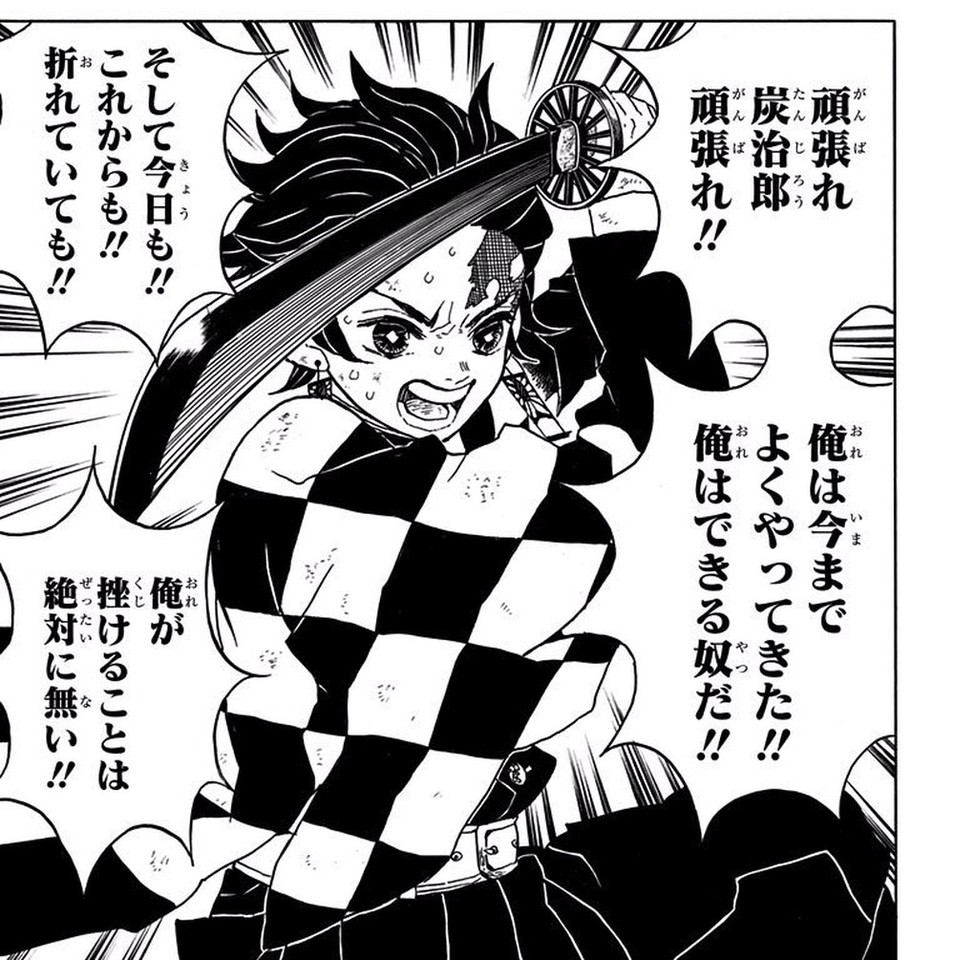
頑張れ炭治郎頑張れ!!
Ganbare Tanjirō, ganbare!!
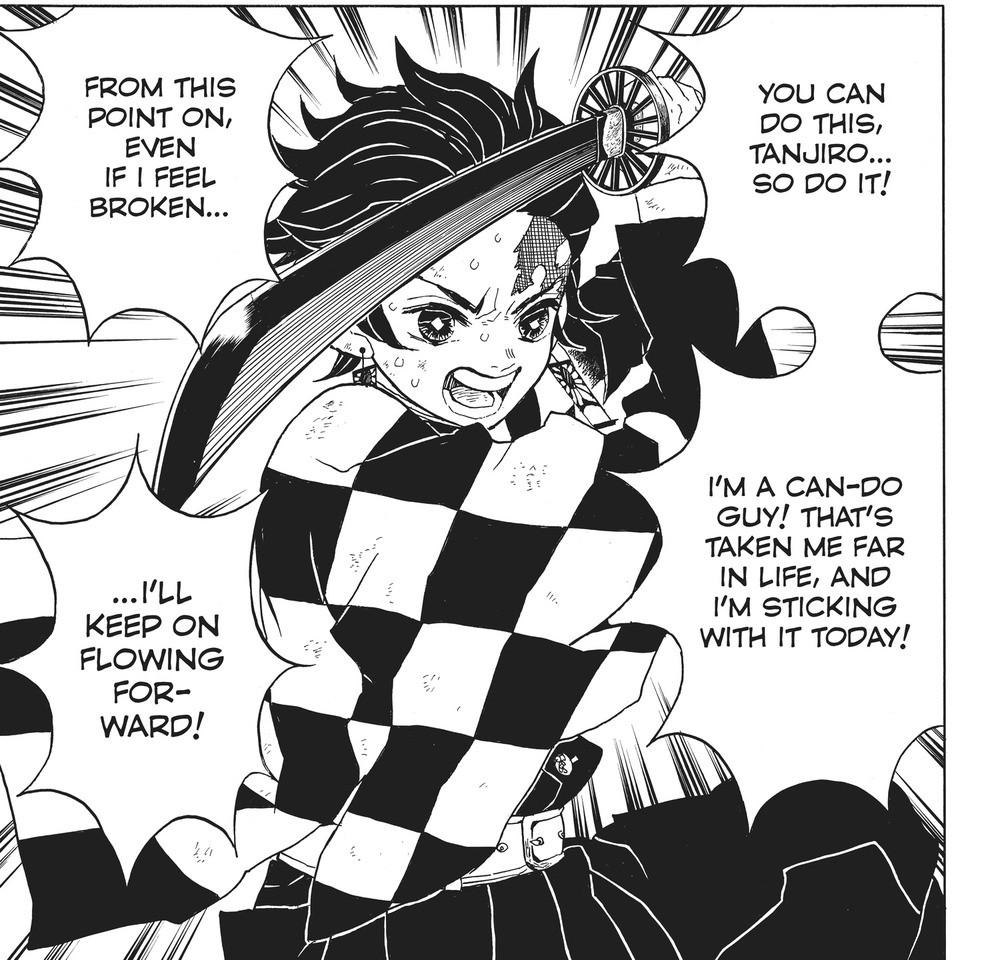
“YOU CAN DO THIS, TANJIRO... SO DO IT!”
Literally: Do your best, Tanjiro, do your best!! — a repeated self-directed imperative, not encouragement from someone else.
Vol. 3, p.165 — self-cheer before the Kyogai drum-house fight
俺は今までよくやってきた!!俺はできる奴だ!!
Ore wa ima made yoku yatte kita!! Ore wa dekiru yatsu da!!
“I'M A CAN-DO GUY! THAT'S TAKEN ME FAR IN LIFE, AND I'M STICKING WITH IT TODAY!”
Literally: I've done well up until now!! I'm a guy who can do things!!
Vol. 3, p.165 — same self-cheer monologue, continuing on the same page
家族を殺した奴も見つけ出すから
Kazoku o koroshita yatsu mo mitsukedasu kara
“I'LL ALSO FIND THE ONE THAT KILLED MY FAMILY!”
Vol. 1, p.36 — vowing to Giyu moments after finding Nezuko turned into a demon
成仏してください
Jōbutsu shite kudasai
“REST IN PEACE!”
Literally: Please become a Buddha; please pass on properly.
Vol. 1, p.164 — praying over the demons he's just killed at the Final Selection
俺は鼻が利くから平気だよ
Ore wa hana ga kiku kara heiki da yo
“I'VE GOT A GOOD NOSE FOR TROUBLE. I'LL BE FINE.”
Literally: My nose works well, so I'm fine.
Vol. 1, p.15 — reassuring Giyu about his sense of smell
地獄の果てまで追いかけて
Jigoku no hate made oikakete
“I'LL FOLLOW YOU TO THE DEPTHS OF HELL...”
Literally: I'll chase you to the very ends of hell.
Vol. 2, p.131 — swearing vengeance as Muzan walks away, having just met him for the first time
俺は長男だから我慢できたけど次男だったら我慢できなかった
Ore wa chōnan dakara gaman dekita kedo, jinan dattara gaman dekinakatta
“I LEARNED TO PUT UP WITH A LOT BECAUSE I'M THE OLDEST. IF I'D BEEN THE SECOND SON, I DOUBT I'D BE SO RESILIENT.”
Literally: Because I'm the eldest son I could endure it, but if I'd been the second son I couldn't have endured it.
Vol. 3, p.162 — confessing to Zenitsu how much his still-unhealed wounds actually hurt
煉獄さんの悪口言うな!!!
Rengoku-san no waruguchi iu na!!!
“DON'T INSULT THE MEMORY OF RENGOKU!”
Literally: Don't badmouth Rengoku-san!!!
Vol. 8, p.142 — charging at Sanemi after he mocks Rengoku's death
もし俺が鬼に堕ちたとしても、鬼殺隊の誰かが俺の頚を斬ってくれるはず
Moshi ore ga oni ni ochita to shite mo, Kisatsutai no dareka ga ore no kubi o kitte kureru hazu
“IF I EVER BECAME A DEMON... SOMEONE FROM THE DEMON SLAYER CORPS... WOULD TAKE MY HEAD.”
Literally: Even if I ever fell to becoming a demon, surely someone from the Demon Slayer Corps would do me the favor of cutting off my neck.
Vol. 11, p.92 — reflecting to Mitsuri on what should happen to him if he ever turned demon
みんなが俺を心配してくれてる匂いでわかる
Minna ga ore o shinpai shite kureteru nioi de wakaru
“I CAN SMELL THAT THEY'RE WORRIED ABOUT ME.”
Literally: I can tell by the smell that everyone is worried about me.
Vol. 23, p.135 — speaking as a demon himself, still able to smell his friends' worry
All lines are byte-exact captures from a bilingual corpus of the Japanese tankōbon and the official VIZ Media edition.
Tanjiro's Japanese runs on 俺 (ore) — the default plain, masculine first person of a teenage boy, not the swaggering 俺様 or rough 俺っち some shōnen leads reach for. What makes his voice distinctive isn't the pronoun; it's what he does with the register around it. He is the rare shōnen hero who keeps his keigo on even in combat. 「成仏してください」 (jōbutsu shite kudasai) — "please become a Buddha, please pass on" — is built on 〜してください, the JLPT N5 request form any beginner learns for asking a stranger to write their name. Tanjiro aims that same everyday courtesy at demons he has just beheaded. VIZ renders it "REST IN PEACE!" every time, which preserves the ritual but loses the direction and the salvation Japanese is offering — the full breakdown is in 成仏してください: praying the demon onward.
The famous 長男 (chōnan, "eldest son") line — 「俺は長男だから我慢できたけど次男だったら我慢できなかった」, "because I'm the oldest I could put up with it, but if I'd been the second son I couldn't have" — is a small joke with a real theory behind it: birth order as a private stoicism license he grants himself, mid-injury, while comparing notes with Zenitsu. It's the same self-narrating habit that produces his most quoted panel: 「頑張れ炭治郎頑張れ!!」, "Go, Tanjiro, go!!" — a sincere imperative aimed at himself, by name, out loud, before he's fought a single demon that fight. VIZ smooths the repeated command into address plus encouragement ("You can do this, Tanjiro... so do it!"), which reads more naturally in English but quietly erases the thing that makes the panel iconic in Japanese: he is giving himself an order, twice, the exact grammatical shape he'd use to cheer on a teammate.
His nose is the other throughline. 「俺は鼻が利くから平気だよ」 — literally "my nose works well, so I'm fine" — treats 利く ("to function, to be effective") as a plain fact about his body, the same verb you'd use for a sharp knife or an efficient medicine. By volume 23, even flattened into a demon himself, the smell-motif survives everything else: 「みんなが俺を心配してくれてる匂いでわかる」, "I can tell by the smell that everyone's worried about me" — his humanity outlives his face. The mechanics of that construction, and the object English insists on supplying that Japanese never states, are unpacked in 鼻が利く: a nose for trouble he never claimed; his other favorite vow, chasing a target to hell, is covered in 地獄の果てまで: hell with levels.
VIZ's consistent choice across all of this is to trade Tanjiro's grammar for his intent: the repeated imperative becomes a pep talk, the benefactive くれる in 「俺の頚を斬ってくれるはず」 — "someone would do me the favor of taking my head" — collapses into the flatter "would take my head," and the boast "俺はできる奴だ" ("I'm a guy who can do things") becomes the punchier idiom "I'm a can-do guy." None of it is wrong, exactly — VIZ's Tanjiro is kind and earnest in English too. But the Japanese version is kind in a very specific, traceable way: through borrowed politeness, through orders he gives no one but himself, and through a verb tense (くれる) that treats even his own death as a kindness he'd be grateful to receive.