Zenitsu's Japanese runs on 俺 (ore), the same default masculine first person Tanjiro and half of shōnen manga use — but Zenitsu is the character who proves how much a fixed pronoun can still shift under pressure. Awake and frightened, which is his baseline state, his sentences don't finish so much as collapse: 「どうすんだどうすんだ死ぬよこれ死ぬし死ぬ死ぬ死ぬ」, a stammered question doubled over itself before dissolving into a four-times-repeated 死ぬ ("die"). VIZ matches the escalation almost beat for beat — "WHATTA WE DO? WHATTA WE DO?! WE'RE GONNA DIE! DIE, DIE, DIE, DIE!" — one of the rare places where English's usual instinct to smooth a stammer into one clean line would actually be the mistranslation, because the panic itself is built out of repetition.
His fear even gets its own pseudo-diagnostic vocabulary. 「はあああ!!膝にきてる恐怖が八割膝に!!」 — "eighty percent of my fear is in my knees" — assigns his own terror a measured percentage, the grammar of a man filing an incident report on his own cowardice mid-collapse. 恐怖 (kyōfu, "fear") gets treated like a liquid with a pourable volume, the same register clinical Japanese uses for measurable quantities; VIZ keeps the bit ("IT'S IN MY KNEES! EIGHTY PERCENT OF MY FEAR IS IN MY KNEES!") because it's visual as much as verbal, but the joke's engine — a coward narrating his own body like data — is pure Zenitsu.
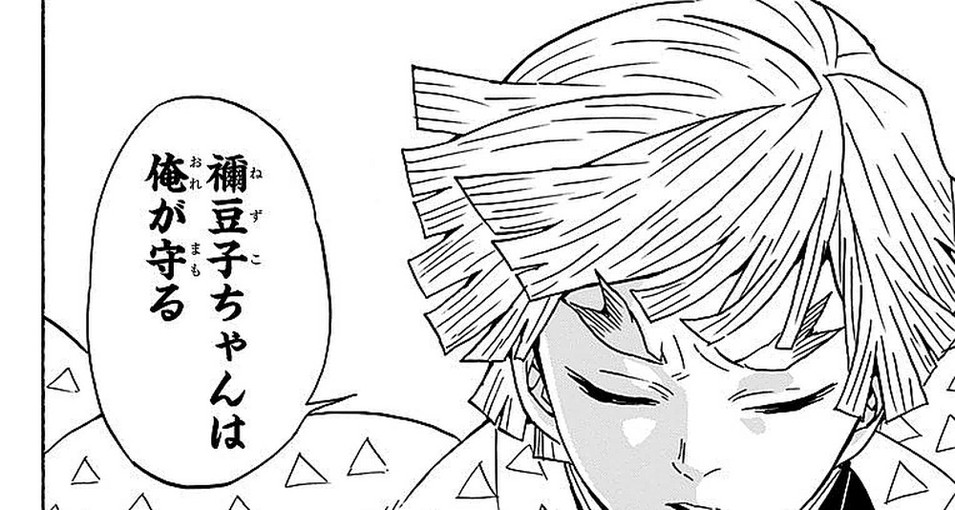
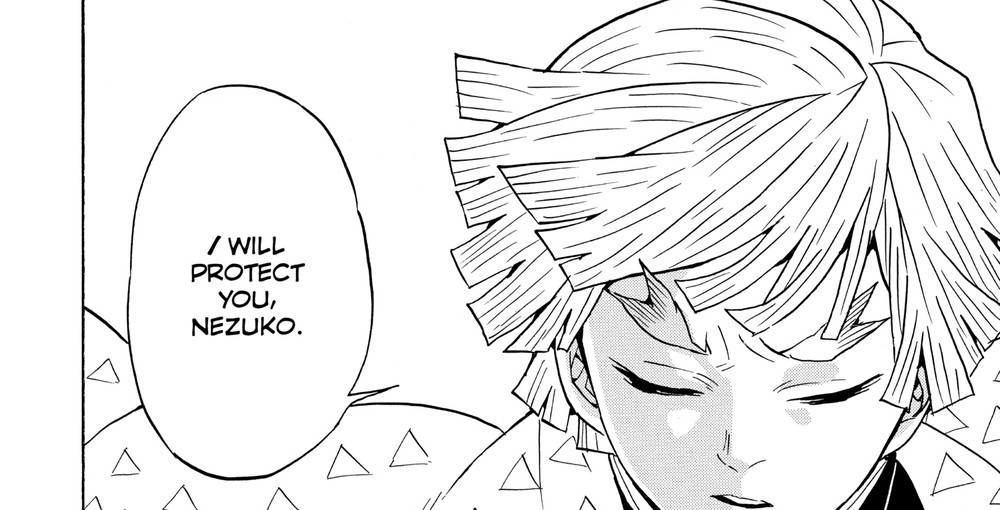
Then he faints, and the grammar changes completely. 「禰豆子ちゃんは俺が守る」 — unconscious, sword undrawn, panel silent — is a complete, hedge-free declarative sentence, the topic particle は doing the work of a vow: Nezuko, specifically, is the thing he will protect, full stop. VIZ's "I WILL PROTECT YOU, NEZUKO" reads as dignified and clean — in a small irony, more dignified than the Japanese, since English has no polite way to keep the diminutive ちゃん that Zenitsu can't put down even asleep. He never once calls her plain 禰豆子; it's always 禰豆子ちゃん, in terror, in devotion, and here, unconscious, mid-vow — the same childish affix that makes him ridiculous awake is the thing his sleeping self can't stop attaching to the most serious sentence he ever says, and English quietly removes the evidence. His signature move fires from that same unconscious state: 「雷の呼吸 壱ノ型 霹靂一閃」, the only form he can perform, sharpened instead of diversified. VIZ's "THUNDERCLAP AND FLASH" keeps 霹靂 (thunderclap) and 一閃 (one flash) together as a matched pair rather than picking one half to translate — the full breakdown of the technique's naming logic is at 霹靂一閃: Thunder Breathing, First Form.
The Infinity Castle duel with Kaigaku, his demon-turned senior disciple, runs both registers back to back. The insults stay blunt and plain — 「俺がカスならアンタはクズだ」, "if I'm scum, then you're trash" — before Zenitsu takes the exact taunt Kaigaku once used on him and throws it back reshaped: 「壱ノ型しか...使えない俺と...壱ノ型だけ...使えないアンタ」, "I can only do the first form, and you can do everything except that" — same restrictive しか/だけ grammar, same one-technique insult, now aimed at Kaigaku's one real gap instead of his own. A few pages earlier the register drops out of anger entirely: recounting how their teacher died alone, 「介錯もつけずに」 — "without even appointing a kaishaku" — pulls in Edo-period ritual vocabulary no JLPT list teaches, delivered through the same broken, sobbing plain-forms as his panic screams. VIZ's "THERE WAS NO SECOND!" borrows a Victorian duelist's term for the office; the full translation history is unpacked in 切腹・介錯: borrow the ritual, translate the mercy. Their teacher's own first person is worth reading alongside this page too — Jigoro Kuwajima never says 俺: 儂 (washi) and the elder "I" English flattens.
Read across all ten lines, the throughline isn't really the pronoun — it's that Zenitsu's Japanese almost never modulates gradually. It has two settings, hysterical and unconscious, with barely anything in between, and the manga's whole structural joke is that only one of them can hold a katana.